
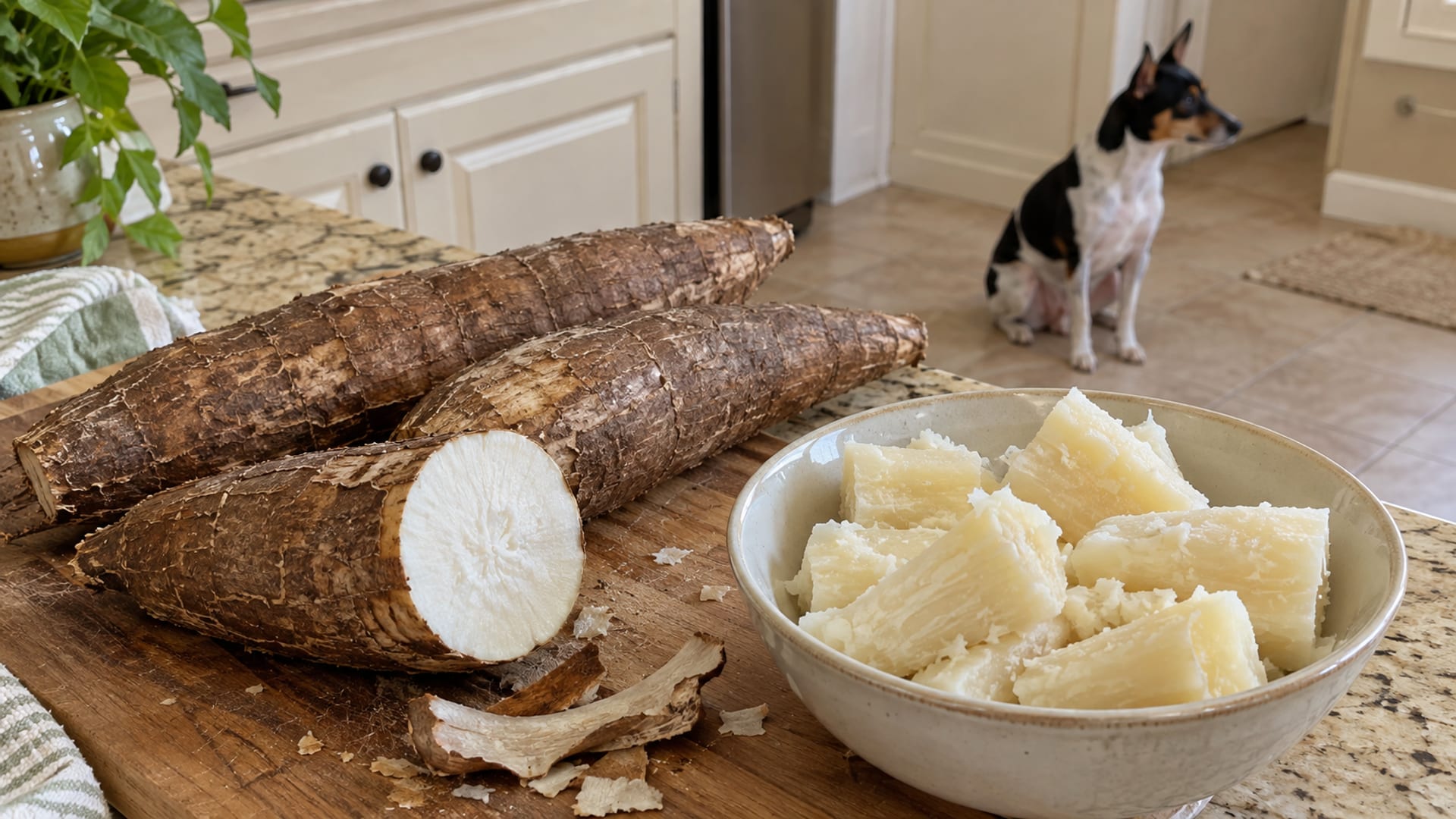
Only with caution. Raw cassava, its peel, leaves and stems, and cassava of unknown preparation can release cyanide, so keep them away from your dog; plain, properly peeled and fully processed cassava, such as cooked yuca or tapioca, carries much less risk, though no safe serving size for dogs has been set.
If your dog just ate raw root, peel, leaves or a cassava dish you didn't make, call your vet or a pet poison line now instead of waiting for symptoms. Keep the package or a piece of what was eaten, and note the time.
Key takeaways
Tap a card to bring it forward.
- Raw root, peel, leaves, stems, bitter cassava and its soak water are the high-risk forms.
- Plain tapioca and peeled, well-cooked yuca carry much less risk, with no set safe amount.
- Signs can start within 15 to 20 minutes to a few hours.
- Call right away for any raw, leafy, unknown or symptomatic exposure.
- Chips, fries, cakes and puddings add salt, fat, sugar, onion, garlic or xylitol.
What to do right now if your dog ate cassava
Each step gives the person on the phone something they will ask for.
- Work out which form it was. Raw root, peel, leaves, a cooked dish and a packaged product carry different levels of risk. The FAO reports more cyanide in the peel than in the white flesh, and less after processing.
- Keep the evidence. Save the bag, the label, a piece of the root or leaf, or a photo, so the vet can judge the variety, part and preparation without guessing.
- Note the amount, the time and your dog's weight. The Merck Veterinary Manual figures cyanide toxicity per kilogram of body weight, so the same mouthful counts for more in a small dog. Mention other ingredients too, such as onion, garlic or xylitol.
- Call right away for raw, leafy, bitter, unknown or symptomatic exposures. The ASPCA says to contact your vet or its poison control center immediately after a possible toxic ingestion, and the Merck Veterinary Manual's pet owner guide says of cyanide, "Immediate treatment is extremely important."
- Skip home remedies. Give nothing, including hydrogen peroxide or medicine, unless the vet says to. With a poison this fast, the minutes belong to the phone call and the drive.
- Stay with your dog for the next few hours. Watch breathing and gum color, because signs can begin within 15 to 20 minutes to a few hours, per Merck.
If I found my dog chewing a cassava peel by the compost bin, I'd make the call first and clean up after.
Which parts of cassava cause the trouble
Cassava, also sold as yuca or manioc, is the plant *Manihot esculenta*. Its root and leaves hold compounds called cyanogenic glycosides, mainly linamarin. When the plant is cut or chewed, they meet an enzyme and release hydrogen cyanide, which keeps the body's tissues from using oxygen, the FAO explains. The Merck Veterinary Manual lists cassava among the plants behind cyanide poisoning in animals.
Peeling, grating, fermenting, drying and cooking all lower the level, but boiling alone isn't always enough. The FAO says the result depends on the method, the temperature, the time and whether the cooking water gets poured off. The USDA plant guide for cassava recommends peeling, boiling, grinding and drying the roots.
Tap or hover a row to highlight it.
| Form | Risk | Why |
|---|---|---|
| FormRaw root, sweet or bitter | RiskHigh | WhyThe compounds remain, mostly in the peel and just under it |
| FormPeel | RiskHigh | WhyMore cyanide than the white flesh |
| FormLeaves and stems | RiskHigh | WhyHigh levels possible; cooking alone is no guarantee |
| FormBitter cassava | RiskHigh | WhyMuch more of the compounds than sweet cassava |
| FormWater or juice from soaked or grated cassava | RiskHigh | WhyThe compounds dissolve into it |
| FormBriefly sun-dried root | RiskCaution | WhyCan keep a substantial amount |
| FormHome-cooked, peeled yuca | RiskLower, depends on the cooking | WhyBoiling results vary |
| FormCassava flour, gari, fufu, casabe | RiskLower, depends on processing | WhySome cyanide can remain |
| FormPlain tapioca starch or pearls | RiskLower | WhyRefined starch; check other ingredients |
| FormChips, fries, cakes and puddings | RiskCaution | WhyAdded salt, fat, sugar, onion, garlic or xylitol |
Sweet and bitter cassava are the same species with different levels of these compounds, according to the FAO introduction to cassava, so if you don't know which kind your dog found, treat it as the riskier one.
Sharing plain yuca or tapioca, and how much raw cassava is a concern
If you want to share. Plain, peeled, fully cooked yuca or plain tapioca is a much smaller risk than raw root. Cook it all the way through, pour off the water, and skip salt, butter, oil, onion, garlic and sugar. Dogs have no set serving size for cassava, so keep it an occasional plain bite and ask your vet before adding it to regular meals.
The risky forms. For raw root, peel, leaves, stems or bitter cassava, any amount is a reason to call with your dog's weight and your best guess at how much was eaten. The published numbers measure cyanide itself or the plant, never a serving:
Tap or hover a row to highlight it.
| Figure | What it measures | Source |
|---|---|---|
| FigureAbout 2 mg per kg of body weight | What it measuresApproximate lethal oral dose of hydrogen cyanide itself in most animal species | SourceMerck |
| Figure200 ppm or more | What it measuresCyanogenic glycosides in plant material (wet weight) that Merck calls dangerous | SourceMerck |
| FigureMore than 20 mg per 100 g | What it measuresTypical level in fresh bitter cassava | SourceFAO |
| FigureLess than 10 mg per 100 g | What it measuresTypical level in fresh sweet cassava | SourceFAO |
| FigureAbout 650 ppm in peel, 310 ppm in flesh | What it measuresOne bitter-variety example | SourceFAO |
| FigureAbout 200 ppm in peel, 38 ppm in flesh | What it measuresOne sweet-variety example | SourceFAO |
| Figure30 to 100 mg per kg | What it measuresCyanide left in some briefly sun-dried roots | SourceFAO |
Cyanide levels swing with variety, plant part, freshness and processing, so Merck's cyanide dose can't become a count of bites. Still, peel carries more than flesh, bitter roots more than sweet, and a small dog gets a bigger dose per kilogram from the same piece.
Signs of cyanide poisoning and how quickly they start
Cyanide works fast. The Merck Veterinary Manual says signs can begin within 15 to 20 minutes to a few hours after eating, and they include:
- fast breathing or trouble breathing
- a racing heartbeat, excitement or restlessness
- drooling, watery eyes and vomiting
- sudden urination or bowel movements
- muscle tremors or twitching
- weakness, staggering or collapse
- gums that look bright red at first and bluish later
- seizures or unresponsiveness
Any of these after cassava means call now, or go straight to an emergency vet if your dog struggles to breathe or collapses. Merck notes that severe cases can progress to heart rhythm problems and breathing failure, and survival after signs begin is rarely more than two hours. That speed is why you call while your dog still looks normal.
A dog that stays bright through those first hours after a little plain, processed cassava is less likely to have acute poisoning. Merck also links repeated exposure with thyroid problems in animals, though how often that affects pet dogs is unclear, so keep cassava off the regular menu.
My dog ate cassava before and was fine
If your dog, or one you grew up with, ate cassava and nothing happened, that really happened. It just can't serve as a rule for this time or another dog:
- Different form. Processed cassava can hold far less cyanide than raw root, peel or leaves, per the FAO.
- Different root. Sweet cassava carries much less than bitter cassava.
- Different part. A bit of flesh without the peel delivers less than chewed skin.
- Different dog and amount. Toxicity depends on cyanide per kilogram of body weight, so a bite a large dog handles can be a big dose for a small one.
- Missed signs. Early signs can pass unseen if nobody was watching, and the amount eaten may have been a guess.
- Chance. That time may simply have involved a lower-risk form or a smaller piece.
Judge this exposure on its own facts: what form, how much, how long ago, and how your dog looks now.
Cassava foods, other names and look-alikes
Cassava goes by many names. The USDA Agricultural Marketing Service treats cassava, yuca, manioc and tapioca root as one product, and mandioca is the same plant.
Yuca and yucca. Yuca, with one "c", is cassava. Yucca, with two, is a separate plant genus, *Yucca*. Tell the vet which one your dog got into.
Other roots. Cassava is a different plant from sweet potatoes, taro and potatoes. Chaya, a leafy plant, is separate too, though it also needs careful cooking for its own cyanide-forming compounds.
Processed foods. Gari, fufu, casabe, farinha, bammy, attieke, and cassava or tapioca flour are made by different methods. Fermented, grated, pressed and dried products generally hold less cyanide than fresh root, though some can remain, per the FAO.
Tapioca pearls and pudding. Tapioca is starch made from cassava root, according to the USDA Agricultural Marketing Service. Plain cooked pearls are a smaller hazard than raw root, so check what surrounds them: sugar, dairy, chocolate, grapes and raisins or xylitol.
Check what you learned
Quick check
Questions about dogs and cassava
These tend to come up once the first scare is over.
Can dogs have tapioca pudding or boba pearls?
The pearls are processed cassava starch, so the dessert or drink around them decides the answer. Puddings add sugar and dairy, and some products contain xylitol. Read the full label, and see our entry on boba for the drink itself.
Is cassava dangerous for cats too?
Yes, the same cyanide risk applies. The Merck Veterinary Manual's pet owner guide discusses cyanide poisoning in dogs and cats together. If a cat chews raw cassava, peel or leaves, handle it the same way: call, and bring the evidence.
Has anyone studied cassava in dogs?
One small study, published in the British Journal of Nutrition, fed growing dogs a gari diet expected to release about 10.8 mg of hydrogen cyanide per kg of cooked food, at roughly 100 g of diet per kg of body weight daily for 14 weeks. With six dogs per group, it found biochemical and tissue changes. The European Food Safety Authority left it out of its own risk review because the dogs were also being treated for parasites, which could have muddied the results.
My dog chewed the leaves of a cassava plant in the garden. What now?
Treat it like raw root and call now. Leaves can hold high levels of these compounds, according to the FAO review of cassava in animal feeding. Bring a leaf or a stem cutting so the plant can be identified.
Sources
Checked September 25, 2026.
- Merck Veterinary Manual, Cyanide Poisoning in Animals
- Merck Veterinary Manual, Cyanide Poisoning (pet owner version)
- Food and Agriculture Organization of the United Nations, Roots, Tubers, Plantains and Bananas in Human Nutrition: Toxic Substances and Antinutritional Factors
- Food and Agriculture Organization of the United Nations, Chapter 1, Introduction
- Food and Agriculture Organization of the United Nations, Roots, Tubers, Plantains and Bananas in Animal Feeding
- ASPCA, Falling for Fall Plants: Macy's Case
- USDA Natural Resources Conservation Service, Cassava Plant Guide
- USDA Agricultural Marketing Service, Cassava, Yuca, Manioc, Tapioca Root
- British Journal of Nutrition, Pathological changes in growing dogs fed on a balanced cassava diet
- European Food Safety Authority, Evaluation of the health risks related to the presence of cyanogenic glycosides in foods other than raw apricot kernels