
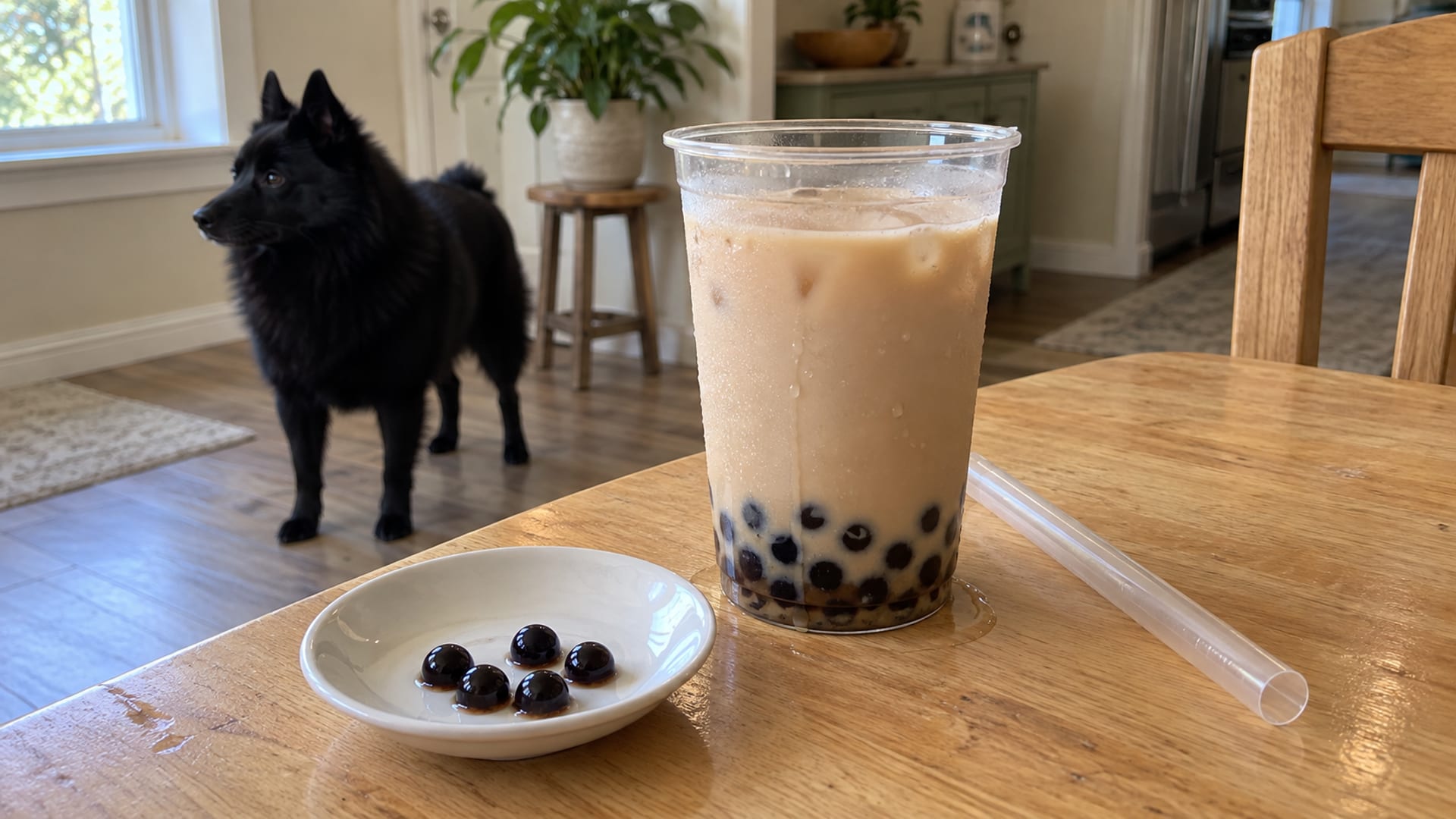
Only with caution, and bubble tea is a drink I'd keep to yourself. A few plain cooked tapioca pearls are not a known poison for dogs, but whole sticky pearls can cause choking or a blockage, and the drink decides the rest: black, green or matcha tea and coffee bring caffeine, and a sugar-free version may contain xylitol.
If your dog already got into your cup, sort out what went down: a pearl or two off the floor, or the tea as well? Check the flavor and the base, look for "sugar-free" on the cup or receipt, guess how much is missing, and note the time and your dog's weight. Those answers settle most of these situations, and your vet will ask for the same details.
Key takeaways
Tap a card to bring it forward.
- A few plain cooked tapioca pearls are not a known poison, but whole sticky pearls can cause choking or a blockage, and small dogs and puppies are at greater risk.
- The drink matters most. Black, green and oolong tea, matcha and coffee carry caffeine, and sugar-free versions may contain xylitol.
- Call your vet right away for caffeine, xylitol, chocolate or alcohol, several pearls in a small dog or puppy, or a drink you cannot identify.
- Keep the cup or receipt close by for the call.
- Popping boba, jelly toppings and dry pearls from the package are separate products, so check each one on its own.
What to do if your dog got into your bubble tea
Work through these in order.
- Move the cup and watch your dog's breathing. Gagging, pawing at the mouth or struggling for air after swallowing pearls points to choking, and that needs a vet now, whatever was in the drink.
- Figure out whether it was only pearls or the drink too. Plain cooked pearls raise a blockage question, while the tea itself raises a poisoning question, and your vet handles the two differently.
- Read the cup, the receipt or the shop's menu. You're looking for black, green, oolong or matcha tea, coffee, chocolate, alcohol, and any "sugar-free," "zero sugar," "light" or "diet" wording, because those point to caffeine or a sweetener like xylitol.
- Estimate how much is gone and note the time. A rough guess at the drink and a count of missing pearls is enough.
- Get your dog's weight. A small dog takes in a bigger dose from the same sip, and the ASPCA notes that smaller dogs can be affected by smaller amounts of a toxic food.
- Call if any red flag applies, and hold off on home fixes. The ASPCA advises contacting your veterinarian or its poison control center immediately for a possibly toxic exposure. Skip home remedies and medicine unless a veterinary professional tells you to give them.
Which parts of a boba drink matter
"Boba" can mean the pearls, the whole drink, or even another topping in the cup, and each part carries a different concern for a dog.
Tap or hover a row to highlight it.
| Part | What it is | The concern for a dog |
|---|---|---|
| PartPlain cooked tapioca pearls | What it isChewy balls made from cassava starch | The concern for a dogNot a known poison; whole sticky pearls can choke or block |
| PartDry pearls from the package | What it isHard, uncooked pearls | The concern for a dogKeep away; they may swell or lodge after swallowing |
| PartBlack, green or oolong tea base | What it isBrewed tea, often with milk | The concern for a dogCaffeine |
| PartMatcha or coffee drinks | What it isPowdered green tea or coffee | The concern for a dogCaffeine |
| PartSugar-free, zero-sugar or diet versions | What it isSweetened with a sugar substitute | The concern for a dogPossible xylitol |
| PartChocolate or cocoa flavors | What it isChocolate syrup or powder | The concern for a dogChocolate |
| PartCream, condensed milk and syrups | What it isSugar and fat | The concern for a dogStomach upset |
| PartPopping boba | What it isGel balls filled with fruit juice | The concern for a dogFruit concentrates, acids, dyes or sweeteners; check the label |
| PartJellies, red bean, pudding, fruit | What it isSeparate toppings | The concern for a dogEach needs its own ingredient check |
Caffeine is the most common worry in the cup. Pet Poison Helpline lists it as toxic to dogs in sufficient amounts and says the effect depends on how much was taken in, the dog's size and other factors. Our Tea and Coffee entries go further on those drinks.
Xylitol is the other one to rule out fast. The ASPCA says it can cause a fast drop in blood sugar and liver injury in dogs, and advises getting professional help right away for a possible exposure. The ASPCA's list of people foods to avoid also covers the other drink-side hazards, including chocolate, caffeine and alcohol. If the drink had any of those, the Chocolate and Alcohol entries apply too.
The pearls come from cassava, a root whose natural compounds, linamarin and lotaustralin, can release cyanide. Processing lowers them, according to a review of cassava processing by Montagnac and colleagues and a paper on strategies for removing cyanogens from cassava. That concern belongs to raw or poorly processed cassava root, peel or leaves, so if your dog chewed raw cassava, call your vet.
Sharing a pearl, and how much is a concern
There's no recommended boba serving for dogs of any size, so I'd skip sharing it altogether. A plain cooked pearl is the lower-risk part, but it still makes a poor treat, because it is sticky, it is swallowed whole, and the drink it sat in is usually the bigger problem. Cornell University's College of Veterinary Medicine describes a blockage in the stomach or intestines as an emergency that may need surgery.
The number of pearls on its own won't tell you whether your dog is in trouble. There's no published toxic dose for boba as a product, because the risk depends on what was in that particular drink, how much of it went down and how big the dog is. Call your vet with your dog's weight, the amount and the ingredients if any of these apply:
- The drink had tea, coffee, matcha, chocolate, alcohol or a sugar-free sweetener, or you cannot tell what it had.
- You don't know how much your dog got.
- A small dog or a puppy swallowed several whole pearls. Puppies swallow foreign objects more often than adult dogs, according to Hill's client information on foreign bodies.
- The label or menu is gone and you have no way to check.
A small lick of an ordinary milk tea that is not sugar-free and has no chocolate, alcohol or strong caffeine is less likely to be a poisoning emergency. Even then, no amount is known to be safe for every dog, so watch closely. If your dog has diabetes or has had pancreatitis, mention the sugar, cream or condensed milk when you call, since those can matter more for a dog with that history.
Signs to watch for tonight and tomorrow
What you watch for depends on what your dog swallowed.
Tap or hover a row to highlight it.
| What went down | Signs to watch for | Timing the source gives |
|---|---|---|
| What went downWhole pearls (blockage) | Signs to watch forGagging, choking, vomiting, belly pain, loss of appetite, diarrhea, dehydration, lethargy | Timing the source givesVaries with where the pearl lodges and how long it stays (Merck Veterinary Manual) |
| What went downCaffeine from tea, matcha or coffee | Signs to watch forRestlessness, hyperactivity, vomiting, diarrhea, a fast or uneven heartbeat, tremors, seizures | Timing the source givesDepends on the amount and the product (Pet Poison Helpline) |
| What went downXylitol from a sugar-free drink | Signs to watch forWeakness, wobbling, trembling, seizures from low blood sugar | Timing the source givesBlood sugar can drop in as little as 30 minutes; signs may take up to 12 hours (ASPCA) |
Go to a vet now, without waiting, for any of these: choking or trouble breathing, repeated vomiting, retching that brings nothing up, a painful or swollen belly, weakness or collapse, tremors or seizures, severe restlessness, refusing food, or a dog that is unusually flat and quiet.
If your dog seems fine tonight after a pearl or two, keep watching through tomorrow: the next meal, any vomiting, and normal stool. Blockage signs don't follow a set schedule, so a change the next day still counts.
My dog had boba before and was fine
I believe you. Plenty of dogs lick a dropped cup or snag a pearl and nothing comes of it, and that happened with your dog. It still isn't a rule for the next cup or the next dog, and the reasons are specific.
The amount was probably small, and Pet Poison Helpline is clear that caffeine trouble depends on how much. That drink may have had no caffeine, xylitol, chocolate or alcohol, while the next one might. Individual dogs respond differently, and a blockage depends on the size of what was swallowed, where it ends up and how long it stays there, as Merck explains. Xylitol signs can also take up to 12 hours to show, per the ASPCA, so a dog that looked fine at bedtime can still show signs later. Sometimes a dog also swallows much less than it seemed to.
Toppings, look-alikes and other names
Boba, bubble tea, pearl milk tea, pearl tea and tapioca tea can all mean the same drink, and recipes change from shop to shop, so the label or ingredient list tells you more than the name.
- Tapioca can mean the purified starch, tapioca flour, tapioca pudding, the pearls or other cassava products.
- Cassava, yuca, manioc and mandioca all name the cassava plant or root. Yuca the root is a different plant from yucca, the ornamental.
- Taro milk tea is flavored with taro, a separate ingredient from the tapioca pearls, and taro toppings need their own check.
- Jelly toppings may be grass jelly, aloe jelly, coffee jelly, coconut jelly or fruit jelly. Coffee jelly adds coffee to the cup.
- Sugar-free, light, zero-sugar and diet drinks need a xylitol check. Erythritol and sucralose are different sweeteners, though the drink can still hold other hazards.
Check what you learned
Three quick questions on what matters most.
Quick check
Questions about dogs and boba
Questions that come up once the first worry has passed.
Do the tapioca pearls themselves have caffeine?
Plain tapioca pearls are made from cassava starch, so the caffeine comes from the tea, matcha or coffee they sit in. Pearls that soaked in a caffeinated drink will carry some of it with them, so treat pearls fished out of the cup the same as the drink.
My cat got into the bubble tea too. Is it the same?
Partly. Pet Poison Helpline says cats are sensitive to caffeine as well, and chocolate is a concern for them too. The ASPCA says xylitol does not cause serious problems in cats, but a swallowed pearl can still cause a blockage in a cat.
My dog licked a cup someone left outside. What now?
Treat it as an unknown drink, since you can't read the label or ask the shop. Watch for the signs in the table above, and call your vet if your dog is small, if a lot seemed to go down, or if any sign appears.
Is tapioca starch in dog treats a problem?
Processed tapioca starch is a different thing from raw cassava, because processing lowers the natural compounds in the root. There's no dog-specific serving guide for it, so the other ingredients in the treat and the amount your dog eats are what to check.
Sources
Checked September 25, 2026.
- ASPCA, What to Do If Your Pet Gets into Chocolate
- ASPCA, The Poisons We Pack: Pet Hazardous Items Lurking in Your Bag
- Pet Poison Helpline, Caffeine
- ASPCA, Xylitol: The Sweetener That Is Not So Sweet for Pets
- ASPCA, People Foods to Avoid Feeding Your Pets
- Montagnac, Davis and Tanumihardjo, Processing Techniques to Reduce Toxicity and Antinutrients of Cassava for Use as a Staple Food
- PubMed, Strategies for Elimination of Cyanogens from Cassava for Reducing Toxicity and Improving Food Safety
- Cornell University College of Veterinary Medicine, Gastrointestinal Foreign Body Obstruction in Dogs
- Hill's Veterinary Client Information Series, Foreign Bodies
- Merck Veterinary Manual, Gastrointestinal Obstruction in Small Animals
- ASPCA, Updated Safety Warning on Xylitol: How to Protect Your Pets