
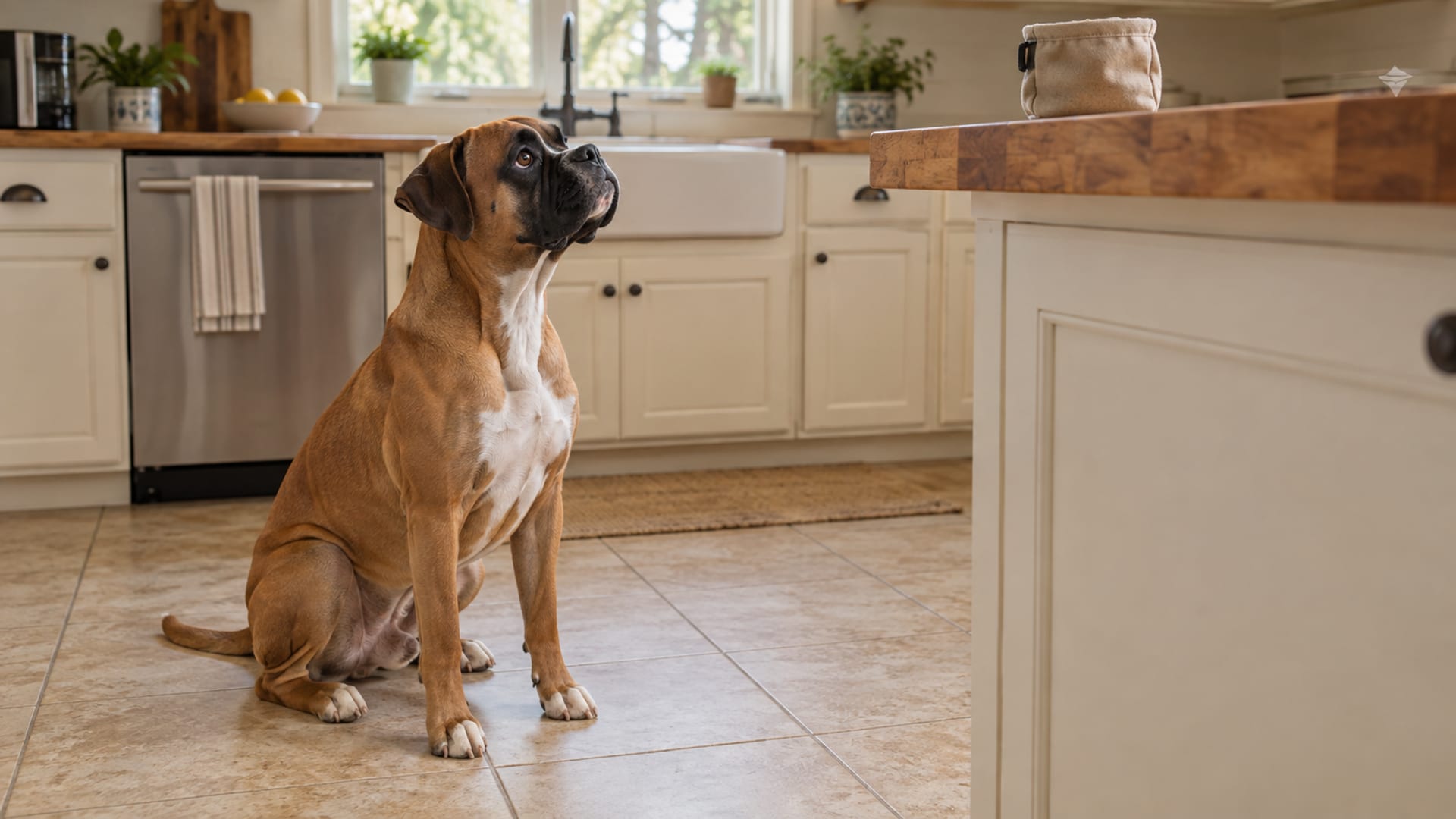
You can start teaching sit tonight, in about five minutes, with a few small treats. Hold a treat at your dog's nose and move it slowly up and a little back over the head. As the head goes up, the rear usually goes down. The instant the rear touches the floor, say "yes" and give the treat. After that, you switch to an empty hand, add the word "sit," and practice briefly in new places. Never push your dog into position, and if sitting seems hard or uncomfortable, talk to your veterinarian before you keep practicing.
Key takeaways
Tap a card to bring it forward.
- Lure the nose up and back, mark the moment the rear touches the floor, and reward right away.
- Teach the movement first, then say "sit" just before the hand signal once the dog follows the lure every time.
- Hide the food and use an empty hand so the treat becomes a reward, not a bribe you show in advance.
- Make one thing harder at a time: how long, how far, or how distracting, and keep the other two easy.
- There is no fixed timeline; short, frequent sessions over several weeks are normal.
- Reluctance to sit, a sloppy sit or trouble getting up can mean pain, so ask your veterinarian.
Most people who search this are not really worried about the word "sit." They want to know whether they can get through to their dog, stop the jumping when guests come in, and tell the difference between a training problem and a health problem. I'll take those in the order you'll probably meet them.
Your first session tonight: lure, mark, reward
Keep the first session small. Pick a quiet room, a rug or mat so your dog's feet don't slide, and a handful of treats cut into tiny pieces. You don't need to say anything yet.
The lure method, one rep at a time
The AKC's step-by-step sit lesson uses the same basic sequence most reward-based trainers start with:
- Hold a small treat right at your dog's nose.
- Move it slowly upward and slightly back over the head.
- As the head follows, the rear usually lowers.
- The instant the rear touches the floor, say "yes" (or click, if you use a clicker).
- Give the treat immediately.
- Do a few reps, then take a break.
That "yes" is called a marker. It tells your dog exactly which moment earned the treat, so a late "yes," after your dog has popped back up, rewards the standing instead of the sit. Luring is usually the quickest start for a dog that follows food and sits comfortably, but it isn't the only way.
Two other ways in, if luring doesn't click
Capturing works well for dogs that already sit a lot on their own or don't like being guided. You simply watch for a natural sit during ordinary moments, mark it, and reward it. You don't ask for anything. Once your dog starts offering sits on purpose, you add the word.
Shaping helps when your dog stands up or backs away from a lure. You mark and reward a small step toward sitting, like the hips dipping or the back legs bending, then slowly ask for a little more until you get the full sit. The AKC's explanation of shaping notes that it takes better timing and more patience. If your dog stops trying, make the next step easier.
Whichever you choose, skip the old advice to press the rear down. The American Veterinary Society of Animal Behavior's 2021 position statement says there is no evidence that aversive methods are necessary and recommends reward-based methods for all dog training. Pushing, leash jerks and intimidation are off the table.
When to say "sit" and how to fade the treat into a hand signal
Wait on the word until your dog follows the lure into a sit almost every time. If you say "sit" while your dog is still figuring out the movement, the word gets attached to confusion. Teach the movement first, then the name for it.
Adding the word
Once the sit is predictable, say "sit" once, right before your hand moves. Then mark and reward the sit. Repeat until the word starts to predict the hand motion, and you may notice your dog beginning to fold before your hand does much at all. Give the cue one time. If nothing happens, wait a moment, then reset and make it easier instead of repeating "sit, sit, sit."
Getting the treat out of your hand
This is the step that fixes "my dog only sits when he sees food." The AKC's home CGC training steps describe fading the lure to an empty hand, and the sequence looks like this:
- Make the same upward hand motion with no treat in that hand.
- Mark the sit, then give the reward from your other hand or a nearby container.
- Gradually make the hand motion smaller.
- Keep the food out of sight until after your dog sits.
Your dog should not see the treat before responding. When food shows up first, it works like a bribe. When it shows up after, it's a reward, and that's the version you want.
Cutting back on treats without stopping cold
Don't quit rewarding all at once. At first, reward every correct sit. Once your dog clearly knows the cue, reward some sits with food and others with praise, play, a trip to the yard, the start of a walk, or permission to go say hello. Keep rewarding now and then for as long as your dog does it, and hold on to the really good treats for hard places, like a busy sidewalk or the vet's lobby.
The days after: a second place, then duration, distance and distractions
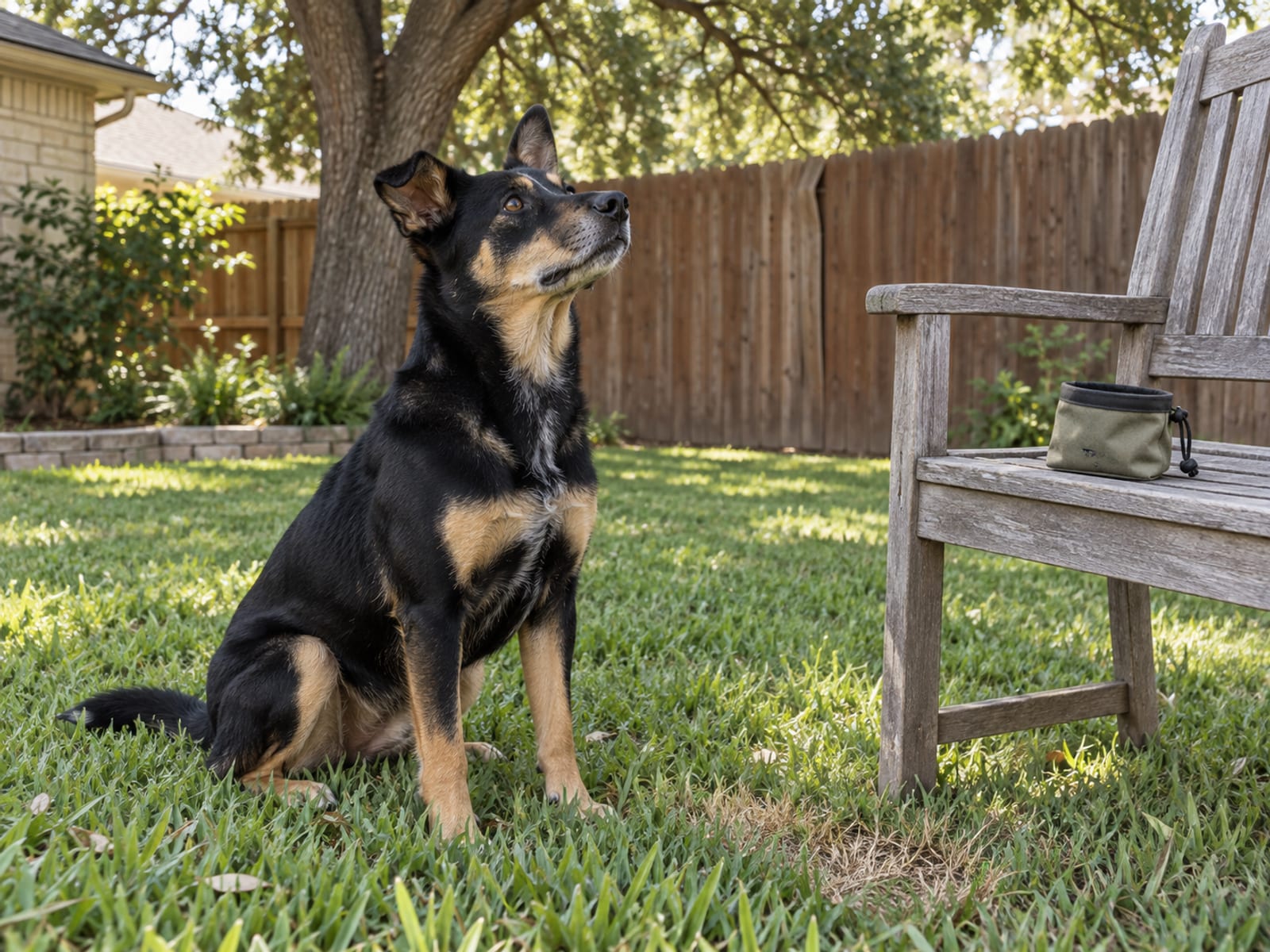
Here's where a lot of owners get stuck. Your dog sits beautifully in the kitchen and then acts like he's never heard the word at the front door. That's normal. According to the AKC's guide to the three Ds, dogs don't generalize well from one place to another, so each new setting has to be practiced on purpose.
One change at a time
The three Ds are duration (how long your dog stays sitting), distance (how far away you are), and distraction (what's going on around you). Change only one at a time, and when you make one harder, make the other two easier.
Duration. Start with about one second. Mark and reward while your dog is still sitting, not after he stands. Add time in small steps. If he gets up, go back to a shorter sit.
Distance. Once your dog can hold a short sit next to you, take one step away, step back, mark and reward. Build from there. While you're adding distance, keep the sit short and the room quiet.
Distraction. Move through settings slowly: a quiet room, a different room, the hallway, the yard, a quiet sidewalk, and only later busier places. Keep distractions far enough away that your dog can still eat and pay attention to you.
A dog that sits for 30 seconds in the kitchen may manage one second next to the front door. That doesn't mean he forgot. It means the door is a harder place, and you're starting over there at an easier level.
A rough plan for the first month
There's no reliable universal number of days for teaching sit. These are planning ranges, not promises:
Tap or hover a row to highlight it.
| Stage | What it often looks like |
|---|---|
| StageFirst days | What it often looks likeYour dog follows the lure or offers some natural sits. You're learning to time the "yes." |
| StageWeek 1 | What it often looks likeSits reliably in a quiet, familiar room, often still needing the hand motion. The word is still developing. |
| StageWeek 2 | What it often looks likeFood can be hidden, the hand signal gets smaller, and you practice in more than one room. Sits are still short. |
| StageWeeks 3 to 4 | What it often looks likeStarts responding in the yard, at a quiet doorway or on a calm walk. Mild distractions can be added. |
| StageAfter the first month | What it often looks likePractice keeps going with new people, surfaces, places and distractions. A busy vet lobby or guests arriving may take a lot longer. |
As for session length, Texas A&M's veterinary school reports that home sessions may run five to ten minutes, a couple of times a day, four to five days a week. For a brand new cue, even shorter successful sessions can make sense.
Using sit where it matters: greetings, the door and the food bowl
Once your dog can sit in the actual place you need it, sit becomes a polite thing to do instead of jumping. Some of the most useful everyday moments are:
- Sitting before a person gives attention.
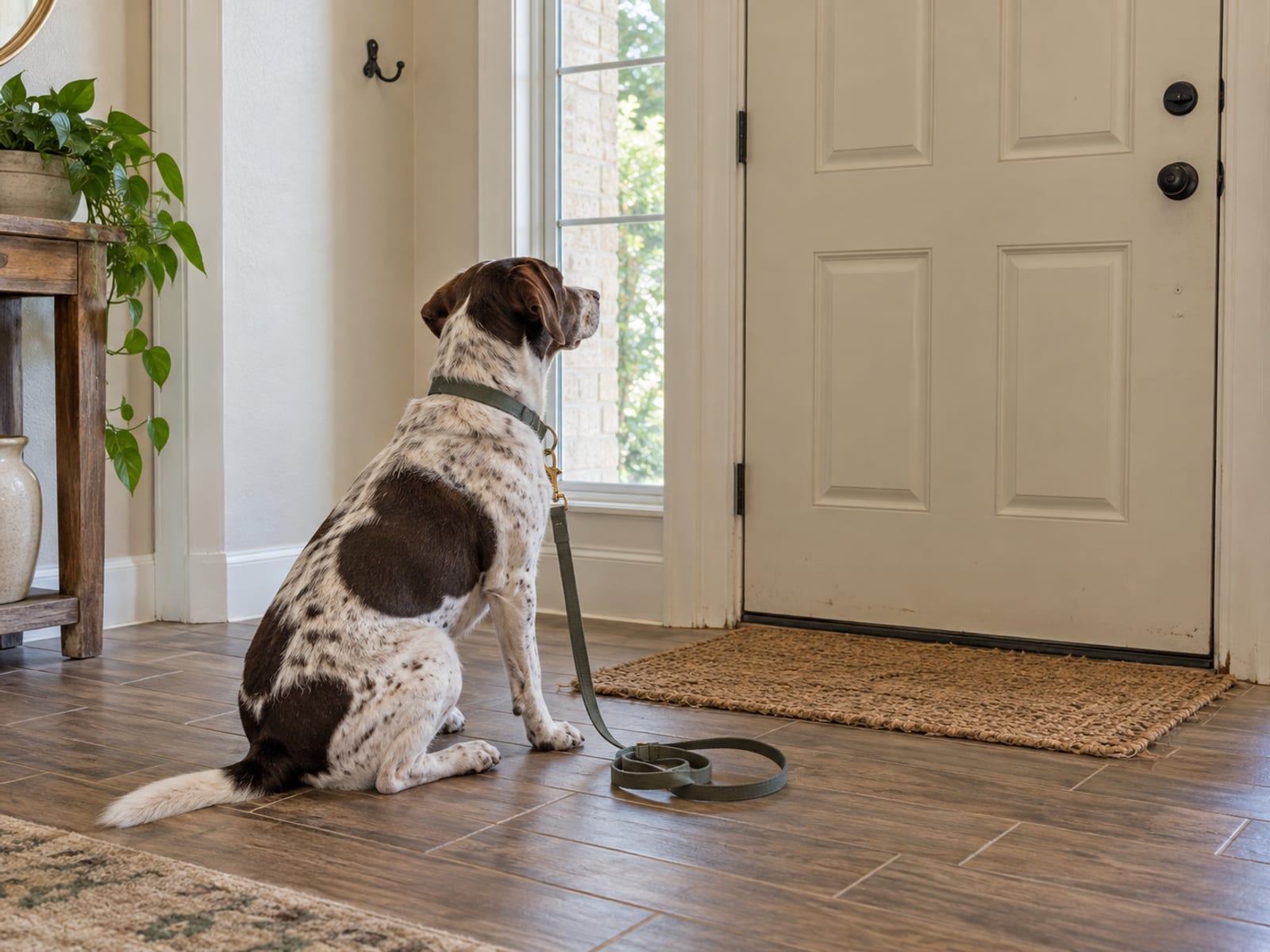
- Sitting before the door opens, or before stepping through a doorway.
- Sitting before the food bowl or a toy goes down.
- Sitting before the leash gets clipped on.
- Sitting for a moment of handling, like getting ready for a vet visit.
The catch is order. Your dog has to understand sit before you make it the price of something exciting. If you ask for a sit when a guest walks in on day three, you're asking for a one-second sit at the hardest level of distraction, and it will probably fall apart.
Start with easy versions. Practice at the real front door with nobody there, then with a family member knocking, then with a calm visitor who waits for the sit before saying hello. Do the same with the food bowl: hold it at chest height, wait for the sit, lower it. If your dog stands, lift it back up and try again. Reward the sits you get.
When progress is slow: what's normal and what to change
Slow progress is common, and it usually has a fixable reason. The research I worked from lists a few mistakes that show up again and again. It isn't ranked by how often each happens, but the order is a practical place to start checking:
- Making it harder too fast. Change only one of distance, duration or distraction at a time.
- Showing the treat before every cue. Hide the food and reward after the sit.
- Repeating "sit" over and over. Say it once, wait, then reset or make it easier.
- Rewarding after your dog stands. Get the treat to him while his rear is still down.
- Only practicing in the kitchen. Practice on purpose in other rooms, on other floors, at the door, outside and with visitors.
- Long sessions. Stop while it's still going well, before your dog gets tired or frustrated.
A few specific problems have specific fixes. If your dog jumps for the treat, keep the food low and close to the nose, move slowly, and calmly reset without rewarding the jump. Mark and reward four paws on the floor or a partial sit. If your dog pops right back up, reward sooner while he's still down, and add a release word, like "okay," so he knows when the sit is finished. If your dog gets frustrated, drop back to something easier, reward it, take a break, and end on a success.
If you're worried your dog is just stubborn, it's worth checking other explanations first: how the lure is moving, how much your dog cares about the reward, what's distracting him, whether he's nervous, and whether he's comfortable. Our post on training a stubborn dog goes into that more broadly. Adult and rescue dogs can learn sit too. Their pace may depend on past training, fear, new surroundings and how safe they feel, so a slow start doesn't mean a dog can't learn.
When a dog won't sit because of pain, and when to get a trainer or vet
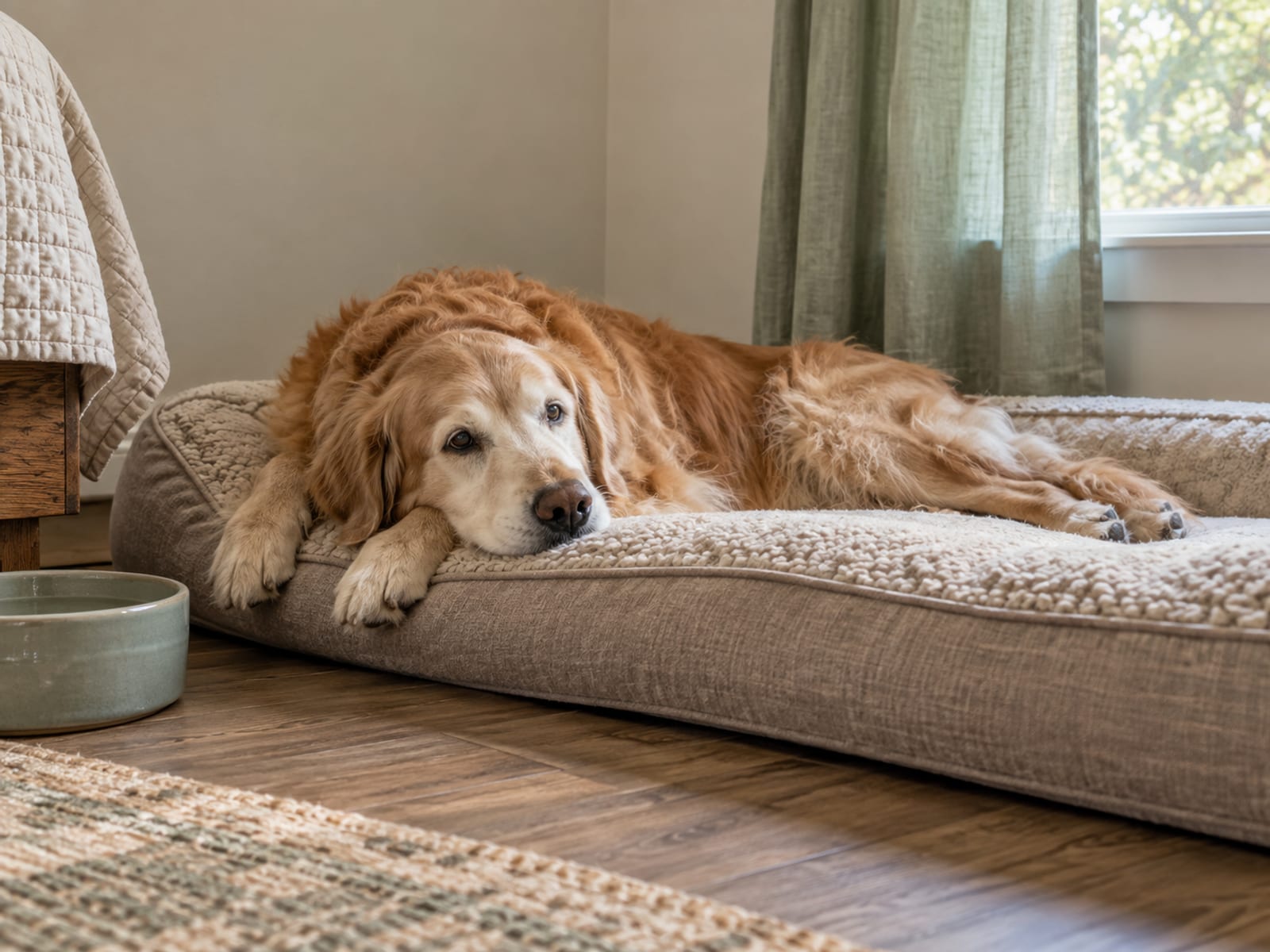
Sometimes a dog doesn't sit because sitting hurts. VCA Animal Hospitals notes that repeated sitting can stress arthritic knees in older dogs, and that some tricks may not suit a dog's body. Hip dysplasia, arthritis, knee problems, back pain, an injury or a slippery floor can all make sitting uncomfortable.
Signs to take seriously
VCA's guide to recognizing pain describes the kinds of changes to watch for. In the context of sit, look for:
- Reluctance to sit, or a sit that used to be easy and now isn't.
- Trouble getting back up.
- A splayed or "lazy" sit with the legs off to one side.
- Shifting weight, limping or stiffness.
- Not wanting to climb stairs or lift the head.
- Pulling away when you touch certain areas.
If you see these, stop asking for repeated sits and set up a veterinary exam. A medical problem should be ruled out before anyone treats refusal as disobedience. Meanwhile, you can keep training something low-impact, like standing calmly, looking at you, touching your hand with his nose, or going to a mat. Don't force the sit.
Who to call for what
A veterinarian is the right call when sitting suddenly gets hard, or your dog shows pain, limping, stiffness, trouble rising, an odd posture, sensitivity to touch, or a big change in behavior.
A qualified trainer makes sense when you've practiced consistently with rewards and aren't getting anywhere, your dog is getting frustrated or fearful, you need sit in a demanding place, or you'd just like coaching. The Certification Council for Professional Dog Trainers describes its CPDT-KA credential as requiring a comprehensive exam and at least 300 hours of training experience, and the CPDT-KSA adds a hands-on skills assessment. A credential doesn't prove every trainer works the same way, so ask what methods and tools they use, how they handle fear and stress, and whether they'll work with your vet. Walk away from anyone who recommends pinning a dog on its back, leash pops, intimidation, shock or prong collars as routine tools, or pushing your dog into a sit.
A veterinary behaviorist is for aggression, serious fear or anxiety, bite risk, or behavior tied to pain. These are veterinarians who are board certified through the American College of Veterinary Behaviorists. The IAABC's credentials page also describes its Certified Dog Behavior Consultant credential as meant for complex cases like fear, aggression and phobias.
What to teach next
Sit is a good first building block, but it isn't the same as stay. A dog who sits won't automatically hold it while you walk away or ring the doorbell. You have to teach that duration and a release word separately.
From a solid sit, owners commonly move on to:
- Stay or wait, by adding duration and a release cue.
- Down, by moving the lure from the sit toward the floor.
- Stand, by rewarding rising on cue.
- Leave it, by teaching your dog to turn away from an object.
- Loose-leash walking, by asking for a sit before you start moving.
It's also worth being honest about what sit can't do. It isn't a fix for fear, aggression, panic or pain. For a wider list of first cues, DW Dog Training has a helpful piece on the ten commands to teach first.
Questions people ask about teaching sit
These come up constantly, so the short answers below are worth keeping handy.
How long does it take to teach a dog to sit?
Some dogs follow a lure into a sit in the very first session. Getting a sit you can count on at the door, on a walk or at the vet usually takes weeks of short practice, and no universal timeline is supported. Pain, fear, inconsistent practice or lots of distractions can slow things down, while age and breed alone don't decide it.
Can I train my dog to sit myself?
Yes. Luring, capturing and shaping all work at home with small treats and a few minutes a day. Bring in a certified trainer if you've practiced consistently and stalled, or if you'd like someone to coach your timing.
How do I teach a stubborn dog to sit?
Start by checking the basics that often look like stubbornness: a slippery floor, a lure that moves too far forward, a reward your dog doesn't care much about, or too many distractions. Try a rug for traction, a better treat, and a quieter room, or switch to shaping and reward partial sits. If refusal is new, rule out pain with your vet first.
Why won't my dog sit?
The usual reasons are traction, lure direction, reward value, distraction, nervousness and physical comfort. A dog with long legs, an unusual build or an old injury may do better with a different behavior, like standing calmly or lying down. If the refusal comes with stiffness or trouble getting up, contact your veterinarian.
At what age can a puppy learn to sit?
Puppies can pick up the movement quickly, but they have short attention spans and not much self-control yet. Use very short sessions with lots of breaks in easy settings. Don't expect a puppy who sits in the kitchen to sit during an exciting greeting.
Your next step
Tonight, grab a few tiny treats, find a quiet room with a rug, and do five or six lure-mark-reward reps. Then stop while your dog is still into it. Tomorrow, do it again, and when the sit is predictable, start saying "sit" once, right before your hand moves.
Keep an eye on how your dog sits, not just whether he does. If it looks uncomfortable, pause the practice and check in with your veterinarian. Otherwise, give it a few weeks of short, easy sessions, change one thing at a time, and let the sit follow you from room to room, out the door and eventually to the people your dog is most excited to meet.
Sources
- American College of Veterinary Behaviorists: American College of Veterinary Behaviorists
- American Kennel Club: AKC's explanation of shaping
- American Kennel Club: AKC's guide to the three Ds
- American Kennel Club: AKC's home CGC training steps
- American Kennel Club: AKC's step-by-step sit lesson
- American Veterinary Society of Animal Behavior: American Veterinary Society of Animal Behavior's 2021 position statement
- Certification Council for Professional Dog Trainers: Certification Council for Professional Dog Trainers
- DW Dog Training: the ten commands to teach first
- IAABC: IAABC's credentials page
- Texas A&M College of Veterinary Medicine: Texas A&M's veterinary school
- VCA Animal Hospitals: VCA Animal Hospitals notes
- VCA Animal Hospitals: VCA's guide to recognizing pain