
Mobile Dog Grooming Business in Tennessee: Vans, Wastewater, Licenses and Costs
By Cal Hewitt · Published
Business guides
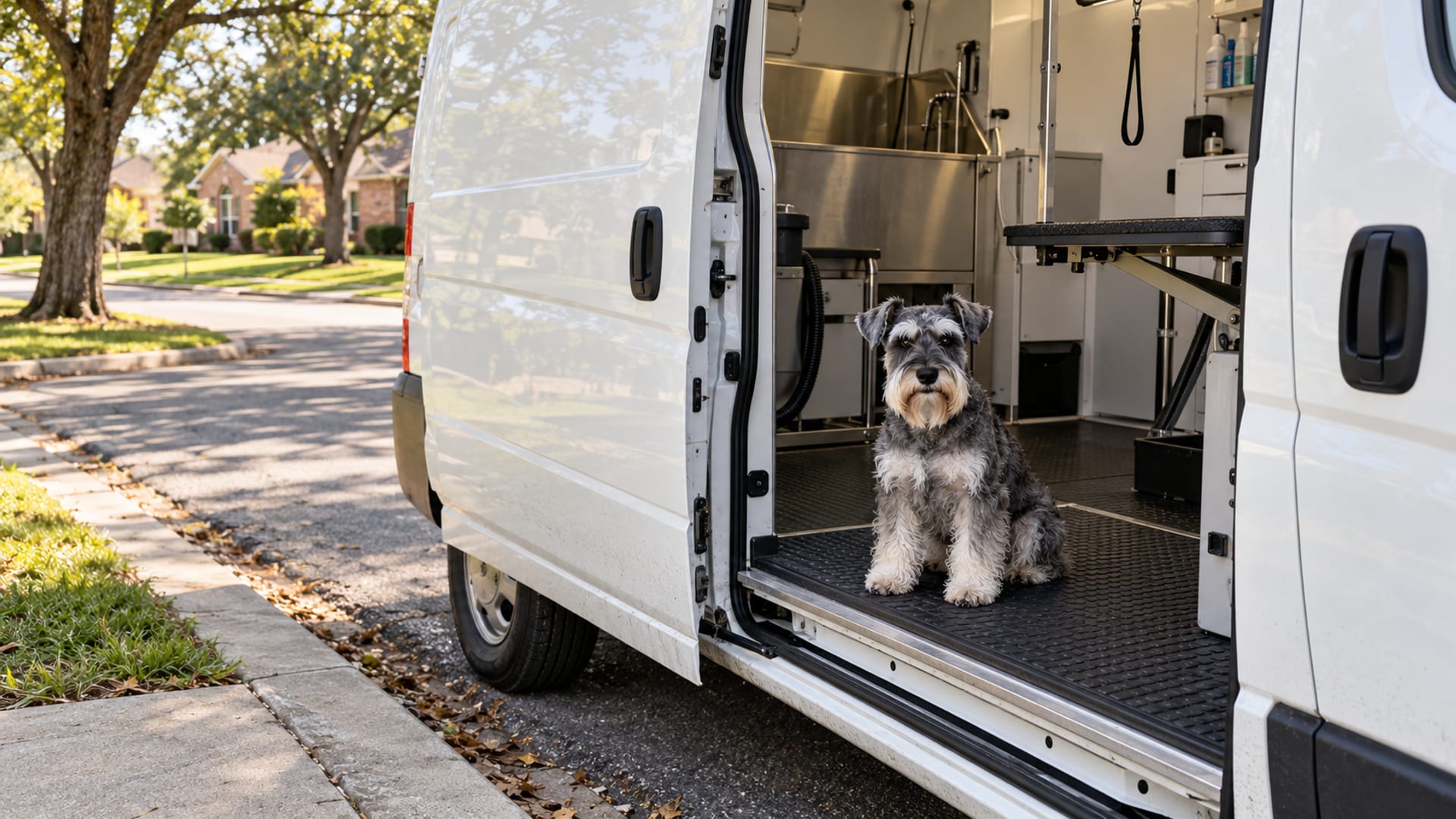
Starting a mobile dog-grooming business in Tennessee usually means handling state business-tax registration plus county and city licensing, local zoning and parking rules, wash-water disposal, sales tax on bathing, insurance, and safe van operations. The Tennessee Department of Revenue treats pet grooming and bathing as business-tax activities, and its SUT-119 notice taxes bathing but generally not grooming.
Before you buy a van, ask the county clerk, city clerk, zoning office, wastewater authority and public-works or stormwater office how their rules fit your business address, customer driveways, public streets and wash water.
Key takeaways
Tap a card to bring it forward.
- Tennessee business tax covers pet grooming and bathing (T.C.A. § 67-4-708), and local licenses come from your county clerk and, inside a city, the city.
- T.C.A. § 67-4-723 sets a $15 fee per license and a separate license for each location; ask each clerk how a mobile route is treated.
- Wash water never goes to a street, gutter, yard or storm drain. Filter out hair and send water to a sewer with permission, or hold it for approved disposal.
- SUT-119 says bathing is taxable, grooming is not, and one lump-sum bath-and-groom charge is taxable.
- Published 2026 prices run from about $18,950 for a grooming trailer package to roughly $65,000 to $120,000 for a finished van.
- Parking and driveway work depend on your city, your zoning district and any HOA, lease or landlord rules.
What should you settle before you buy the van?
I know the pull of the van. It is the exciting purchase, and it is also the one that is hardest to undo, so I would rather you settle the paper questions first. Six answers decide whether the van you pick will work in Tennessee: your state business-tax registration, your county and city licenses, where the van can be kept and worked, where the wash water goes, how bathing is taxed, and what insurance you carry.
None of these is hard alone. The trouble is that different offices answer each one, and a van bought before you ask can turn out to be too large for the lot you planned to park it on or too thirsty for the sewer connection you hoped to use. Spend a week making calls, write down each answer and the name of the person who gave it, and then shop.
Which licenses apply to a mobile groomer?
The Department of Revenue says pet grooming, bathing and boarding are subject to business tax under Tenn. Code Ann. § 67-4-708 (BUS-57). Your first call is therefore the business-tax side of the Department of Revenue, and your next calls are the local offices. As BUS-14 explains, county clerks and city officials issue business licenses, and you need the license before you operate.
The statute behind that, Tenn. Code Ann. § 67-4-723, has the county clerk license taxpayers in the county and the appropriate city official license those inside an incorporated municipality. It sets a $15 application fee and says a separate license and $15 fee are required for each location. Shelby County tells businesses to register with the county clerk and to get a separate city license when they operate inside a municipality.
Here is the part a route business has to ask about. A van drives through many cities and counties, and whether a customer's address, your base, or a temporary stop counts as a "location" is a question for each clerk. Don't assume the $15 fee works the same for every stop. Ask each county clerk and city clerk in your service area, and describe the route the way you will really run it.
Two more filings may apply. The Secretary of State lists business forms and fees, including assumed-name registration if you will trade under a name other than your own. The Department of Agriculture lists Animal Health chapters 0080-02-12 and 0080-02-15, which cover dogs, cats and dealers. If you are unsure whether they touch a grooming operation, ask Animal Health before you assume either way. For the general sequence of Tennessee licenses, see Tennessee dog business license requirements.

What address do you license the business under?
Your business address matters because it decides which clerk's office you deal with first. The Tennessee Business Tax Manual says a business with several locations generally registers with the county and city for each location, and it says the Department of Revenue does not issue local business licenses.
A business that works at customer locations raises a question that the Department of Revenue calls its Classification 3 treatment, the rule for the dominant activity at each location. Confirm it directly with the Business Tax Division, using BUS-13 and BUS-57 as your reference. When you call, give them the real model: your base address, the mobile unit, the places you will groom, the services you perform, and about how much you expect to take in from each jurisdiction. The county and city clerks answer the local license questions; the Department of Revenue answers the business-tax address and classification question.
If you work from home, the home-business rules are a separate topic. I cover them in running a dog business from home in Tennessee.
Where can grooming wash water go?
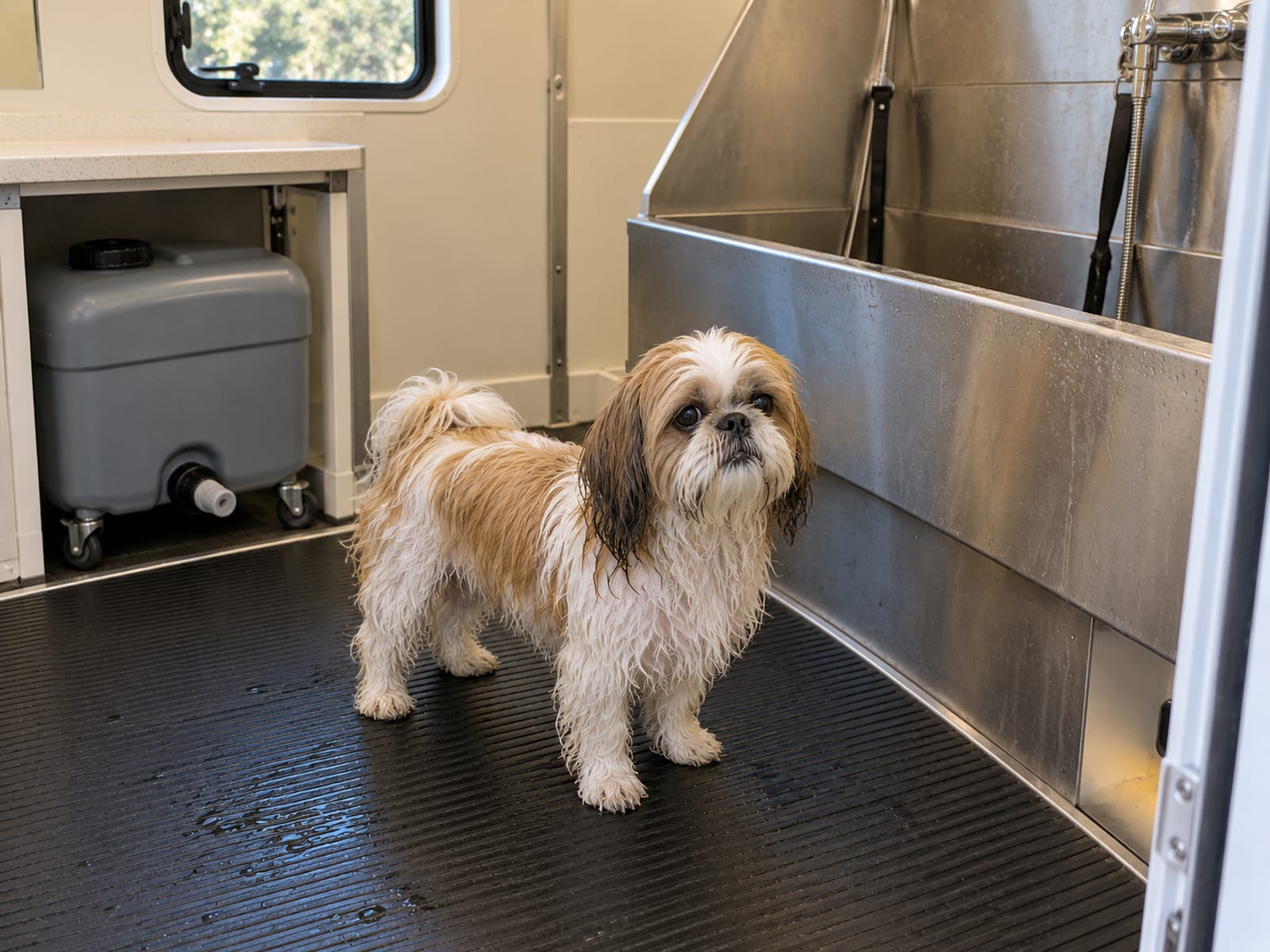
This is the question that gets mobile groomers into trouble, so I would settle it before anything else about the van. Streets to Creeks is clear: wash water does not go to a street, gutter, parking lot, yard, lawn bed or storm drain. Only rainwater belongs in a storm drain, and a "biodegradable" shampoo does not change that.
Here is what the guidance asks you to do instead:
- Capture all wash water on the van, trailer or work area.
- Filter it through a wire-mesh strainer and put the fur and other solids in the trash.
- Send the water to a sanitary sewer, with permission from the sanitary sewer district and the property owner, or collect it in a holding tank for later disposal at an approved location.
- Ask your local wastewater authority whether a one-time discharge permit applies.
Enforcement is real. Nashville's 2020 stormwater annual report records a notice of noncompliance to a mobile grooming company that discharged soapy water to the street, and the company had to capture and contain its wash water.
The state side runs through TDEC. Its State Operating Permit page covers temporarily holding wastewater and pump-and-haul systems, and applications for mobile wash systems or pump-and-haul permits go to the Division of Water Resources. Before you pick a dump site, call TDEC, the county environmental-health office, the local wastewater authority and the property owner. Ask whether you may connect to a customer's sewer cleanout, where you may empty a holding tank, and whether a permit is needed. Write down who said yes.
Where can the van park and work?
There is one Tennessee answer to the question of where a grooming van can park: it depends on the city and the address. Zoning, parking, right-of-way and private-property rules can each apply separately, so a van that may legally park somewhere is not automatically allowed to groom there.
Here is what the big cities require. Nashville regulates mobile vending and public right-of-way activity, and its codes office covers residential business operation, parking surfaces and home-occupation conditions. Clear a residential base or a public-street stop with Metro zoning, codes, transportation or public works, and the clerk. Knoxville's zoning manual addresses parking and commercial-vehicle storage. Chattanooga's zoning materials discuss commercial vehicles in residential areas and permitted parking areas, and its public-property rules for mobile food units are written for food, so do not read them as grooming rules. For Memphis, ask the city zoning and codes offices about your exact address.
An HOA, an apartment lease, a landlord or a gated community can add limits even where the city allows the van. If a customer lives in one, ask them to check before you book.
How does Tennessee tax bathing and grooming?
The SUT-119 notice, dated March 27, 2025, says the total sales price for animal bathing is subject to Tennessee sales tax and grooming services are not. If you charge one lump sum for a bath and a groom, the whole charge is taxable.
On the road, one more question comes up: which local rate applies when you bathe a dog at a customer's address. SUT-119 does not hand you a route rule, so use the Department of Revenue's local-rate lookup and ask the Department which locality applies. How to word an invoice that separates the two services belongs in Tennessee sales tax on pet services. You will want that page before you print your first invoice.

What do a van and its equipment cost?
These are published examples with their dates, not Tennessee averages and not a promise about what yours will cost.
Tap or hover a row to highlight it.
| Item | Published figure | Source and date |
|---|---|---|
| ItemLocal business license | Published figure$15 per license | Source and dateTenn. Code Ann. § 67-4-723 |
| Item2026 grooming trailer package | Published figure$18,950 base package, $21,750 upgraded package | Source and dateBella's Custom Trailers, accessed October 2026 |
| ItemFinished van and conversion | Published figureAbout $65,000 to $120,000 | Source and dateVanaholic, June 8, 2026 |
| ItemConversion alone, without the cargo van | Published figureAbout $28,000 to $65,000 | Source and dateVanaholic, June 8, 2026 |
| ItemTanks, pump, plumbing, hair trap, water heater | Published figureAbout $2,500 to $8,000 installed | Source and dateVanaholic, June 8, 2026 |
| ItemGenerator | Published figureAbout $1,200 to $4,500 | Source and dateRepurpose Atlas, accessed October 2026 |
| ItemGrooming table | Published figureAbout $700 to $2,500 | Source and dateRepurpose Atlas, accessed October 2026 |
The trailer figure comes from Bella's Custom Trailers and includes a water package, generator, table and dryer. The van figures come from Vanaholic, and the generator and table ranges from Repurpose Atlas.
The spread is wide because "a van" can mean a used cargo van with a basic conversion or a finished unit. Decide what you can park, power and fill before you decide what you can afford. For local price levels, compare dog service prices in Tennessee. I can't tell you what you'll earn, and nothing here predicts it.
What insurance, records and weather policy does a van need?
Insurance comes in several kinds, and each one covers a different risk. Commercial auto normally addresses the vehicle. General liability, animal bailee (sometimes called care, custody and control) coverage, equipment coverage and workers' compensation may address the other risks. Get quotes from a licensed insurance professional and read the exclusions, especially for an animal injured in your care and for the equipment inside the van.
A solid appointment file for each customer includes:
- Owner name, phone, email and an emergency contact.
- The service address, and permission to work there.
- The dog's name, a description, age if the owner gives it, and the owner's written authorization.
- Rabies information, if your policy or a local rule asks for it; see Tennessee rabies law for dog businesses.
- Behavior, escape, bite and handling disclosures, plus grooming history. For the legal side of a bite, see Tennessee dog bite law for dog businesses.
- Appointment date, arrival and departure times, services, charges and payment.
- Where the wash water went, when that is relevant.
- Notes on any incident, injury, escape, equipment problem, weather event or cancellation.
For heat, write a policy that sets a temperature limit, ventilation, air-conditioning, power-failure steps, water, shade, how often you check the dog, and the point where you stop work. A parked van should not continue an appointment if safe climate control cannot be kept up. For storms, list lightning, tornado warnings, flooding, dangerous roads, power loss and evacuation as reasons to stop, postpone or reschedule. A van holds an animal, water, propane or electrical equipment, and a generator, so a cancellation is a safety decision before it is a customer-service one.
TEMA's ReadyTN Business program runs four weeks at no cost and covers risk assessment, an emergency plan, continuity, customer communication, insurance review, evacuation or shelter-in-place planning, supplies and drills. It is a good model for your own plan. For the Tennessee-specific version, see storm and flood planning for dog businesses in Tennessee.
What can you do this week, and what should you ask each city and county?
Here is a sequence you can start today:
- Choose the business address you will license the business under.
- Register the entity or assumed name with the Secretary of State if it applies.
- Call the Department of Revenue about business tax and the classification question.
- Call the county clerk and every city clerk in your planned service area.
- Ask zoning about your base, storing the van, driveway work and your route.
- Ask the wastewater authority about sewer discharge and holding tanks.
- Get insurance quotes and price the van or trailer.
- Write your intake form, authorization form, incident form, and heat and storm policies.
- Test the whole water and electrical loop before the first paying customer.
When you call a city or county, these are the questions I would ask:
- Is a mobile grooming van a permitted use at my business address?
- Can I store it in a residential driveway?
- Can I groom in a customer's driveway?
- Can the van operate from a public street?
- Do I need a right-of-way, parking, vending or encroachment permit?
- Does my route create a city or county license obligation?
- Where may I discharge captured wastewater?
- Do I need a sewer authority permit?
- Are hair, shampoo, gray water, propane, generators or commercial vehicles regulated separately?
- Does the property owner, HOA or apartment lease add rules?
The offices to ask are the county clerk, city clerk, planning or zoning office, codes office, public works or transportation department, wastewater authority, stormwater program, fire marshal and animal control.
Questions Tennessee mobile groomers ask
The short answers are below; the sections above give the detail.
Does Tennessee have a mobile dog-grooming license?
Tennessee business-tax licensing and local approvals are what apply, so start with the Department of Revenue, the county clerk, the city clerk and the local zoning office. Ask each of them how your van and route are treated.
Do I need a grooming certification or license to open a grooming business?
The first approvals are business-tax registration and local licenses from the county clerk and city officials. If you ask whether a grooming credential is required, put that question to the Department of Agriculture's Animal Health office.
Is it illegal to groom dogs at home in Tennessee?
Whether you can groom at home depends on your zoning and home-occupation rules. I answer it in running a dog business from home in Tennessee.
How much does it cost to open a mobile grooming business?
Published 2026 figures run from $18,950 for a trailer package to roughly $65,000 to $120,000 for a finished van, before insurance quotes and license fees. Those are examples, not Tennessee averages, so get dated quotes for your own setup.
Can wash water go into a storm drain?
No. Streets to Creeks says wash water, shampoo and hair should not enter streets, gutters, lawns or storm drains. Capture the water, filter out the hair, and use an approved sewer connection or holding-tank disposal.
What is the next step?
Make the first call this week. Pick up the phone and ask the Department of Revenue Business Tax Division and your county clerk what they need from you, then book the zoning and wastewater conversations before you tour a single van. Each answer will shape the van you buy.
I am not a lawyer, accountant or veterinarian, and none of this is legal, tax or veterinary advice. Every office named above can give you a ruling for your own business. When the van is on the road, add your mobile grooming business to DogServ, and get in touch if you want a website that shows your route and booking.
Sources
- bellascustomtrailers.com: Bella's Custom Trailers
- chattanooga.gov: public-property rules for mobile food units
- filetransfer.nashville.gov: 2020 stormwater annual report
- law.justia.com: Tenn. Code Ann. § 67-4-723
- mtas.tennessee.edu: Tennessee Business Tax Manual
- nashville.gov: codes office
- nashville.gov: mobile vending and public right-of-way activity
- permits.knoxvilletn.gov: Knoxville's zoning manual
- register.chattanooga.gov: Chattanooga's zoning materials
- repurposeatlas.com: Repurpose Atlas
- revenue.support.tn.gov: BUS-14
- revenue.support.tn.gov: pet grooming and bathing as business-tax activities
- revenue.support.tn.gov: SUT-119 notice
- shelbycountytn.gov: Shelby County
- sos.tn.gov: business forms and fees
- streetstocreeks.org: Streets to Creeks
- tn.gov: Animal Health
- tn.gov: Business Tax Division
- tn.gov: local-rate lookup
- tn.gov: ReadyTN Business program
- tn.gov: State Operating Permit page
- vanaholic.com: Vanaholic