
Florida Sales Tax on Pet Services: Grooming, Boarding, Supplies, Retail Products and Registration
By Cal Hewitt · Published
Business guides

A Florida dog groomer or boarder generally should not add sales tax to a separately stated grooming or boarding charge. Florida Administrative Code Rule 12A-1.0215 says, “Charges for boarding animals or for grooming animals are not subject to tax.” The same rule says the items you buy to use in boarding or grooming are taxable. Retail products you sell to customers are a separate question and may be taxable. Florida’s general state rate is 6%, plus any county discretionary sales surtax. Walking, sitting, training and waste removal should be classified by the Florida Department of Revenue before you decide how to invoice or register.
Key takeaways
Tap a card to bring it forward.
- Rule 12A-1.0215 says charges for grooming or boarding animals are not subject to Florida sales tax.
- Supplies you buy to groom or board, such as shampoo, clippers, brushes, dog food and disinfectants, are taxable to you.
- Products you sell to customers, such as treats, shampoo, toys and collars, are a separate line and may be taxable.
- Taxable sales carry the 6% state rate plus the county surtax where the sale is delivered.
- Ask the Department of Revenue’s Office of Technical Assistance to classify walking, sitting, training and waste removal.
- Register before your first taxable sale, through the online Florida Business Tax Application or Form DR-1.
If you’re worried you’ve been charging customers the wrong amount, or that you registered for something you didn’t need, start here. Pet businesses mix services and products all day, and Florida treats those two things differently. The fix is mostly about separating them, on paper and on your invoices, and getting a ruling from the state where your service isn’t clearly grooming or boarding. I’m not an accountant or a lawyer, and nothing here is tax or legal advice. What I can do is lay out what Florida’s own rule and brochure say, in the order you need it, and point you to the office that decides.
Do you charge Florida sales tax on grooming or boarding? What Rule 12A-1.0215 says
Florida’s rule on this is titled Veterinary Sales and Services, and it took effect February 17, 2015. It’s short on this point, and it’s clear. Rule 12A-1.0215 states: “Charges for boarding animals or for grooming animals are not subject to tax.”
So, if a customer brings a dog in for a bath and trim, or leaves a dog with you for three nights of boarding, that service charge doesn’t carry Florida sales tax. The Department of Revenue’s brochure GT-800045, revised October 2025, identifies boarding charges as exempt and sends readers back to the same rule.
Two words in that first answer matter: “separately stated.” The rule covers the grooming or boarding charge. It doesn’t cover everything else that might ride along on the same ticket, like a bag of treats at checkout or a bottle of shampoo the owner takes home. The rule also doesn’t classify every kind of pet care. Walking, sitting, training and waste removal aren’t named in it, so those need their own answer from the Department, which I cover further down.
The shampoo, food, brushes and disinfectants you buy: why they’re taxable to you
This part is about what you buy. The service is tax-free, but the things you use up while providing it are not.
Rule 12A-1.0215 says items purchased for use in providing boarding or grooming are subject to tax. It lists them: cat food, dog food, nail-care items, clippers, shears, brushes, combs, soaps, detergents, deodorizers, colognes, and the disinfectants used to clean kennels, cages, equipment and other grooming or boarding items. GT-800045 says the same thing about items purchased for grooming or boarding.
In plain terms, you pay tax when you buy your working supplies, and you don’t pass a separate tax on the service to your customer. Your clippers, your kennel cleaner and the food a boarding dog eats are your costs of doing business.
There’s a second trap here, and it involves resale. Many shops buy retail stock, like shampoo or treats, tax-free for resale. That’s fine as long as you resell it. GT-800045 says items first purchased tax-free for resale and then used in the business instead are subject to Florida use tax. A resale certificate isn’t permission to consume inventory tax-free. If you pull a retail bottle of shampoo off your shelf and use it in the tub, that bottle now owes use tax, and you should record it.
Selling treats, shampoo, toys and other products beside a nontaxable service
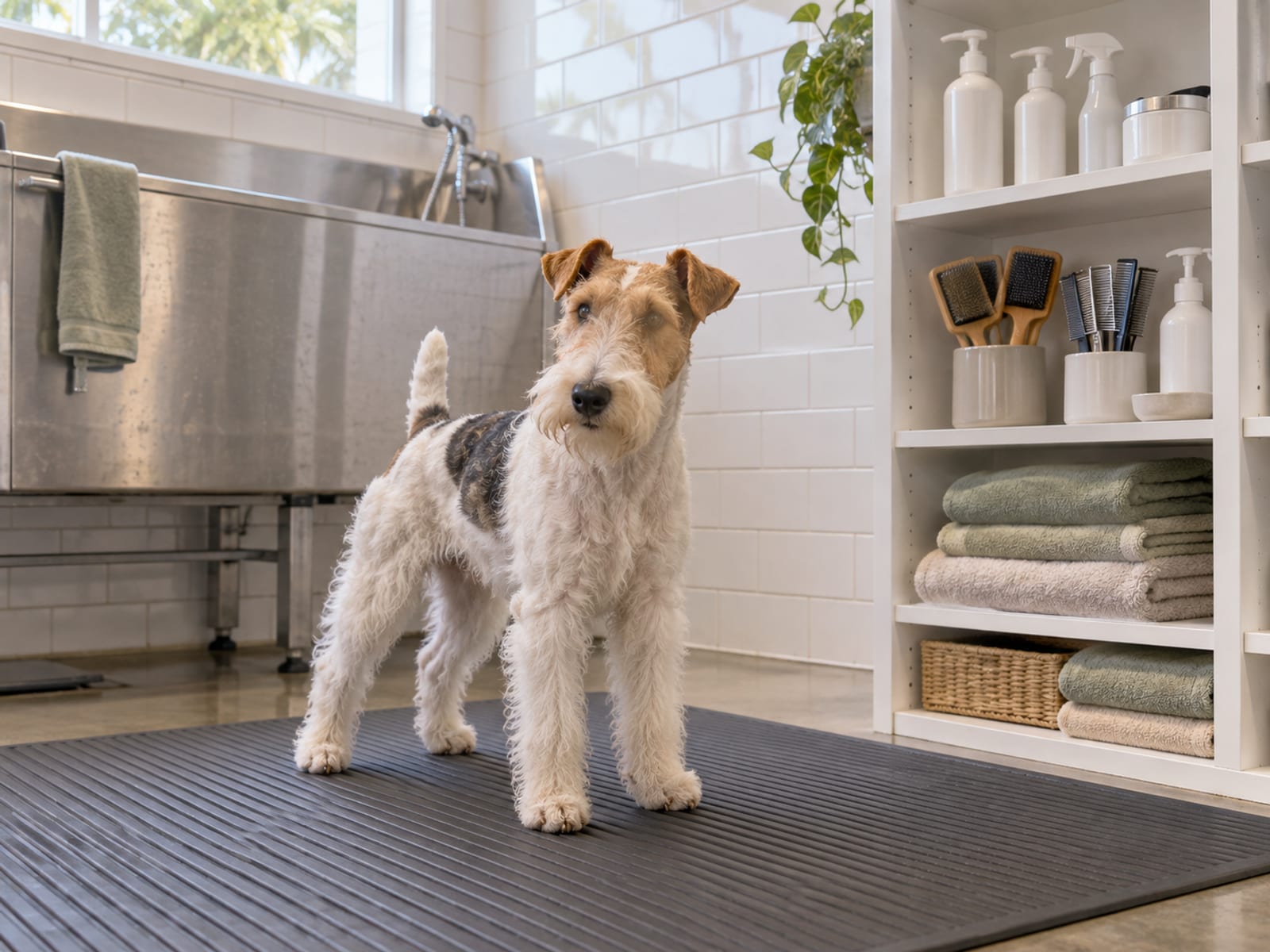
Once you sell something a customer takes home, you’re in a different category. Treats, food, shampoo, toys and collars sold to customers are retail products, and those sales need their own classification. A product can be taxable even when the grooming or boarding charge it sits next to is not.
What I’d do first is make a list of every product you sell, even the small impulse items by the register. Then list the supplies you use in the business, separately. Those two lists are the start of everything else in this post: your invoices, your registration answer and your records.
Selling products also changes your registration answer. A shop that only grooms may never collect sales tax. A shop that grooms and sells shampoo at the counter probably will. If you’re not sure which side of that line you’re on, ask the Department before you start selling.
One invoice with a grooming charge and a product sale: the separate lines to show
A single bundled price, like “Full groom with take-home shampoo,” makes it hard for anyone, you or an auditor, to tell which part was exempt and which part was taxable. Splitting the lines solves that.
Tap or hover a row to highlight it.
| Line | What it shows | Tax treatment |
|---|---|---|
| LineGrooming or boarding service | What it showsThe service charge on its own line | Tax treatmentNot subject to tax under Rule 12A-1.0215 |
| LineEach retail product | What it showsProduct or product category, with its price | Tax treatmentClassify each product; may be taxable |
| LineTaxable subtotal | What it showsThe total of the taxable products only | Tax treatmentBasis for the tax lines |
| LineState sales tax | What it shows6% of the taxable subtotal | Tax treatmentState rate |
| LineCounty surtax | What it showsThe rate for the county where the sale is delivered | Tax treatmentVaries by county |
| LineTotal tax | What it showsState tax plus county surtax | Tax treatment |
| LineTotal due | What it showsService, products and tax together | Tax treatment |
Set your point-of-sale system or invoice template up this way once, and it does the work every day after. If you sell an unusual bundle, like a package that mixes boarding, a bath and a bag of food, ask the Department to classify it before you price it. GT-800045 and the rule both treat the service and the goods differently, so your invoice should too.
Walking, sitting, training and waste removal: what to ask the Office of Technical Assistance
If your main service is walking, pet sitting, training or pet waste removal, Rule 12A-1.0215 doesn’t answer your question directly. The office that does is the Department of Revenue’s Office of Technical Assistance, which makes taxability determinations based on the specific facts of a business. You can reach it at 850-617-8346 or DOROTA@floridarevenue.com. The Department’s contact page lists its other tax-assistance lines.
Ask for the classification in writing where you can, and describe your business plainly. The details that change an answer include:
- What the worker physically does, and where the service happens.
- Whether the customer receives a product or only labor.
- Whether the price includes transportation, food, treats, waste bags, disposal or equipment.
- Whether waste bags are supplied to the customer, sold, or used up by your business.
- Whether the customer provides the food or treats, or you buy them.
- Whether any retail goods change hands.
- Whether a package combines walking, sitting, training, boarding, grooming or products.
- Whether you work through a marketplace or app.
- Whether you buy products for resale and later use some in the business.
Keep the answer you get. If the Department classifies your service differently than you assumed, change your invoices and registration to match, and keep the written response with your records.
The 6% state rate and the county discretionary sales surtax for 2026
Florida’s general state sales-tax rate is 6%, according to the Department of Revenue’s sales and use tax page. Counties can add a discretionary sales surtax on top, so the total rate on a taxable sale is 6% plus the surtax for the county involved. The surtax applies when a taxable sale or taxable service is delivered into a county that imposes one, according to the Department’s surtax information page.
The state publishes the county rates each year on Form DR-15DSS. The 2026 DR-15DSS, revised November 2025, lists every county and flags changes in three of them.
Tap or hover a row to highlight it.
| Rate | Value | Source and date |
|---|---|---|
| RateFlorida general state sales-tax rate | Value6% | Source and dateFlorida DOR sales and use tax page, as of September 30, 2026 |
| RateJackson County surtax, 2026 | Value1.5% | Source and dateDR-15DSS, revised November 2025 |
| RateMartin County surtax, 2026 | Value0.5% | Source and dateDR-15DSS, revised November 2025 |
| RatePalm Beach County surtax, 2026 | Value0.5% | Source and dateDR-15DSS, revised November 2025 |
For any other county, or for a specific address, use the Department’s county surtax rate table and its address lookup. That matters most if you’re mobile or you deliver products, since the delivery address sets the county. Recheck the rates when a new year’s DR-15DSS comes out.
One point that saves a lot of worry: a nontaxable grooming or boarding charge doesn’t become taxable just because your county has a surtax. The surtax rides on taxable sales only.

When and how to register: the Florida Business Tax Application or Form DR-1
The Department’s registration page says a business that will sell taxable goods or services must register as a sales and use tax dealer before it begins those taxable activities. There’s no waiting until you hit a certain amount of sales. The timing is before the first taxable sale.
The route looks like this:
- Start the online Florida Business Tax Application.
- Answer its questions about what your business does.
- Register for sales and use tax if the application identifies taxable activity.
- Or file Form DR-1 instead of applying online.
- Receive your certificate and follow its filing instructions.
- Register each location when the Department requires it.
- File returns and pay through the Department’s File and Pay system.
If you only groom or board, and you state those charges separately, you may not have taxable sales at all. But if you also sell products or offer other services, ask the Department whether you need to register. That one question is cheaper than fixing a year of uncollected tax.
The sales-tax records to keep so service charges and product sales show separately
Good records are what let you prove the split. For each transaction, keep:
- The date and a customer or transaction number.
- The location or delivery address, when it affects the county rate.
- The service description and the separate grooming or boarding charge.
- Each product’s description and price.
- The taxable subtotal, state tax, county surtax and total collected.
- Any refunds or adjustments.
Then keep the business side: purchase invoices for supplies and inventory, resale certificates where you used them, use-tax entries for inventory you consumed, filed returns and payment confirmations, and any written classification from the Department.
The IRS asks for the same habits on the federal side. Its recordkeeping guidance says your system must clearly show income and expenses, backed by invoices, receipts, deposit information and purchase documents. IRS Publication 583 covers the same ground for new businesses. A service report and a product report, run separately each month, will serve both the state and the IRS.
The local permits beside sales tax: business tax receipt, certificate of use and zoning
Sales tax is a state matter. Where you can operate is a local one, and Florida has no single statewide permit, zoning or home-business rule for every dog business. Rules differ by city, county, unincorporated area, zoning district, homeowners association, building and fire codes, and local animal-control rules.
Call your city or county planning and zoning office and ask:
- Is this use allowed at my exact address?
- Do I need a business tax receipt, a certificate of use, or both?
- Are home-based animal businesses allowed here?
- Are customer visits, signs, parking, noise, sanitation or animal numbers limited?
- Are kennels, boarding, grooming or daycare classified separately?
- If I’m mobile, do I need a receipt where I perform the service?
- Do I need both a county and a city receipt?
- Does my HOA add its own limits?
As one example, the City of Orlando requires a Certificate of Use with a Business Tax Receipt so the city can confirm the business is allowed in its zoning district, and it sends a billing summary within 10 days after processing. Jacksonville has its own local business tax receipt through its tax collector, and so does Palm Beach County. If you operate under a name other than your own legal name, the Florida Division of Corporations handles fictitious-name registration through Sunbiz; its page says you don’t need one for your own legal name or your entity’s legal name.
Before the questions, a quick check on the main points.
Quick check: Florida sales tax for pet businesses
Questions about Florida sales tax for groomers, boarders, walkers and sitters
These answers cover grooming, boarding and other services, product sales, resale stock and registration.
Is pet grooming taxable in Florida?
No, a separately stated grooming charge is not subject to Florida sales tax under Rule 12A-1.0215. Add-on products the customer takes home are a different line and may be taxable. Your own grooming supplies are taxable when you buy them.
Are dog boarding, walking and pet sitting taxable in Florida?
Boarding charges are not subject to tax under the same rule, and GT-800045 identifies them as exempt. Walking and pet sitting aren’t named in the rule, so ask the Office of Technical Assistance to classify your exact service, including any food, treats or waste bags in the price.
What about the products I sell?
Treats, food, shampoo, toys and collars you sell are retail products, classified on their own. Charge the 6% state rate plus the delivery county’s surtax on any that are taxable, on their own invoice lines.
Can I use shampoo from my retail shelf in the tub?
You can, but GT-800045 says items bought tax-free for resale and then used in the business owe Florida use tax. Record those items as use-tax entries so your books match your returns.
Do I need a Florida sales tax number if I only groom?
If you only provide separately stated grooming or boarding, you may have no taxable sales. Once you sell products or add other services, ask the Department whether you must register, and do it before the first taxable sale.
Your next step this week
You don’t have to fix everything today. Work through it in this order:
This week’s checklist
Tap a card to bring it forward.
- List every service you provide, and separate grooming and boarding charges from everything else.
- List every product you sell, and separately list the supplies you use in the business.
- Mark any products you bought for resale and later used, and record them for use tax.
- Ask the Office of Technical Assistance to classify walking, sitting, training, waste removal or any bundle.
- Check your county’s 2026 surtax on the DR-15DSS or the address lookup.
- Set your invoices to show service, product, tax and surtax lines separately.
- Register before your first taxable sale, if you have one.
- Call your city or county zoning and business-tax office about your address.
- Keep invoices, purchase records, returns and any Department letters together.
If you serve Spanish-speaking customers or work with Spanish-speaking staff, the terms they’ll use are “impuesto sobre las ventas” for sales tax and “servicios para mascotas” for pet services. Point them to the same Florida sources and explain the split the same way: the grooming or boarding charge on one line, the products on another.
Start with the two lists, services and products. Everything else, from your invoice to your registration answer, follows from them.
Sources
- dos.fl.gov: fictitious-name registration
- floridarevenue.com: 2026 DR-15DSS
- floridarevenue.com: contact page
- floridarevenue.com: Department of Revenue’s sales and use tax page
- floridarevenue.com: Form DR-1
- floridarevenue.com: GT-800045
- floridarevenue.com: Office of Technical Assistance
- floridarevenue.com: registration page
- flrules.org: Florida Administrative Code Rule 12A-1.0215
- irs.gov: IRS Publication 583
- irs.gov: recordkeeping guidance
- orlando.gov: City of Orlando
- pbctax.gov: Palm Beach County
- pointmatch.floridarevenue.com: county surtax rate table
- floridarevenue.com: surtax information page
- taxcollector.jacksonville.gov: local business tax receipt