

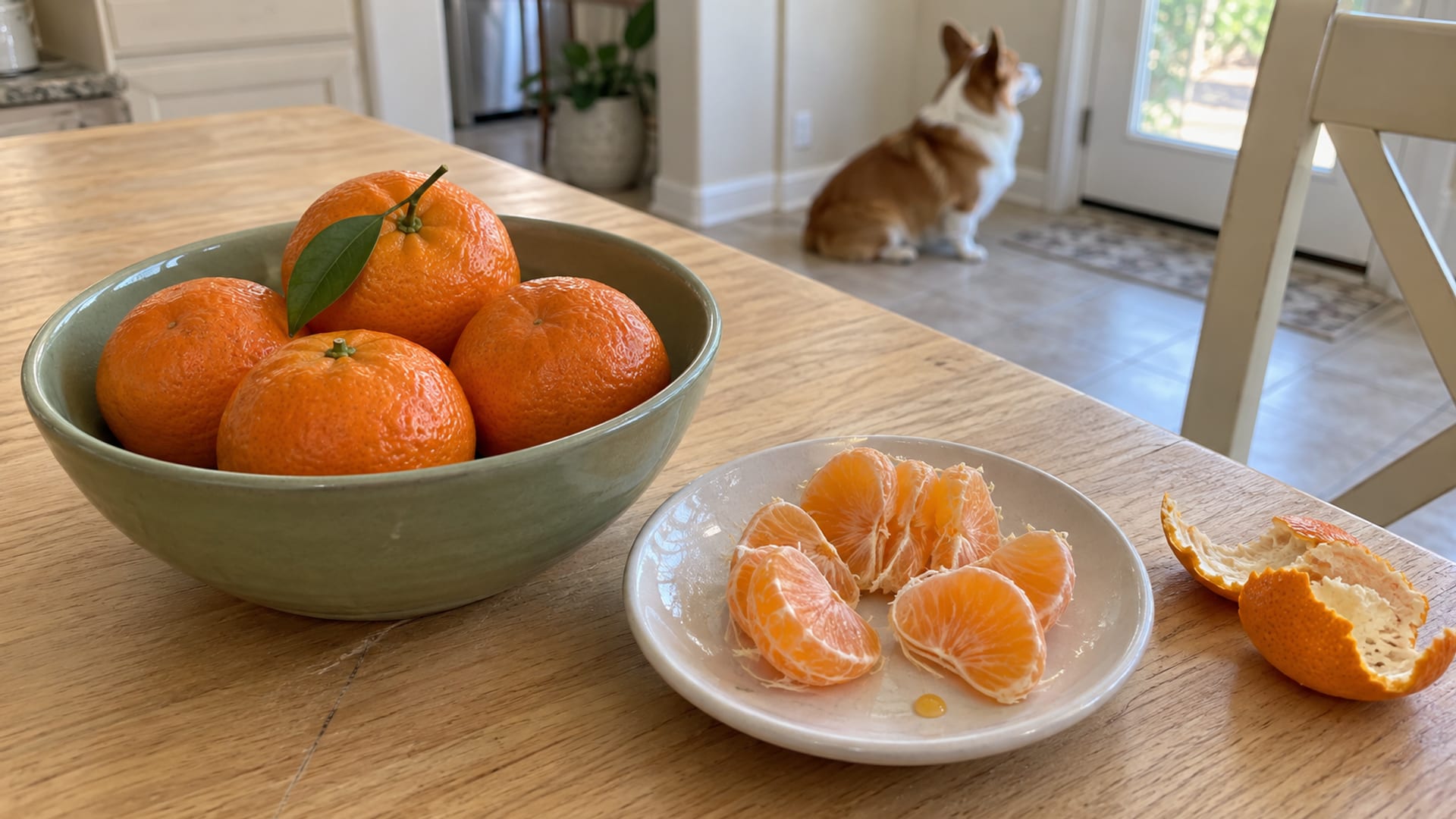
Yes, a small piece of peeled, seedless tangerine is a fine treat for most dogs. The ASPCA says eating a small amount of citrus fruit is unlikely to cause more than a minor stomach upset. The peel, seeds and leaves are where the problems sit, along with any tangerine or mandarin essential oil.
If your dog ate a segment that rolled off the table, there is nothing to do. If they chewed through a whole tangerine with the peel, raided a bag of them, or licked up citrus oil or a citrus-scented cleaner, read the next section before anything else.
Key takeaways
Tap a card to bring it forward.
- Peeled tangerine flesh is fine for most dogs in small amounts.
- The peel, seeds, leaves and stems hold citrus oils and psoralens that can upset a dog's stomach.
- Tough peel can be hard to digest, and a lot of it may not pass.
- Tangerine and mandarin essential oils are a separate, more serious exposure.
- Mandarins, clementines and satsumas follow the same rules.
Your dog ate tangerine: what to do
Tap or hover a row to highlight it.
| What your dog ate | Next step |
|---|---|
| What your dog ateA segment or two of peeled flesh | Next stepNothing. A soft stool afterward is possible. |
| What your dog ateA whole tangerine, peel included | Next stepWatch for vomiting, diarrhea or belly pain. Call your vet if they appear. |
| What your dog ateSeveral tangerines with peels | Next stepCall your vet, especially for a small dog. |
| What your dog ateSeeds along with the fruit | Next stepWatch for gagging or vomiting, and call if you see either. |
| What your dog ateTangerine, mandarin or orange essential oil | Next stepCall your vet or a pet poison line now. |
| What your dog ateA citrus-scented cleaner, potpourri or flea product | Next stepCall now, and bring the bottle to the phone. |
| What your dog ateTangerine candy, cocktails or baked goods | Next stepCheck the label for xylitol, chocolate or alcohol, and call if any are listed. |
For citrus, the ASPCA's advice is to note how much your dog ate and contact your vet or a poison control line. Have the product, the amount, the time and your dog's weight ready.
Call right away for vomiting that keeps coming back, severe diarrhea, marked tiredness, trouble breathing, trembling, wobbling, collapse, or a dog that strains and cannot pass stool.
Which parts of a tangerine are safe
Tap or hover a row to highlight it.
| Part | Safe? | Why |
|---|---|---|
| PartPeeled flesh | Safe?Yes, in small pieces | WhyASPCA: small citrus ingestions rarely cause more than mild upset |
| PartPeel | Safe?No | WhyCitrus oils and psoralens; tough to digest |
| PartWhite pith and membranes | Safe?Remove with the peel | WhyFibrous; can add to stomach upset |
| PartSeeds | Safe?No | WhyContain citrus oils; a choking and blockage risk |
| PartLeaves and stems | Safe?No | WhyASPCA says citrus plant material can cause problems |
| PartJuice | Safe?Skip | WhyConcentrated sugar and acid without the fiber |
| PartCanned in syrup | Safe?Skip | WhyAdded sugar |
| PartDried or candied | Safe?Skip | WhyConcentrated sugar, sometimes zest or sweeteners |
| PartEssential oil, zest, extract | Safe?No | WhyConcentrated citrus oils |
The ASPCA's orange listing calls citrus fruit edible and names essential oils and psoralens in the skin and plant as the problem, with vomiting, diarrhea and depression as the signs. Tangerines are a close citrus relative and are treated the same way.
How much tangerine, and how to serve it
There is no tangerine-specific serving chart. For oranges, the AKC suggests one or two small segments a day, depending on your dog's size, and a tangerine segment is smaller than an orange one. Treat that as the upper limit for tangerine too.
Peel it, pull off as much white pith as you easily can, check for seeds, and cut the segment into bite-size pieces for a small dog. The AKC mentions tangerine flesh without the peel as a citrus option for dogs. Treats of any kind should stay under 10 percent of your dog's daily calories, per the AKC. Dogs with diabetes or weight problems may need less sugar from fruit, so ask your vet first.
Signs to watch for
After too much fruit or a chewed peel, you might see:
- vomiting
- diarrhea
- a sore belly
- not wanting to eat
- tiredness or low mood
These usually come from an irritated stomach. The Merck Veterinary Manual notes that d-limonene, an oil from citrus rind, can make dogs vomit, with signs starting within a few hours. Vomiting that goes on, or straining with no stool after eating peel, can point to a blockage and needs a vet.
"My dog steals clementines every winter and is fine"
That is common, and your dog's experience is real. Many dogs eat a few segments with nothing more than a soft stool. It does not hold for every dog or every form. A few segments of flesh are a small, mild dose; a pile of peels is a lot of citrus oil and tough fiber. The same peel is a bigger load for a ten-pound dog than for a sixty-pound one. Dogs also differ in how sensitive their stomachs are. And an essential oil, a cleaner or a scented product is a different exposure from the fruit altogether, even when it smells the same.
Mandarins, clementines, juice and tangerine-scented products
- Mandarins, clementines, satsumas, Cuties and Halos: all close citrus relatives. Same rules as tangerines.
- Canned mandarin oranges: usually packed in syrup. Skip them.
- Tangerine juice: concentrated sugar and acid. Water is the better drink.
- Tangerine or mandarin essential oil: made from the peel and concentrated. VCA Animal Hospitals treats citrus essential oils as a poisoning risk for dogs, so keep diffusers and bottles out of reach.
- Tangerine-scented cleaners and potpourri: treat as a chemical exposure, not a fruit.
- "Tangerine impatience": a garden flower with a similar name, not a citrus fruit.
- Other citrus: see can dogs eat oranges?, lemons and limes.
- Cats in the house: the ASPCA lists orange, and its oils, as toxic to cats as well.
Check what you learned
Quick check
Questions about dogs and tangerines
Can dogs eat mandarin oranges?
Yes, the same way as tangerines: a small amount of peeled, seedless flesh. Skip canned mandarins in syrup.
Can dogs eat clementines?
Yes, a segment or two of peeled flesh is fine for most dogs. Keep the peel and any seeds away.
What happens if a dog eats tangerine peel?
A little peel often causes nothing worse than an upset stomach. A large amount of peel can irritate the gut and may be hard to pass, so call your vet if vomiting continues or your dog strains without passing stool.
Can puppies eat tangerines?
There is no puppy-specific rule. If you share, keep it to a tiny piece of peeled flesh cut small, since awkward pieces are easier for a puppy to choke on.
Are tangerine seeds bad for dogs?
Take them out. Citrus seeds contain the same oils as the peel, and a few swallowed together can be a choking or blockage risk in a small dog.
Sources
Checked September 25, 2026.
- ASPCA Animal Poison Control Center, People Foods to Avoid Feeding Your Pets
- ASPCA Animal Poison Control Center, Orange
- American Kennel Club, Can Dogs Eat Oranges?
- American Kennel Club, Can Dogs Eat Grapefruit?
- Merck Veterinary Manual, Insecticide Poisoning
- VCA Animal Hospitals, Essential Oil and Liquid Potpourri Poisoning in Dogs