

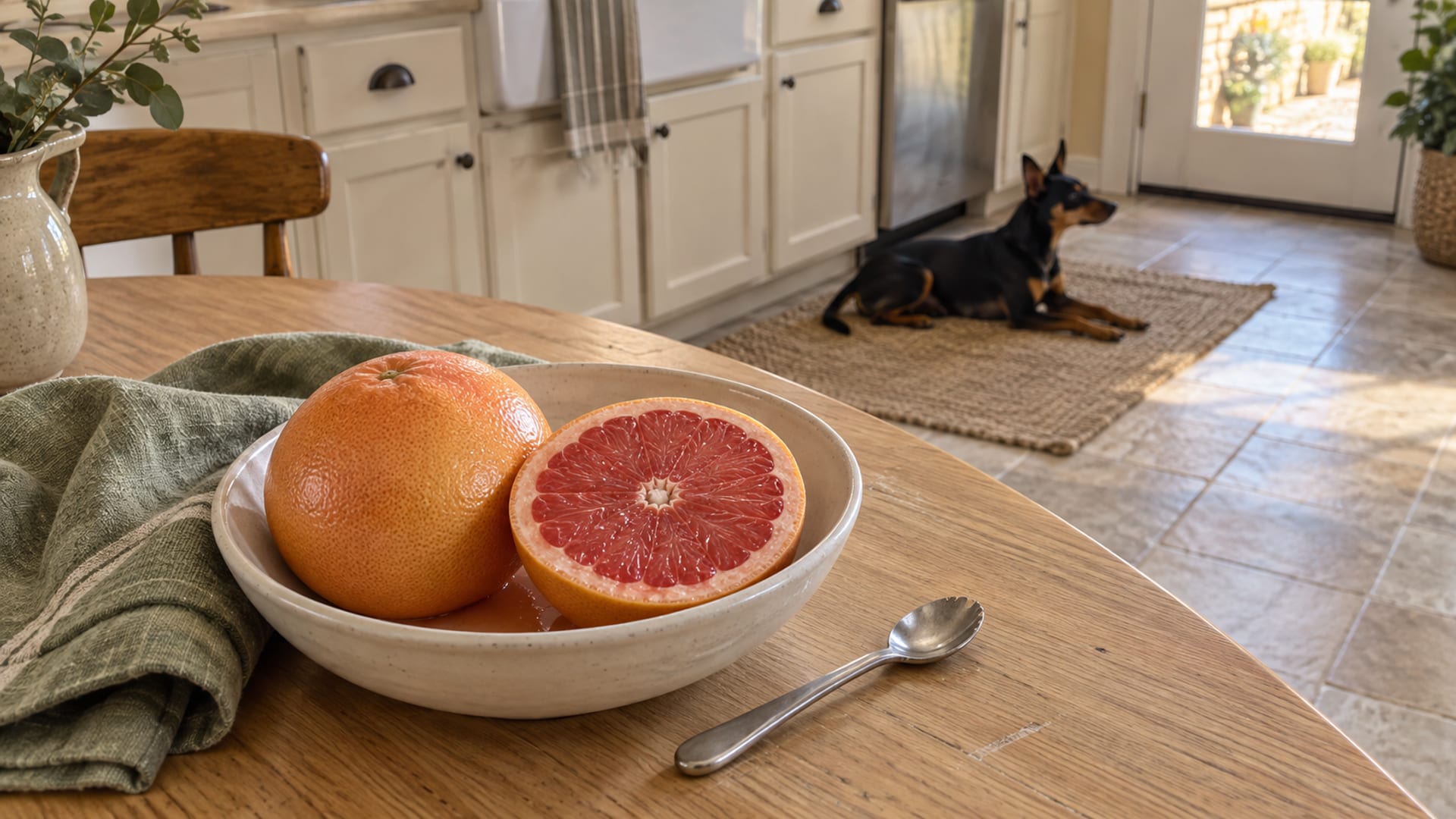
Grapefruit is best left out of your dog's bowl. The ASPCA lists grapefruit as toxic to dogs because of its essential oils and psoralens, and it points to the skins and plant material as the parts that cause trouble. The American Kennel Club says a small amount of the flesh is generally tolerated, but the fruit's acid can irritate the gut, so it recommends skipping it.
If your dog snatched a segment of peeled fruit, keep an eye on their stomach for the rest of the day. If they chewed the peel or rind, ate a whole grapefruit, got into the tree's leaves, or licked grapefruit oil, call your vet or a pet poison line now.
Key takeaways
Tap a card to bring it forward.
- The ASPCA lists grapefruit as toxic to dogs; the oils and psoralens sit mostly in the peel and plant.
- A small bite of peeled flesh is usually tolerated, though the acid can upset the stomach.
- Peel, rind, pith, leaves, stems and grapefruit oil are the exposures that call for a vet.
- Vomiting, diarrhea, low energy or skin irritation after grapefruit are reasons to call.
- Grapefruit has nothing to do with grapes. The kidney risk from grapes does not apply here.
My dog ate grapefruit: what to do now
Tap or hover a row to highlight it.
| What happened | What to do |
|---|---|
| What happenedA lick of juice or one small bite of peeled flesh | What to doWatch for vomiting or loose stool today. Call if either shows up. |
| What happenedSeveral segments or half a fruit or more | What to doCall your vet for advice, with your dog's weight. |
| What happenedChewed or swallowed peel, rind or zest | What to doCall your vet or an emergency clinic now. |
| What happenedLeaves or stems from a grapefruit tree | What to doCall now, and take a photo of the plant. |
| What happenedGrapefruit essential oil, extract or powder | What to doCall now. These are concentrated. |
| What happenedA grapefruit drink, candy or flavored snack | What to doRead the label for xylitol, alcohol or caffeine, and call if any is listed. |
The AKC's advice is direct: after a large amount of flesh, contact your vet, and after rind or skin, call a vet or emergency clinic right away. When you call, say which part your dog ate, roughly how much, what product it was, and when it happened. Keep the peel, the bottle or the wrapper nearby so you can read from it.
Get to a vet without waiting if your dog keeps vomiting, seems weak or dull, or is acting strangely.
Which parts of a grapefruit matter
Tap or hover a row to highlight it.
| Part | Level of concern | Why |
|---|---|---|
| PartPeeled flesh | Level of concernLower | WhyUsually tolerated in a small amount, but acidic enough to irritate the gut (AKC) |
| PartJuice | Level of concernSkip it | WhyAcidic, and bottled juice may carry sugar or other added ingredients |
| PartPeel, rind, pith and zest | Level of concernHigh | WhyWhere the ASPCA places the essential oils and psoralens |
| PartSeeds | Level of concernModerate | WhyNo known toxic dose, but they can cause choking or a blockage |
| PartLeaves and stems | Level of concernHigh | WhyPlant material the ASPCA names as a problem |
| PartGrapefruit essential oil | Level of concernHighest | WhyThe ASPCA warns that concentrated oils can harm pets, and the risk grows with strength |
| PartDried grapefruit, powder, extract | Level of concernHigh | WhyDrying and extracting concentrate the fruit and peel |
The ASPCA's list of people foods to avoid says citrus stems, leaves, peels, fruit and seeds hold citric acid and essential oils that can cause irritation, and possibly depression of the nervous system if a dog eats a lot. Cooking the peel, candying it or baking the zest into a cake does not make it safe to share.
How much grapefruit is too much
There is no published toxic dose of grapefruit for dogs, in grams of flesh or pieces of peel. The part eaten matters more than the count. A segment of flesh in a large dog is a very different event from a small dog chewing through a pile of rinds on the kitchen floor.
A few things raise the stakes:
- Peel over flesh. The oils and psoralens concentrate in the skin.
- Small dogs. The same bite is a bigger share of a small body.
- Concentrated products. Oil, extract, powder and zest pack more into less.
- Added ingredients. Grapefruit sodas, candies and cocktails may contain xylitol, caffeine or alcohol, each a problem on its own.
Because no one can give you a safe amount, a call to your vet is the right move whenever it was more than a nibble of flesh or you are not sure what your dog got.
Signs to watch for after grapefruit
The ASPCA lists these signs of grapefruit poisoning in dogs:
- vomiting
- diarrhea
- depression, meaning a dog who is unusually quiet, dull or slow
- skin irritation, since psoralens can make skin react to sunlight
Stay close to your dog for the rest of the day after any grapefruit, and call your vet if you see any of them, or if your dog stops eating, drools a lot or paws at the mouth.
"My dog has eaten grapefruit before and was fine"
That can be true, and it probably means your dog ate a bit of the flesh and little or none of the peel. It says less about next time than it seems to. The amount changes, the part changes (a rind from the compost bin is not a segment from your plate), and a small dog takes in more for its size than a big one. Some dogs have more sensitive stomachs, and a quiet evening does not rule out an upset later. Each time your dog gets into grapefruit, look at what they ate and decide from that.
Grapefruit juice, oils, pomelo and look-alikes
- Grapefruit juice: skip it. It is acidic, and store-bought juice can include sugar or sweeteners.
- Grapefruit essential oil and diffuser spills: treat any lick or swallow as a call now. If oil got on your dog's coat, ask the vet or poison line how to clean it.
- Grapefruit seed extract: a concentrated supplement. Give none unless your vet has prescribed it, and call if your dog got into the bottle.
- Pink, ruby red and white grapefruit: all the same fruit, with the same answer.
- Pomelo and other large citrus: relatives of grapefruit. Treat the peel the same way, and check the label or a photo if you are unsure what the fruit was.
- Grapes: a different plant with a far more serious risk. Can dogs eat grapes? covers that one.
- Other citrus: can dogs eat oranges?, can dogs eat lemons? and can dogs eat limes? walk through each fruit.
Check what you learned
Quick check
Questions about dogs and grapefruit
Can dogs eat grapefruit flesh?
A small bite of peeled flesh is usually tolerated, according to the AKC, though the acid can upset the stomach. It adds nothing your dog needs, so skip it as a treat.
What happens if my dog eats grapefruit peel?
The peel holds the oils and psoralens the ASPCA links to vomiting, diarrhea, depression and skin irritation. Call your vet or an emergency clinic right away, and have your dog's weight ready.
Is grapefruit juice bad for dogs?
It is not a drink to share. There is no known safe amount, the juice is acidic, and bottled versions often add sugar or sweeteners. A lick off the floor is a small exposure; watch for an upset stomach.
Can puppies eat grapefruit?
Keep it away from puppies too. They are small, so any piece is a bigger dose for their size. Call your vet if a puppy ate peel or more than a nibble.
Is grapefruit toxic to cats?
Yes. The ASPCA lists grapefruit as toxic to cats as well, with the same signs.
Sources
Checked September 25, 2026.
- ASPCA Animal Poison Control Center, Grapefruit
- ASPCA, People Foods to Avoid Feeding Your Pets
- ASPCA, The Essentials of Essential Oils Around Pets
- American Kennel Club, Can Dogs Eat Grapefruit?