
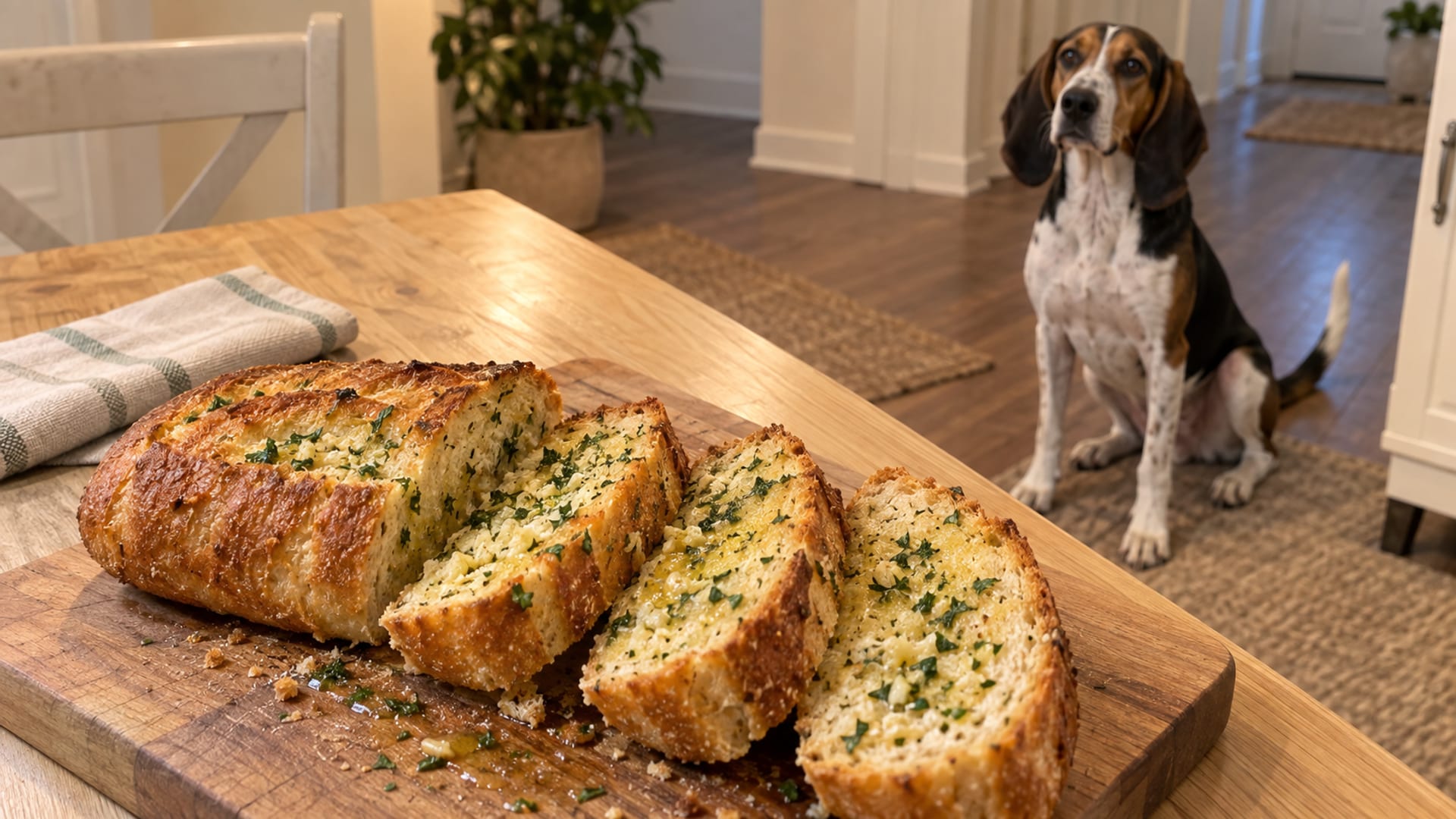
Dogs shouldn't eat garlic bread, even as a small shared bite. Garlic can still damage a dog's red blood cells after it has been baked, and the garlic powder in many recipes is a concentrated form. If your dog already ate some, gather what it was and roughly how much, then call your vet or a pet poison line now instead of waiting to see what happens, because the anemia garlic causes can take days to appear.
A dog who pulled a garlic knot off the counter usually looks normal an hour later, and with garlic the first evening doesn't tell you much. The garlic is the main concern, followed by the butter, oil, cheese and salt that come with it.
Key takeaways
Tap a card to bring it forward.
- Garlic bread stays off the menu for dogs. Heat doesn't make the garlic safe, and powdered garlic packs more garlic into less food.
- If your dog ate some, gather the package or recipe, the amount, the time and your dog's weight, then call your vet or a pet poison line.
- Signs of anemia commonly show up 3 to 5 days later, so a dog who seems fine tonight still needs watching.
- Small dogs, and Japanese breeds such as Akitas and Shiba Inus, are more sensitive to garlic.
- Plain bread with no garlic, onion or other risky ingredients is a different food with a different answer.
What to do if your dog ate garlic bread
The ASPCA and Pet Poison Helpline both tell owners to contact a veterinarian or poison-control service promptly when a pet eats something potentially toxic. These steps get you ready for that call.
- Put the rest of the bread out of reach. A dog who got one slice will often go back for the basket, and every extra piece adds garlic.
- Find the package, the menu item or the recipe. The ingredients tell the vet whether there was fresh garlic, garlic powder, garlic salt or onion.
- Work out how much your dog ate and when. "Half a garlic knot, right after dinner" helps far more than "some bread," even if part of it is a guess.
- Have your dog's weight handy. The same piece of bread is a bigger dose per pound for a small dog than for a large one.
- Call your vet or a pet poison line now. The Merck Veterinary Manual notes that a vet may consider early steps to clear the stomach plus supportive care, depending on the exposure, and those options exist only early on.
- Follow the advice you get and keep watching for several days. The signs that matter most can arrive days later.
If this were my dog, I'd make the call tonight rather than wait for morning.
Which kinds of garlic bread cause the problem
Every common version carries the same core risk, because garlic doesn't lose its effect in the oven. Merck describes garlic poisoning in animals after raw, cooked, dehydrated and granulated garlic, and a review of household foods in the Journal of Veterinary Medical Science found that cooking, drying and processing don't remove the toxic effect.
Tap or hover a row to highlight it.
| Form | What makes it a concern |
|---|---|
| FormHomemade garlic bread with fresh or roasted garlic | What makes it a concernBaked garlic keeps its toxic effect |
| FormFrozen or store-bought garlic bread, Texas toast | What makes it a concernMay use garlic powder, a concentrated form, plus butter or oil and salt |
| FormRestaurant garlic bread and breadsticks | What makes it a concernRecipe unknown; may include garlic powder, onion, butter or cheese |
| FormGarlic knots and garlic rolls | What makes it a concernMay be coated in garlic butter or garlic oil |
| FormCheesy garlic bread | What makes it a concernGarlic plus extra fat from the cheese |
| FormBread with garlic salt | What makes it a concernGarlic plus added sodium |
| FormRaw garlic bread dough | What makes it a concernGarlic plus a separate dough hazard |
| FormPlain bread with no garlic | What makes it a concernThe garlic risk doesn't apply; this is a different food |
The extras matter too. Fat from butter, oil or cheese can upset a dog's stomach and may contribute to pancreatitis in dogs prone to it, according to Merck. A large amount of salty bread adds too much sodium. If the recipe also used onions, chives or leeks, those add more of the same family of toxins, so mention them on the call. Raw dough is its own problem: Merck lists bread dough as a food hazard because yeast dough can keep expanding and fermenting inside a dog, producing alcohol and gas.
How much garlic bread is too much
Nobody can promise a safe number of slices. None of these published figures was measured on garlic bread, and they don't agree with each other.
Tap or hover a row to highlight it.
| Figure | Source | What it means for your dog |
|---|---|---|
| Figure15 to 30 g/kg of raw onion caused clinical signs in dogs | SourceMerck Veterinary Manual | What it means for your dogThis is onion; Merck adds that garlic is roughly 3 to 5 times more toxic, with no set garlic bread figure |
| FigureAbout 5 g/kg of fresh garlic reported as a toxic dose | SourcePublished case report and review literature | What it means for your dogAn approximate number for fresh garlic, with no clean line for powder, bread or repeat meals |
| FigureGarlic extract equal to 5 g/kg of whole garlic, daily for 7 days, in 4 dogs | SourceYamato et al. | What it means for your dogNone of those dogs developed hemolytic anemia, which is why one number can't predict one dog |
A published case report of a fatal garlic poisoning in a dog cites roughly 5 g/kg of fresh garlic as an estimate, while a small study by Yamato and colleagues gave four dogs that much every day for a week without causing anemia.
The AKC says a small slice of Texas toast is unlikely to reach a toxic level, and it still advises calling a vet after a dog eats garlic bread. A nibble is less worrying than a whole loaf, and either one is worth a phone call. Call right away if the amount is more than a trace, you don't know the amount, the product used garlic powder, your dog is small, or this has happened more than once.
Signs to watch for over the next several days
Garlic tends to cause trouble in two waves, and the second is easy to miss.
The first wave comes within hours. Merck lists vomiting, diarrhea, belly discomfort and a drop in appetite.
The second wave is the red blood cell damage. It can begin within 24 hours, and Merck says the anemia commonly becomes visible 3 to 5 days after the meal, sometimes over a longer window. Watch for:
- tiredness, weakness or a dog who won't finish a normal walk
- pale or yellow gums
- fast breathing or a racing heartbeat
- dark or bloody urine
- wobbling, collapse or bluish gums
The ASPCA and the AKC list the same kinds of signs, and any of them means calling your vet urgently, even if you already spoke to someone the first night. Look at your dog's gums in good light tonight so you have something to compare with later.
At the serious end, Merck describes severe anemia, kidney injury, collapse and death, which is why vets would rather hear from you early.
My dog ate garlic bread before and was fine
Plenty of people have a story like this, and I believe it: a dog cleaned up the garlic bread at a family dinner and nothing came of it. That happened in that case, but it doesn't set a rule for the next dog or the next loaf.
The amount is the big one. A thin smear of garlic butter on one slice can hold far less garlic than a heavily seasoned loaf. Size comes next, since the same slice is a much bigger dose for a small dog. The form matters as well: Pet Poison Helpline points out that dried and powdered garlic are more concentrated than fresh.
Then there's the dog itself. Pet Poison Helpline and the AKC note that Akitas, Shiba Inus and other Japanese breeds are more sensitive to this kind of damage, and the AKC adds that dogs with existing anemia or liver disease may be at higher risk. Timing plays a part, too. Because anemia tends to show up days later, an owner might never connect a tired, pale dog on Thursday with the bread on Sunday. This time gets judged on its own amount, its own recipe and its own dog.
Garlic knots, Texas toast and other names to check
Garlic hides under a lot of labels, and the ingredient list is what tells you what your dog actually ate.
- Garlic salt is garlic mixed with salt, so treat it as a garlic product.
- "Garlic flavor," "natural garlic flavor" and seasoning blends may contain garlic powder, onion powder or concentrated extracts.
- Garlic butter and garlic oil carry garlic plus a lot of fat, on bread, pasta or vegetables.
- Garlic naan, garlic rolls and garlic pizza crust belong in the same group as garlic bread.
- Brand names such as Texas Toast, New York Bakery, Pepperidge Farm, Domino's or Pizza Hut garlic bread don't tell you the recipe, because recipes change. Read the current label or ask the restaurant.
- Garlic mustard, garlic chives and wild garlic are different plants from culinary garlic, so confirm which one it was and give the vet the exact name.
Check what you learned
Three quick questions on the points that matter most tonight.
Quick check
Questions about dogs and garlic bread
These tend to come up once the first worry settles.
Why does garlic hurt a dog's red blood cells?
Garlic contains sulfur compounds, including one called N-propyl disulfide, that damage red blood cells through oxidation, according to the ASPCA. The damaged cells form clumps called Heinz bodies and break apart early, leaving the dog short on blood that carries oxygen.
Can my cat get sick from garlic bread too?
Yes, and cats are more susceptible to garlic than dogs, according to Merck. Raw, cooked, dried and granulated garlic can all cause the same kind of anemia in cats, so call your vet if a cat ate some.
My puppy ate garlic bread. Is that handled differently?
Handle it the same way: gather the details and call. A puppy's small body means the same bite is a bigger dose per pound, which is one more reason not to wait. Tell the vet the puppy's age and current weight.
Can I bake my dog a garlic-free version?
Plain, fully baked bread with no garlic, onion, unsafe sweeteners or heavy seasoning doesn't carry the garlic risk, according to the AKC. That still isn't a reason to make bread a regular part of your dog's diet, and raw dough stays off limits.
Sources
Checked September 25, 2026.
- ASPCA Animal Poison Control Center, Toxic and Non-toxic Plants: Garlic
- Merck Veterinary Manual, Garlic and Onion (Allium spp) Toxicosis in Animals
- Pet Poison Helpline, Garlic Is Toxic To Dogs
- American Kennel Club, Can Dogs Eat Garlic?
- American Kennel Club, Can Dogs Eat Bread?
- Journal of Veterinary Medical Science, Household Food Items Toxic to Dogs and Cats
- PubMed Central, Fatal Garlic (Allium sativum) Toxicosis in a Dog: Gross and Histopathological Findings in a Rare Case of Systemic Hemolytic Injury
- Journal of Veterinary Medical Science, Hematologic changes associated with the appearance of eccentrocytes after intragastric administration of garlic extract to dogs