

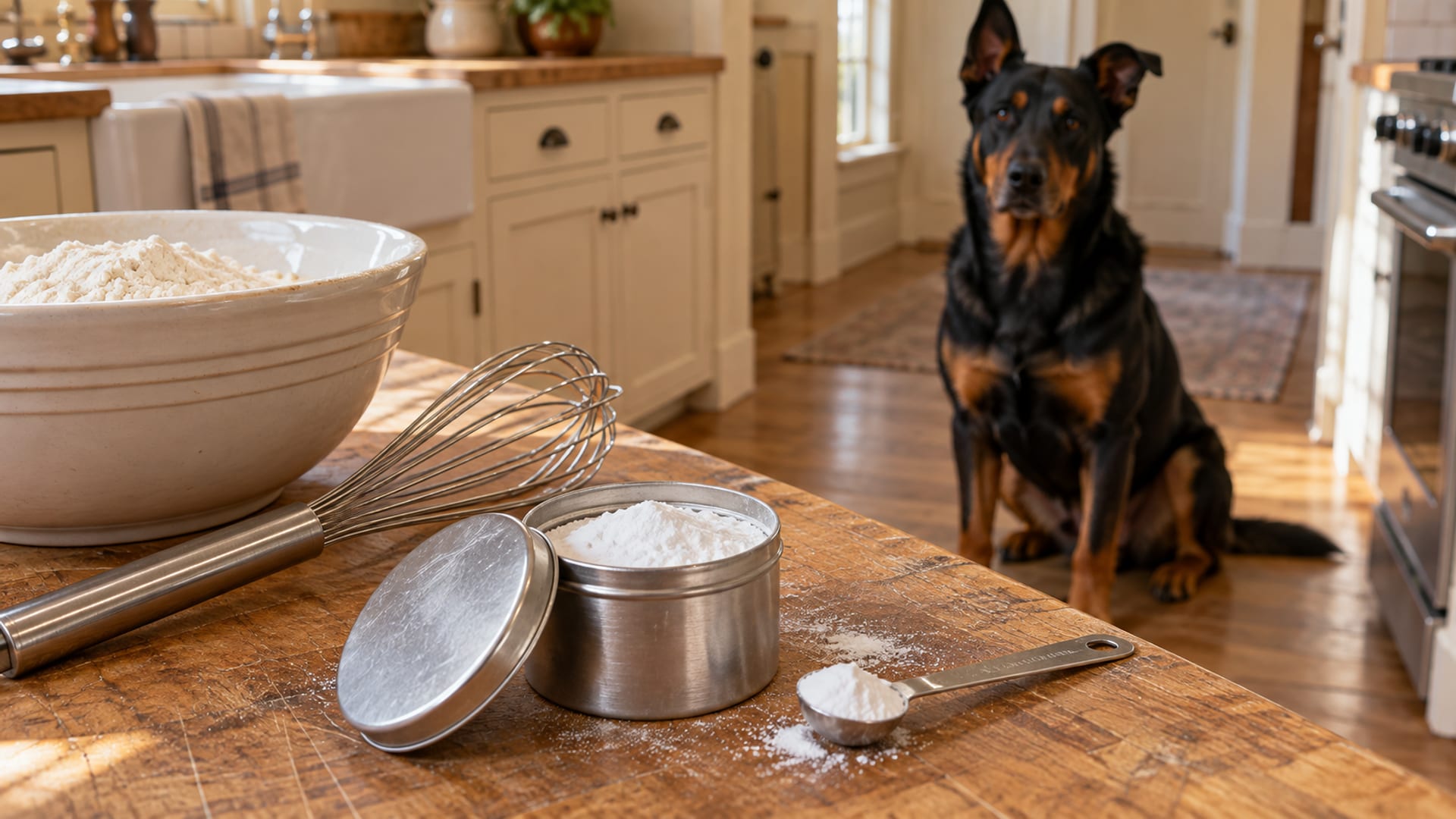
Toxic. Call your vet, an emergency vet or a pet poison line now if your dog ate any measurable or unknown amount of cream of tartar, any dough that contains it, or shows any sign of illness, and make that call even if your dog looks completely normal. Vomiting in the reported dogs began within 1 to 2 hours, and kidney injury showed up later, so waiting to see what happens is not the plan.
Cream of tartar is potassium bitartrate, the white baking ingredient found in recipes for meringue and snickerdoodles. A 2022 veterinary case series describes dogs that vomited and developed acute kidney injury after eating it, including one that died after homemade play dough. A tiny lick from a counter is a different exposure from teaspoons of powder, and the steps below cover both.
Key takeaways
Tap a card to bring it forward.
- Cream of tartar is potassium bitartrate, and dogs should not be fed it on purpose.
- Canine case reports link larger amounts to vomiting within 1 to 2 hours and kidney injury that shows up later.
- Homemade play dough and salt dough deserve their own call, because they can hold cream of tartar, a lot of salt, and a lump that can block the gut.
- Call for any measurable or unknown amount, any dough, or any sign, and do not wait for signs to start.
- A trace licked off a baking surface is less worrying than teaspoons of powder, but a vet or poison line makes that judgment.
What to do right now if your dog ate cream of tartar
Work through these in order. Each step has its reason, and the first one is the one that matters most.
- Call your vet, an emergency vet or a poison line right away. The 2022 veterinary case series reports vomiting within 1 to 2 hours and severe kidney injury documented around 30 hours after exposure, so the early hours can look deceptively fine. Pet Poison Helpline directs owners to veterinary professionals for poisoning concerns.
- Take away the rest and keep your dog from licking more. Whatever is left on the counter, the floor or the bowl is an amount you can still stop from growing.
- Have the details ready. Know the product (pure powder, a baking mix, or a dough recipe), about how much your dog ate, whether it was dry powder, dough or a finished baked food, what time it happened and how much your dog weighs. The vet works from the dose per kilogram of body weight, so the weight matters as much as the amount.
- Skip home remedies and medication unless the vet or poison line tells you to. The case series describes hospital care, with lab monitoring, intravenous fluids and treatment of complications, and it gives owners no home protocol.
- Go to an emergency clinic right away for certain signs. Those are repeated vomiting, weakness, staggering, tremors, seizures, excessive thirst or reduced urination.
If your dog only licked a trace from a baking surface and you are unsure how much that was, still call. It costs a few minutes, and the person on the line can tell you whether your dog's weight and the product make it a watch-at-home situation.
Which forms of cream of tartar are a problem
Cream of tartar is an ingredient, so the form it arrives in matters. This table sorts the ones people ask about.
Tap or hover a row to highlight it.
| Form | Why it matters | What to do |
|---|---|---|
| FormDry powder, straight from the tin | Why it mattersIt is potassium bitartrate, the form in the canine case reports | What to doCall for any measurable or unknown amount |
| FormHomemade play dough or salt dough | Why it mattersCan hold cream of tartar plus a lot of salt, and swallowed dough can block the gut | What to doCall right away, every time |
| FormBaked food with a little cream of tartar | Why it mattersLikely a lower exposure than eating the powder | What to doDo not share it; call if your dog ate a lot or you are unsure |
| FormBaking powder or baking mix | Why it mattersVaries by product; may contain cream of tartar or other acid salts, sodium bicarbonate, starch and salt | What to doKeep the label and call with it |
| FormA trace licked off a counter or spoon | Why it mattersLess concerning than teaspoons of powder | What to doCall if you cannot judge the amount or your dog shows signs |
Homemade dough is the form I'd never treat as routine. PetMD explains that homemade recipes differ from store-bought dough, that cream of tartar may add a kidney-injury risk, that the salt can push sodium to dangerous levels, and that the dough can cause stomach and bowel trouble on its own. Because recipes vary, no single amount applies to every batch, so the call is the answer.
How much is a concern
A small, mild exposure might cause no signs, yet the absence of early signs does not show that a larger amount is safe. No amount of cream of tartar has been established as a safe serving for a dog, so the only rule I can give you is to call for any measurable or unknown amount, and to give the vet your dog's weight and your best guess at the amount.
The two dogs in the published case series show how different the outcomes can be.
Tap or hover a row to highlight it.
| Dog | Amount and form | What happened |
|---|---|---|
| Dog28 kg mixed-breed dog | Amount and form13.52 g, about 483 mg/kg, in homemade play dough | What happenedVomiting within 1 to 2 hours, severe illness, seizures, euthanized about 96 hours after eating it |
| Dog9.6 kg miniature dachshund | Amount and form6.76 g, about 704 mg/kg, of potassium bitartrate | What happenedVomiting within 1 to 2 hours, acute kidney injury, hospitalization |
Both rows come from the 2022 veterinary case series. They are two exposures, so they do not mark a line between safe and dangerous for your dog. The amount, the recipe and the individual dog all change the outcome, and the smaller dog became seriously ill at a higher dose per kilogram. If you cannot say how much was eaten, treat it as an unknown amount and call.
Signs to watch for and when they show up
Reported signs include vomiting, weakness, staggering, kidney injury with raised creatinine and BUN on blood work, seizures and death, all from the 2022 veterinary case series. The timing is the part to keep in mind:
- Vomiting began within 1 to 2 hours in the reported dogs, and in one case it continued about every 30 minutes for 12 hours.
- Severe kidney injury was documented around 30 hours after exposure.
- One dog developed seizures and was euthanized about 96 hours after eating the dough.
At home, also watch for excessive thirst and for your dog peeing less than usual. Any of these means calling your vet right away, and vomiting, weakness, staggering, tremors or seizures means the emergency clinic.
The worst realistic outcome is acute kidney failure with neurologic complications and death. That is why the plan is to call early, while a vet can still check your dog and start care before the kidneys are hurt.
My dog ate it before and was fine
I hear this one often, and I believe it. Dogs do lick a spilled spoonful off a counter or snag a cookie and have nothing happen. That happened, in that dog, on that day.
It still is not a rule for the next dog, and the reasons are concrete. The amount may have been far smaller than in the published cases. Body weight changes the dose per kilogram, so the same spoonful is a larger dose for a small dog. The recipe changes how much cream of tartar was actually in what was eaten. Individual sensitivity can vary, and the same inconsistency between dogs is noted for grapes and raisins. Signs can also begin with vomiting while kidney injury becomes clear later, so a dog that seems fine on day one has not finished the story. And sometimes the "tartar" was something else, such as dental calculus or a different product, which is worth checking before anyone compares dogs.
Look-alikes and similar names
A few names get mixed up with cream of tartar, and the difference changes what you do.
Cream of tartar, potassium hydrogen tartrate and potassium acid tartrate are the same culinary compound, potassium bitartrate, according to the USDA National Organic Program. In people, very large ingestions have caused vomiting and dangerously high potassium, as a case report in emergency medicine describes.
Tartaric acid is a related acid, and it is a different substance from potassium bitartrate. The 2022 case series proposes tartaric acid as the toxic principle in grapes and raisins, and tamarinds have also been tied to kidney injury in dogs. If your dog ate grapes, raisins or tamarind instead, use those pages and call your vet the same way.
Baking powder is a separate product that may contain an acid component plus sodium bicarbonate, and formulas vary. Dental tartar is hardened plaque on teeth and has nothing to do with the kitchen ingredient. Tartar sauce is a condiment; its ingredients can include mayonnaise, salt, onion and garlic, so if your dog got into it, see our entries on onions and garlic.
Check what you learned
Three questions on the parts that matter most.
Quick check
Questions about dogs and cream of tartar
Can my dog have a cookie made with cream of tartar, like a snickerdoodle?
Baked food with a small amount of cream of tartar is likely a lower exposure than the powder, but there is no established safe serving for a dog. Keep them for people. If your dog ate a batch or several cookies, call your vet with the ingredient list. Our cookies entry covers the rest of the recipe.
What will the vet do if I bring my dog in?
The case series describes a physical exam, blood work to monitor the kidneys, intravenous fluids and treatment of complications as they arise. Bring the tin, the recipe or a photo of the label, and your dog's weight. That lets the team work from the real dose.
Is cream of tartar dangerous for cats in the house?
The published case reports concern dogs, and cats should not be given cream of tartar on purpose. If a cat ate some, describe the amount to your vet or a poison service and follow their advice.
Can I use cream of tartar to clean my dog's teeth?
Culinary cream of tartar is not a dental product for dogs, so keep it off your dog's teeth. Dental tartar is a buildup of hardened plaque that your vet can check and treat. Ask your vet about a toothpaste made for dogs.
Sources
Checked September 30, 2026.
- Journal of Veterinary Emergency and Critical Care, Acute kidney injury in dogs following ingestion of cream of tartar and tamarinds and the connection to tartaric acid as the proposed toxic principle in grapes and raisins
- Case Reports in Emergency Medicine, Life-Threatening Hyperkalemia from Cream of Tartar Ingestion
- PetMD, Is Playdough Toxic to Dogs?
- Pet Poison Helpline, Pet Poison Helpline
- USDA National Organic Program, Potassium Acid Tartrate Technical Evaluation Report