

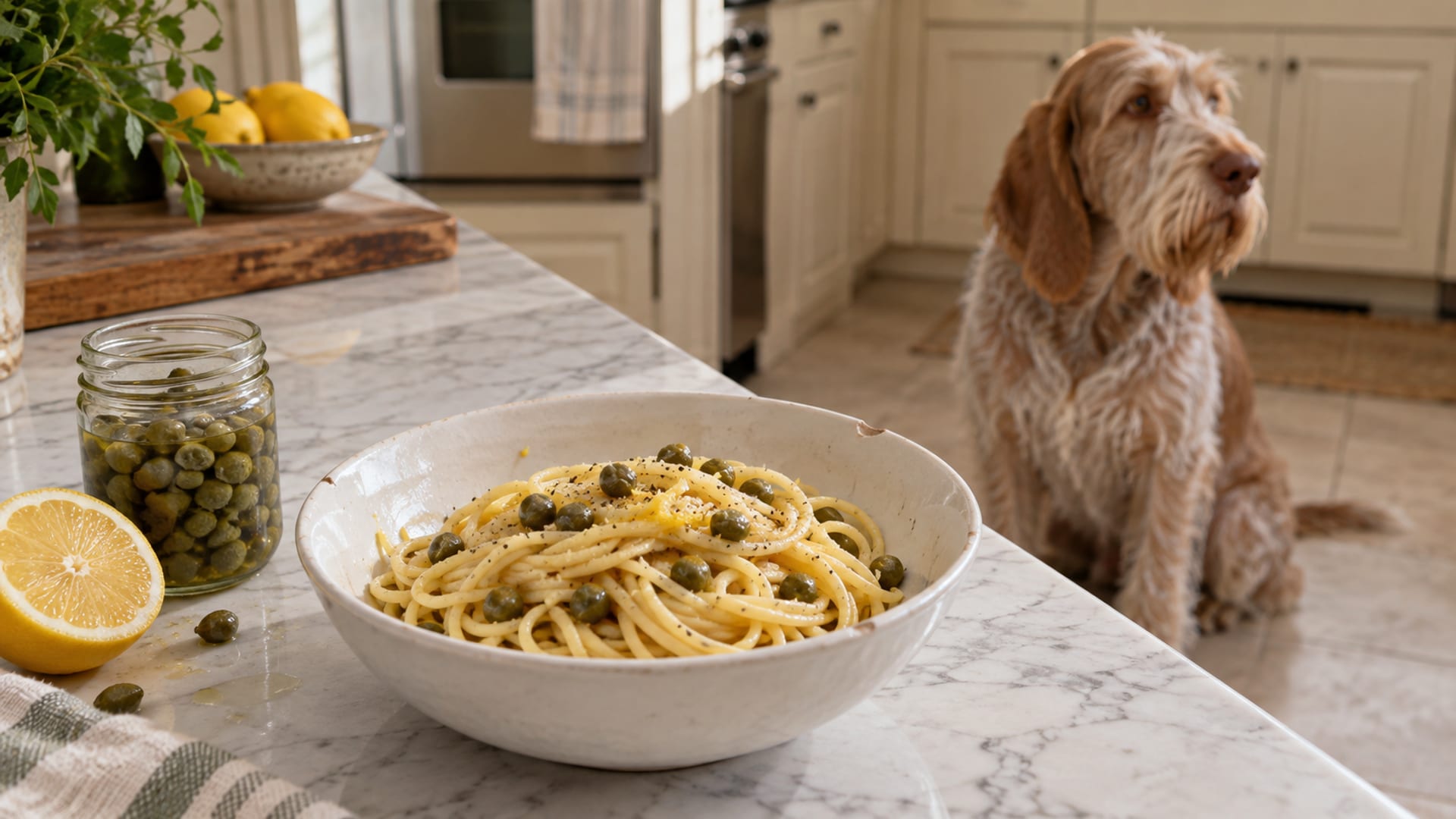
Yes. A caper or two is unlikely to hurt a dog that has fresh water nearby; the salt they're packed in is what deserves your attention. Brine, a big pile of capers, or a sauce with other ingredients changes the answer far more than the little green bud does.
If your dog just snapped one up off the cutting board, set out a bowl of fresh water first. Then look at the jar or the recipe: how many capers went missing, whether they were brined or salt-packed, and what else was on the plate. A call to your vet makes sense for a lot of capers, any brine, a dish with onion, garlic or alcohol, or any change in how your dog is acting.
Key takeaways
Tap a card to bring it forward.
- A caper or two from the caper bush, *Capparis spinosa*, is unlikely to harm a healthy dog with water available.
- Salt is the main concern. Brine, salt-packed capers and caper powder carry far more of it than one rinsed bud.
- Caper sauces, tapenade and puttanesca can hold onion, garlic, alcohol or heavy oil, and those matter more than the capers.
- Call your vet for a large or unknown amount, any brine, a mixed dish, or signs like vomiting, tremors or wobbling.
- If you share one, keep it a rare, rinsed, plain caper.
What to do if your dog just ate capers
Most of the time this ends with a drink of water and a normal evening. These steps help you tell which kind of day yours is.
- Set out fresh water right away. The Merck Veterinary Manual explains that salt poisoning in dogs is much more likely when a dog can't get enough water, so a full bowl is the first thing working in your dog's favor.
- Count what's missing and keep the jar. Whoever you call will want to know how many capers, what form they came in and roughly when, and the label tells you whether they were packed in brine, dry salt or oil.
- Check the recipe or the ingredient list. A caper that rolled off a plate of pasta or fish may have brought onion, garlic, wine or a lot of oil with it, and the ASPCA's people foods page treats those ingredients as hazards of their own.
- Call your vet if it was a lot, any brine, a mixed dish, or you can't tell. The ASPCA advises calling after a possibly harmful ingestion even when the dog seems fine, instead of waiting for signs to get worse.
- Hold off on home remedies and on trying to make your dog throw up. Pet Poison Helpline asks owners to wait for a vet or the helpline to direct either one, since the right move depends on your dog and what was eaten.
- Check on your dog through the rest of the day. Salt-related vomiting can start within several hours, according to Merck, so a dog that looks fine ten minutes later still deserves a few check-ins.
Size counts too. A small dog reaches a risky amount of salt per pound with far less than a large dog, and a dog with kidney disease or another condition that affects water and salt balance is a reason to call sooner.
Which caper forms are fine and which to skip
Capers come in a handful of forms, and the main difference between them is how much salt comes along for the ride. A PubMed review of the different parts of the caper plant describes capers as the unopened flower buds and caper berries as the fruit, and notes that both are usually served marinated in vinegar, brine or oil.
Tap or hover a row to highlight it.
| Form | What it is | What to know |
|---|---|---|
| FormBrined or pickled capers | What it isBuds in a salty vinegar liquid | What to knowOne or two are low risk; rinse before sharing |
| FormSalt-packed capers | What it isBuds packed in dry salt | What to knowHeavy salt on the outside; rinse well or skip |
| FormDried capers or caper powder | What it isBuds dried, sometimes ground | What to knowMore concentrated by weight and often salty; not for regular feeding |
| FormCaper berries | What it isThe fruit of the same bush | What to knowSame salt concern when pickled; a large piece can be a choking or blockage risk |
| FormCaper brine or caper juice | What it isThe liquid in the jar | What to knowTreat it as a salt exposure, not a drink |
| FormCaper sauce, aioli, tapenade, puttanesca | What it isMixed products | What to knowCheck the label for onion, garlic, alcohol and oil |
| FormLeaves, stems, roots, extracts | What it isOther plant parts and supplements | What to knowNot the same as the food; leave them out |
The ASPCA's list of plants for dogs doesn't include the caper bush among its toxic plants. A 2021 study in Food and Chemical Toxicology tested leaf, stem and root extracts on cells in a lab, not on dogs, so leave those parts and caper supplements out.
For the salt itself, Merck puts the start of signs in dogs at about 2 to 3 grams of salt per kilogram of body weight, with about 4 grams per kilogram as the acute lethal dose. Those figures are for salt, not capers, and brands vary so much in saltiness that the label and the amount eaten tell your vet more than any caper count.
How to share a caper if you want to
A caper adds nothing your dog's regular food doesn't already cover, so if you share one, keep it small and plain.
Pick a single bud from the jar and rinse it under the tap to wash off the brine or the salt crust. Offer it on its own, not out of a sauce. I'd keep it a once-in-a-while taste, never a regular treat.
Leave out the brine, dried caper powder, caper supplements and any prepared product with onion, garlic, alcohol or ingredients you can't identify. If your dog is on a low-salt diet or has kidney trouble, ask your vet before offering even one.
Signs to watch for over the next several hours
After a few plain capers you likely won't see anything. The signs below come with too much salt, and they are your cue to call.
The Merck Veterinary Manual describes vomiting within several hours of a large salt intake, followed by weakness, diarrhea, muscle tremors and seizures. Some dogs also show unusual thirst, belly discomfort, circling, trouble seeing, or weakness in part of the body.
Call right away for any of these:
- Vomiting or diarrhea
- Weakness, trembling or muscle tremors
- Drinking far more than usual
- Stumbling, wobbling or walking in circles
- Seizures, collapse, trouble breathing, or not responding to you
A mild stomach upset from a few capers may settle on its own. A large salt dose is another matter: Merck lists seizures, brain injury, coma and death as the worst outcomes from serious salt poisoning.
My dog ate capers before and was fine
Plenty of people have a story like this: a dog who cleaned up a dropped handful of capers, or lapped at spilled brine, and never showed a thing. That happened, and it was real for that dog on that day, but it isn't a rule for every dog or every jar.
A few things could have been on that dog's side. The amount may have been small compared with the dog's body weight. It may have been a couple of buds instead of brine, powder or a heavily salted batch. The dog may have had water close by, which Merck's pet owner page on salt poisoning names as a big part of whether salt causes trouble. The product may have been less salty than it looked, and every dog's health is different.
Timing matters too. The ASPCA warns that some poisoning effects can be delayed, so a dog who looks fine right after eating something may not be in the clear yet.
Capers in sauces, jars and houseplant names
The word "caper" turns up in plenty of places, and not all of them mean a single bud.
Sauces and spreads. Caper sauce, caper aioli, tapenade and puttanesca are mixed products, and they may carry onion, garlic, alcohol or a lot of oil. Tapenade usually brings olives along too, so check that entry for the brine and pit questions. A dish cooked with wine, like chicken piccata, is worth a look at our alcohol entry.
Jars and labels. Brined, pickled, salt-packed, nonpareil, dried and powdered capers all come from the same bush, but the salt level changes from one to the next, and the label tells you which one your dog ate. If the dish also had anchovies or was a tuna or pasta salad, read the whole ingredient list.
Caper berries. These are the fruit of the plant, bigger than the buds. They carry the same salt concern when pickled, and a large one gulped whole can be a choking or blockage risk.
The houseplant mix-up. Ripple peperomia, *Peperomia caperata*, is a common houseplant with "caper" in its scientific name, and it's a different plant from the caper bush. The ASPCA plant list files it separately, under the name Silver Heart, so if your dog chewed a potted plant, look it up there by its own name.
Check what you learned
These three questions cover what matters most if your dog gets into capers again.
Quick check
Questions about dogs and capers
These cover a few situations the sections above don't reach.
Can puppies or small dogs have capers?
Size matters more than age here. A small dog or puppy reaches a risky level of salt with less than a large dog would, so a handful of capers is a bigger deal for a 5-pound puppy. If a small dog ate more than one or two, or any brine, call your vet with the jar in hand.
My dog ate a whole jar of capers. What now?
Set out water, keep the jar, and call your vet now instead of waiting for signs. Your vet can work out the risk from your dog's weight and the salt on the label.
Are capers safe for cats too?
Cats face the same salt risk, and Merck describes salt poisoning in cats as well as dogs. Don't assume a small amount is fine for a cat because it's usually fine for a dog. Ask your vet about your cat on its own terms.
Do capers have any health benefit for dogs?
The caper plant has been studied for its plant compounds, but that work used extracts in the lab, not dogs eating capers. A caper adds salt and flavor, not nutrition your dog needs. Regular dog food and plain treats cover that.
Sources
Checked September 25, 2026.
- Merck Veterinary Manual, Salt Toxicosis in Animals
- Merck Veterinary Manual, Salt Poisoning
- ASPCA, Toxic and Non-Toxic Plants List, Dogs
- ASPCA, People Foods
- ASPCA, What to Do if Your Pet Is Poisoned
- ASPCA, My Pet Ate Something! When Should I Seek Help?
- Pet Poison Helpline, 24/7 Animal Poison Control Center
- PubMed, The Current State of Knowledge about the Biological Activity of Different Parts of Capers
- Food and Chemical Toxicology, Investigation into the biological properties, secondary metabolites composition, and toxicity of aerial and root parts of Capparis spinosa L.