
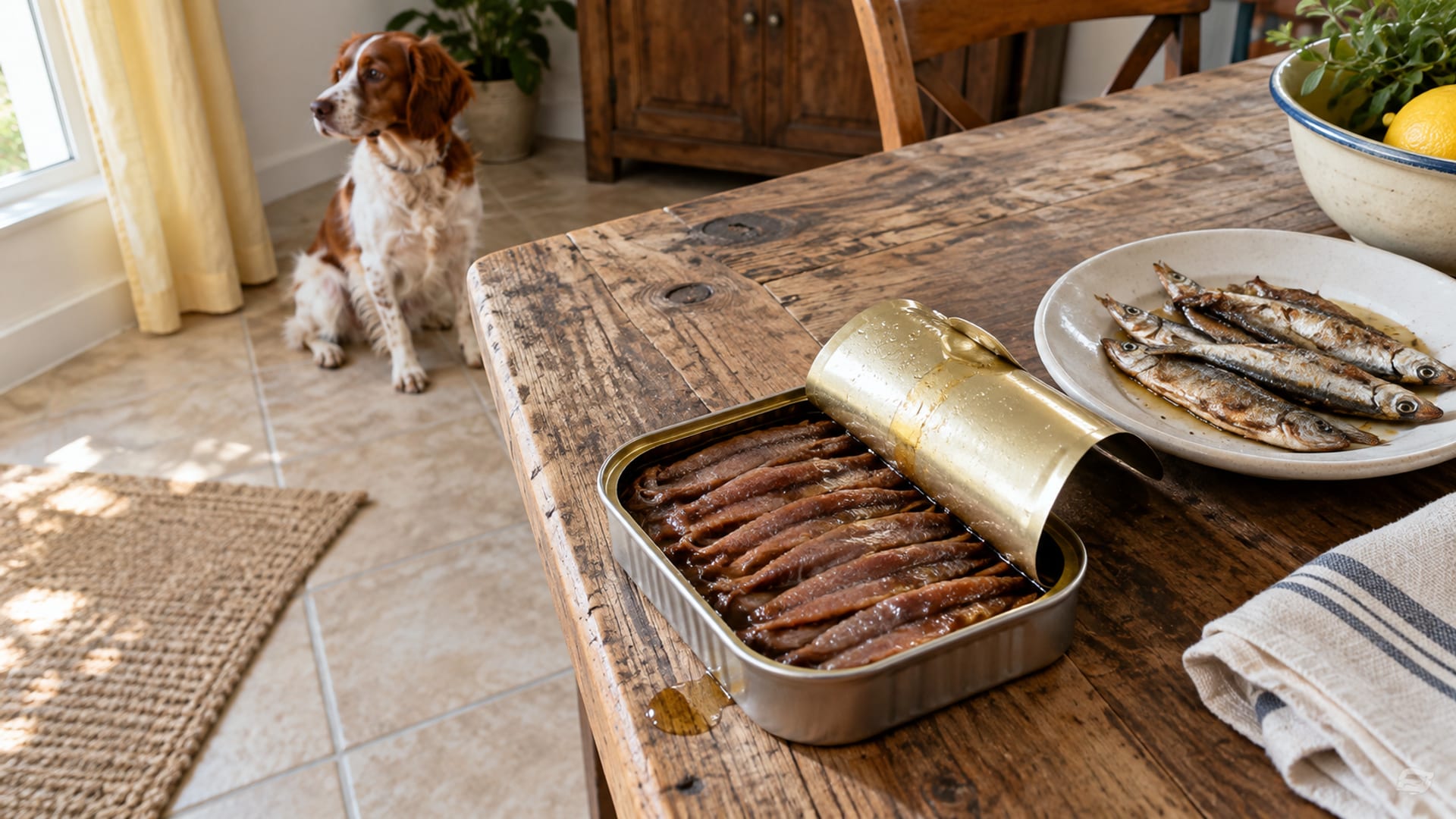
A small piece of plain, fully cooked anchovy with the bones out and no added salt is fine for most dogs. Most store-bought anchovies are another story: salt-packed, canned, dried, brined and paste products can carry enough salt to make a dog sick, and a small dog gets sick from less. If your dog just pulled anchovies off a pizza or got into an open tin, find out what the product was and roughly how much went down, put out fresh water, and hold on to the tin or tube for the call to your vet.
Key takeaways
Tap a card to bring it forward.
- Plain, fully cooked, deboned anchovy with no added salt is low concern in a small piece.
- Salt is the main risk in canned, salt-packed, dried, brined and paste anchovies, and a small dog gets a bigger dose from the same bite.
- Call your vet or a pet poison line for a large or unknown amount of salty product, a dog that drank the brine or oil, or any vomiting, heavy thirst, stumbling or tremors.
- Never give salt or salt water to get a dog to vomit.
- Pizza, Caesar dressing and some pastes can also contain garlic or onion, which are a separate problem.
If your dog just ate anchovies, do this now
Most of what decides how worried to be is sitting next to the empty tin. Work through these in order.
- Check what the product was. Plain cooked fish, oil-packed fillets, salt-packed fillets, dried fish and paste hold very different amounts of salt, and the label tells you which you have.
- Estimate how much, and when. Count the missing fillets or check the tube; the amount and the time are the first things a vet will ask.
- Find out whether the brine or oil went too. A dog that licked the tin clean took in the salty liquid along with the fish, and oil brings its own stomach upset.
- Put out fresh water and let your dog drink. The Merck Veterinary Manual notes that salt poisoning is unlikely when an animal has steady access to fresh drinking water, though that is no guarantee.
- Keep the tin, jar, tube or pizza box. The sodium line and the ingredient list show the vet how much salt your dog swallowed and whether garlic or onion came with it.
- Call when the risk points stack up. A large or unknown amount of salty anchovies or paste, a small dog or puppy, a dog with kidney or heart disease, a possible swallowed bone, or any sign of illness all mean calling your vet or a pet poison line now.
- Skip every home remedy for vomiting. Pet Poison Helpline warns that salt and salt water should never be used to bring up a meal because of the high risk of causing salt poisoning, and hydrogen peroxide or human medicine waits for a vet's go-ahead.
Which anchovy forms are low concern and which carry the salt
Between a plain cooked fish and a tube of concentrated paste, the big difference is salt. The FDA's fish and fishery products hazards guidance also lists parasites and other hazards for anchovy species, which is why raw fish lands in the caution column even with no salt added.
Tap or hover a row to highlight it.
| Form | Main concern | How it sits |
|---|---|---|
| FormPlain cooked flesh, bones out, no salt | Main concernVery little in a small piece | How it sitsLow concern as an occasional treat |
| FormCanned in oil | Main concernOften high in salt; oil adds fat and stomach upset | How it sitsCaution; read the sodium line |
| FormCanned in water | Main concernCan still hold a lot of added salt | How it sitsCaution; read the sodium line |
| FormSalt-packed, brined or marinated | Main concernSalt concentrated by the curing process | How it sitsAvoid |
| FormDried anchovies | Main concernDrying concentrates the salt | How it sitsAvoid |
| FormAnchovy paste | Main concernConcentrated fish, salt, oil, sometimes garlic or onion | How it sitsAvoid |
| FormRaw or fresh, uncooked | Main concernParasites and germs | How it sitsCook it first |
| FormPizza, Caesar dressing, pasta sauce, tapenade | Main concernSalt, fat, garlic, onion | How it sitsAvoid |
The tiny, soft bones in a small anchovy often pass without trouble, but larger or sharp ones, including the head, tail and fins, can cause choking, a cut mouth or a blockage in the gut, so pull them out wherever you can. Our Fish bones entry covers what to watch for. Anchovy powders and fish meal are concentrated, and their salt varies, so check the label before any of it goes in a bowl.
Sharing a plain piece, and how much salt becomes a problem
To share on purpose, the lowest-risk version is one you cook yourself: fresh anchovy, fully cooked, bones pulled, with no salt, brine, sauce, garlic, onion or heavy oil. Offer a bite-sized piece now and then, and keep your dog's regular food as the main meal. The AKC gives the same general advice for people food: plain, and in moderation. A dog on a low-sodium diet or with a history of pancreatitis is a poor fit for oily or salty fish, and whatever your vet has told you about that dog's diet comes first.
For the salty forms, the published toxic numbers are for salt itself, measured against your dog's body weight.
Tap or hover a row to highlight it.
| Amount of salt | What it means | Source |
|---|---|---|
| Amount of saltAbout 2 to 3 g per kg of body weight | What it meansSigns of salt poisoning can appear | SourceMerck Veterinary Manual |
| Amount of saltAbout 3.3 g per kg (1.5 g per lb) | What it meansListed as a toxic dose | SourcePet Poison Helpline |
| Amount of saltAbout 4 g per kg | What it meansAcute lethal dose by mouth | SourceMerck Veterinary Manual |
Those are grams of salt, not grams of anchovy. The Merck Veterinary Manual gives the 2 to 3 g/kg and 4 g/kg figures, and Pet Poison Helpline lists 1.5 g per pound. Salt content swings widely between a salt-packed fillet, a tin in oil and a tube of paste, so I would not try to turn those numbers into a count of fillets at home. Give the vet or poison line your dog's weight, the product name and the sodium figure from the label, and they can work it out for that exact product.
Because the dose is measured per kilogram, the same salty fillets hit a toy breed far harder than a large retriever, and a puppy gets a bigger dose from one bite than an adult. Dogs with kidney disease or a low-sodium diet have less room for a salty snack, too.
Signs to watch for over the next several hours
With too much salt, vomiting can start within several hours, according to the Merck Veterinary Manual. Signs can then move on to diarrhea, heavy thirst, weakness, stumbling, muscle tremors, confusion, seizures and collapse. Pet Poison Helpline lists the same stomach and nervous system signs. In the worst cases, Merck describes dangerously high blood sodium, brain swelling, coma and death, so any of these signs means calling right away.
With a swallowed bone, choking, repeated gagging, pawing at the mouth, belly pain, trouble swallowing or trouble breathing all need a vet now.
Raw fish can bring a slower problem. Merck's page on salmon poisoning disease describes signs about 7 days after a dog eats raw salmon or trout, and sometimes as late as 33 days. That timing is for salmon and not anchovies, but mention any raw fish to your vet if your dog gets sick days later.
If a few hours pass after a small amount and your dog is eating, drinking and acting normally, keep water out and keep an eye on them through the evening.
My dog ate anchovies before and was fine
That happens, and I believe it. Plenty of dogs have grabbed an anchovy off a plate and never had a bad moment. It just does not set a rule for the next time or the next dog, because what kept that dog safe can change. It may have eaten a small amount, or a lower-salt product. It may have been a bigger dog, so the dose per kilogram was lower. It may have eaten cooked fish instead of raw, skipped the brine, paste or seasoning, and had plenty of water nearby, which Merck links to a lower chance of salt poisoning. Dogs also differ, and some raw-fish illness shows up days later. The story you remember is real; the product, the amount and the dog in front of you today decide this one.
Pizza, Caesar dressing, paste and the names on the label
On a Pizza, they come with salty cheese, sauce and crust, and the sauce or toppings may include Garlic or Onions, which are toxic in their own right. Caesar dressing, tapenade, Worcestershire sauce and fish sauce are processed with salt and seasoning; mention them when you call. A product labeled "anchovy flavor" may contain no anchovy at all, or plenty of added salt.
"Anchovy" is a market name for many related fish, and the FDA's Seafood List includes the European, Northern, Japanese and Argentine anchovies plus the anchoveta, among others. In Spain, "boquerón" often means fresh or vinegar-marinated anchovy, while "anchoa" usually means the salted or oil-packed kind. Sardines are a different fish with their own labels, so read a sardine tin on its own terms. Whatever the name, the same details sort it out: how it was prepared, the sodium figure, and whether garlic or onion is on the ingredient list.
Check what you learned
Three questions on the parts that matter most.
Quick check
Questions about dogs and anchovies
A few more questions that come up after an anchovy run-in.
Are anchovies good for dogs?
The AKC notes that fish can supply fats and amino acids, and plain cooked anchovy fits that. A dog on a complete, balanced food does not need anchovies, though, so treat them as an occasional extra rather than a health step.
Can my cat have the leftover anchovies?
Treat the same salty products with the same caution for a cat. The Merck Veterinary Manual's salt poisoning page for pet owners covers both dogs and cats, and in both, treatment is handled by a vet with fluids given slowly.
What about anchovy oil or an anchovy supplement?
Anchovy oil adds fat, can upset the stomach, and some products contain flavoring or salt. For a supplement, read the whole ingredient list and check with your vet before giving one made for people.
My dog ate anchovies at the beach. Does that change anything?
It might. Pet Poison Helpline lists drinking too much ocean water as its own cause of salt poisoning in dogs. If your dog also gulped sea water, tell the vet about both, since the salt adds up.
Sources
Checked September 25, 2026.
- Merck Veterinary Manual, Salt Toxicosis in Animals
- Merck Veterinary Manual, Salt Poisoning
- Merck Veterinary Manual, Salmon Poisoning Disease in Dogs
- Pet Poison Helpline, Salt Is Toxic To Pets
- Pet Poison Helpline, Should You Give Salt to Your Dog
- Pet Poison Helpline, Summer Toxins To Pets
- FDA, Fish and Fishery Products Hazards and Controls Guidance
- FDA, The Seafood List, Engraulis encrasicolus
- AKC, People Foods Dogs Can and Can't Eat