
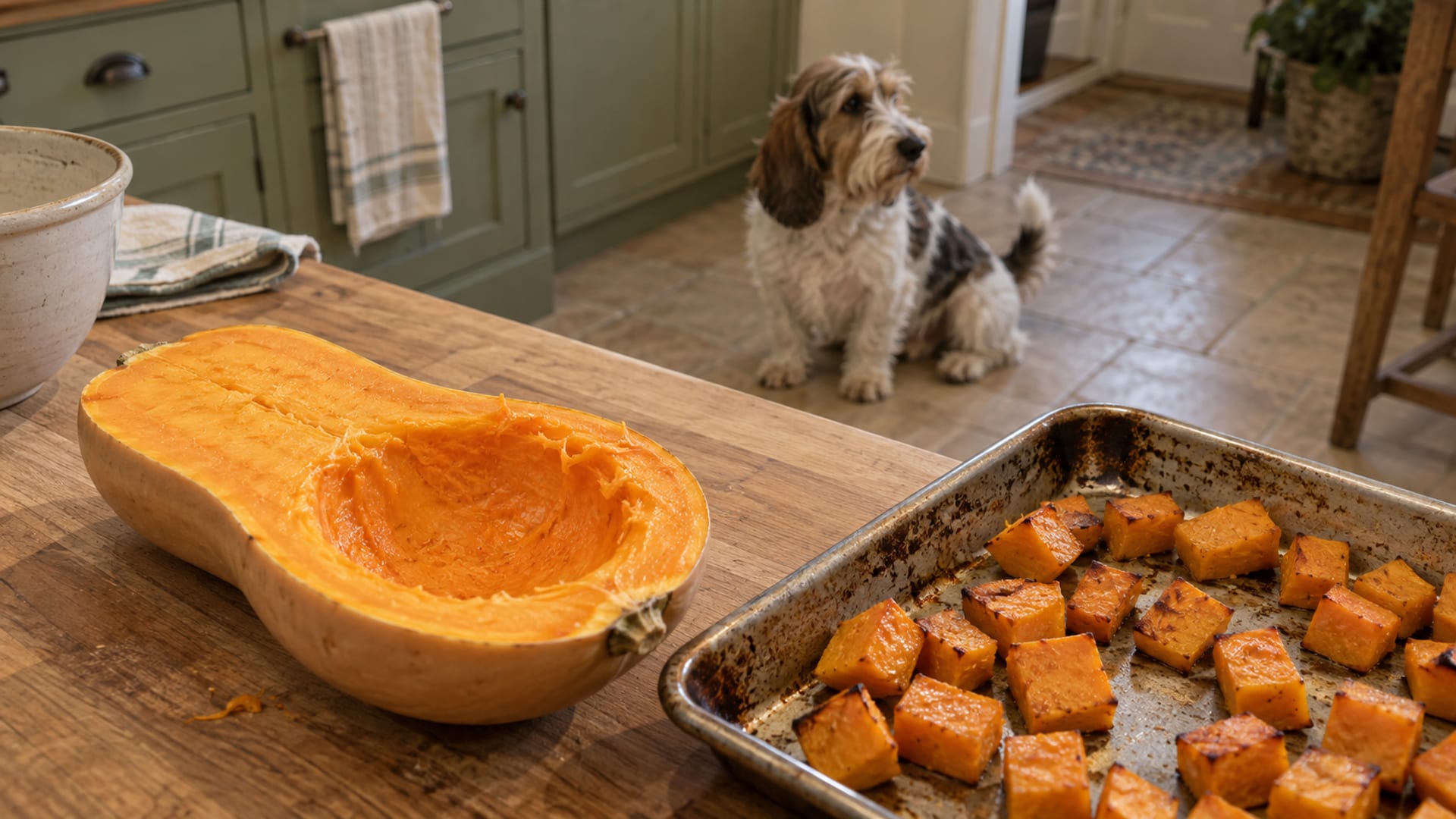
Yes. Plain butternut squash flesh is non-toxic to dogs, and you can share it in moderation as long as it's peeled, seeded and served without butter or seasoning, ideally steamed or roasted. If your dog already helped itself, what happens next depends on which part it got, what the squash was cooked with, and how much went down.
A plain roasted cube off the sheet pan usually just means watching your dog. Peel, seeds and big hard pieces can cause choking or get stuck in the gut, and soup or casserole made with onion, garlic, a lot of salt or xylitol deserves a phone call.
Key takeaways
Tap a card to bring it forward.
- The ASPCA lists butternut squash as non-toxic to dogs, so plain flesh is fine as an occasional extra.
- Peel it, scoop out the seeds and cut away the stem first; the hard parts are what cause choking and blockages.
- Plain steamed or roasted squash is the easiest form for dogs to digest, according to the AKC.
- Soups, casseroles, pie filling and seasoned sides can carry onion, garlic, salt, butter or xylitol, and those ingredients set the risk.
- Call your vet for repeated vomiting, gagging, trouble swallowing, belly pain or a dog that seems flat and tired.
What to do if your dog already ate butternut squash
Most squash grabs end with a dog that is fine. Work through these in order.
- Take the rest away. The first step in the ASPCA's advice for a suspected poisoning is to move your pet away and stop any more from being eaten, and less food in the dog means less to sort out.
- Work out which part it was. Plain flesh is the non-toxic part, while the rind and seeds are tough enough that Pet Poison Helpline and the AKC both say to remove them before feeding.
- Check what the squash was cooked with. Onion, garlic, leeks and chives can damage a dog's red blood cells, xylitol is toxic to dogs, heavy salt brings its own risk, and butter, oil or cream can upset the stomach or trigger pancreatitis.
- Estimate how much, and think about your dog's size. The same spoonful of a garlicky soup is a bigger dose for a small dog than for a large one.
- Call your vet or a pet poison line if the dish was seasoned with those ingredients, if you can't tell how much was eaten, or if your dog has any signs. The ASPCA says to call right away for a suspected toxic ingestion even when the dog looks normal, because some poisonings show up late. The numbers are on the card at the top of the page.
- Hold off on home remedies. Don't give medicine or home treatments unless a vet or a poison-control professional tells you to.
Which parts and forms of butternut squash are safe
The rind, the seeds and whatever went into the pot are what change the answer.
Tap or hover a row to highlight it.
| Part or form | Can your dog have it? | What to watch |
|---|---|---|
| Part or formPlain cooked flesh (steamed, roasted, mashed) | Can your dog have it?Yes, in moderation | What to watchNo butter, oil or seasoning |
| Part or formPlain raw flesh | Can your dog have it?Not toxic; cooked is easier to digest | What to watchHard raw chunks, piece size |
| Part or formSkin or rind | Can your dog have it?Remove it | What to watchTough; choking or blockage |
| Part or formSeeds | Can your dog have it?Remove them | What to watchChoking, hard to digest |
| Part or formStem and leaves | Can your dog have it?Don't feed them | What to watchTough plant material |
| Part or formPlain frozen pieces | Can your dog have it?Only if plain and cut small | What to watchSize and hardness |
| Part or formPuree, canned squash, baby food | Can your dog have it?Read the label first | What to watchOnion, garlic, salt, dairy, sweeteners |
| Part or formSoup, casserole, pie filling | Can your dog have it?Skip unless every ingredient is safe | What to watchOnion, garlic, salt, butter, cream, xylitol |
| Part or formDried squash or squash powder | Can your dog have it?Read the label first | What to watchHardness, onion, garlic, salt, sugar, xylitol |
| Part or formSquash drink or cordial | Can your dog have it?Skip it | What to watchSugar, sweeteners, flavorings |
Raw flesh isn't listed as toxic, but a raw cube is hard and dense, and the AKC says dogs digest squash most easily when it's steamed or roasted.
The seeds and rind get pulled out for a physical reason. Neither source names a toxin in butternut seeds; the concern is that tough, hard material can lodge in the throat or the gut, and a small dog or a puppy has less room for that to pass.
How much butternut squash to give and how to serve it
There's no set serving size by dog weight for butternut squash, so keep it small: a spoonful of mash or a few bite-size cubes as a treat, fed alongside your dog's regular food. The Merck Veterinary Manual explains that dogs need a complete, balanced diet and that diets built on a small number of foods can come up short, so squash belongs on the side of the bowl as an extra.
To prepare it, peel the squash, scoop out every seed, cut off the stem, and cube the flesh into pieces your dog can't swallow whole. Steam or roast it with nothing on it: no butter, oil, salt, onion, garlic or spice mix. The AKC recommends introducing new vegetables slowly.
Butternut squash does bring something to the bowl. The AKC notes that squash contains fiber, beta-carotene and vitamin A, and that butternut in particular is rich in vitamin C.
A few dogs need extra care. Puppies are more likely to choke on hard pieces and to react to a sudden change in food, so mash it soft for them. A dog with pancreatitis or trouble handling fat should never get squash cooked with butter, oil or cream. If your dog has diabetes or kidney disease, ask your vet before adding new foods.
Signs to watch for after your dog eats squash
Plain butternut squash isn't expected to poison a dog. If your dog ate a lot of it, you might see vomiting, diarrhea, gas, some belly discomfort, or less interest in the next meal.
Hard parts bring a different set of signs. Gagging, coughing, trouble breathing or trouble swallowing right after eating rind or a big raw chunk can mean something is stuck in the throat, and that needs a vet now. Repeated vomiting, belly pain or a dog that seems tired and flat later on can point to a blockage further down.
If the squash was part of a seasoned dish, the signs and the outcome depend on the ingredient and how much of it your dog got. Onion, garlic, xylitol and alcohol can cause serious illness, and the ASPCA warns that some poisonings have delayed effects.
Call your vet for any of these:
- repeated vomiting or severe diarrhea
- belly pain or a dog that seems lethargic
- choking, trouble breathing or trouble swallowing
- a seasoned dish with onion, garlic, xylitol, alcohol or a lot of salt, even with no signs yet
My dog ate butternut squash before and was fine
That happened, and it counts. A dog that nosed a few roasted cubes off a plate last fall and had no trouble is a real result. It just doesn't make every squash grab the same.
Amount matters: a couple of plain cubes are much less likely to upset a stomach than a big helping. The dog's size matters too, both for how easily a piece of rind can get stuck and for how much of an ingredient like garlic that one bite amounts to. The form counts, since plain cooked flesh isn't the same exposure as a strip of rind, a mouthful of seeds or a casserole made with onion and butter. Dogs also differ in how well they handle a sudden change in food. And some effects show up late; the ASPCA's guidance on when to seek help says to get advice about a potentially hazardous ingestion even when signs are mild or absent.
One quiet evening after a squash snack is good news for that evening. It doesn't cover a different dish, a different part of the squash or a different dog.
Butternut squash products and look-alikes
Butternut is one of the winter squashes, the same group as acorn and spaghetti squash, and the plain flesh of these is handled the same way. The squash and zucchini entries cover the rest of the family.
Pumpkin is a close cousin and a separate product. The AKC's list of fruits and vegetables dogs can or can't eat points out that plain pumpkin and pumpkin pie filling aren't the same thing, and the same goes for butternut squash pie or squash pie filling, which can hold spices, salt, sugar or xylitol.
Even the plant name varies. The Royal Horticultural Society lists butternut as a type of *Cucurbita moschata*, while the ASPCA's entry uses *Cucurbita maxima* cv. butternut. What matters is what's in the bowl and on the label.
In some countries "squash" also means a sweetened fruit drink or cordial, which can contain sugar, sweeteners and flavorings. Don't share it.
Squash shows up most at fall and holiday meals, next to buttered sides and onion-heavy casseroles. Plain sweet potatoes and carrots have their own entries.
Check what you learned
Three quick questions on the main points.
Quick check
Questions about dogs and butternut squash
These come up often once the first worry has settled.
Can puppies eat butternut squash?
A little plain, cooked squash is fine for most puppies, but mash it soft or cut it very small. Puppies are more likely to choke on hard pieces and to get an upset stomach from a sudden change in food.
Is dog food with butternut squash in it safe?
Butternut squash as an ingredient isn't considered toxic, so seeing it on a dog food bag isn't a concern in itself. Judge the whole product by its full label, the same way you would any food.
Is there a toxic amount of butternut squash for dogs?
Plain butternut squash has no known toxic dose, and the ASPCA classifies it as non-toxic. The trouble with too much is an upset stomach from the extra fiber. In a prepared dish, the dose that matters is the dose of the onion, garlic, xylitol or salt, and a vet or poison line needs the product details to work that out.
Will butternut squash settle my dog's diarrhea or constipation?
The AKC talks about plain pumpkin as a common home option for mild digestive upset, but that hasn't been shown for butternut squash, and there's no treatment amount for it. If loose stool or constipation lasts, see your vet.
Can cats have butternut squash too?
The ASPCA lists butternut squash as non-toxic to cats as well as dogs. Pet Poison Helpline gives the same advice for both: cooked, plain, with the rind and seeds removed.
Sources
Checked September 25, 2026.
- ASPCA Animal Poison Control Center, Toxic and Non-toxic Plants: Butternut Squash
- ASPCA Animal Poison Control Center, What to Do if Your Pet Is Poisoned
- ASPCA Animal Poison Control Center, My Pet Ate Something! When Should I Seek Help?
- Pet Poison Helpline, Friendly Fall Foods
- American Kennel Club, Can Dogs Eat Squash?
- American Kennel Club, Fruits and Vegetables Dogs Can or Can't Eat
- Merck Veterinary Manual, Nutritional Requirements of Small Animals
- Royal Horticultural Society, Cucurbita moschata