

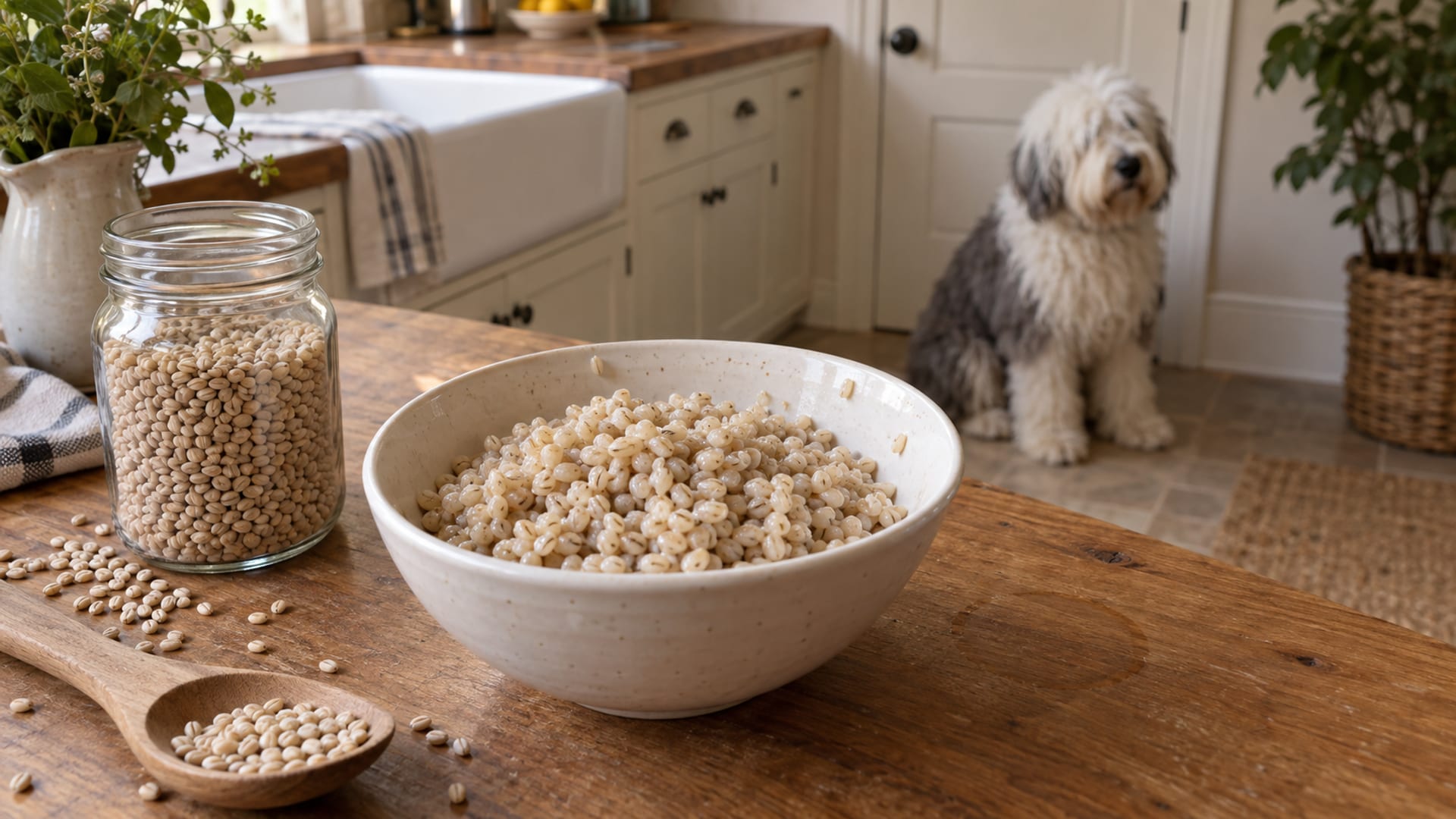
Yes. Plain, fully cooked barley is generally fine for dogs in a small amount, and the answer changes with the form it came in and whatever else was in the product. If your dog just ate some, work out which kind it was, about how much, and when, then follow the steps below.
A few spoonfuls of plain pearl barley is usually something you can watch at home. Barley bread with raisins, a malt drink with alcohol, or an afternoon in wild barley or foxtail grass is another matter, because the risk comes from the added ingredients or from barbed seed heads.
Key takeaways
Tap a card to bring it forward.
- Plain, fully cooked barley is generally tolerated in modest amounts; extra fiber can bring gas or loose stool.
- In bread, cereal, granola, malt or brewing products, the other ingredients set the risk. Check for alcohol, xylitol, chocolate, raisins, onion and garlic.
- Wild barley and foxtail grass carry barbed awns that can work into ears, eyes, nose, paws or skin, and that needs a vet.
- Dry, uncooked kernels are harder to digest and can upset the stomach.
- Keep barley a small extra beside a complete and balanced diet.
What to do if your dog already ate barley
Go through these in order.
- Name the form. Cooked grain, dry kernels, baked goods, cereal, malt, brewing grain and grass seed heads each carry a different risk, so this answer shapes the rest.
- Read the whole label if it came from a package. In a mixed product, alcohol, xylitol, chocolate, raisins, onion or garlic cause the harm far more often than the barley.
- Estimate how much and when. Pet Poison Helpline advises working out what was eaten, how much, and when, which is what a vet will ask first.
- Think about your dog's size. The same handful is a bigger dose for a small dog, and Pet Poison Helpline treats small size as a reason to call for advice.
- Check for grass. If your dog was in wild barley or foxtail-type grass, look over the ears, eyes, nose and paws and call your vet, because a barbed awn can move deeper while your dog seems fine.
- Call right away for a product with a toxic ingredient. Pet Poison Helpline advises against waiting for symptoms after a significant amount of something toxic, since early help gives your vet more options.
- Otherwise, watch and keep the package. For a small amount of plain cooked barley, observe your dog, keep the packaging handy in case you need to call, and skip home remedies.
Which kinds of barley are fine and which need a closer look
The American Kennel Club lists barley among the grains dogs can eat. A study in the Turkish Journal of Veterinary and Animal Sciences fed dogs of 15 to 30 kg a diet that was 25% barley and found it digestible, with no change in stool consistency compared with rice. The table sorts the forms you are most likely to find.
Tap or hover a row to highlight it.
| Form | What to know | What to do |
|---|---|---|
| FormPlain cooked barley (pearl, hulled, pot) | What to knowGenerally tolerated; cooking makes the starch easier to digest | What to doFine as a small extra |
| FormRaw or dry kernels | What to knowHarder to digest; a large gulped amount raises a choking or blockage concern | What to doCall if vomiting or belly pain starts |
| FormBarley flour, bread, cereal, granola, cookies | What to knowThe rest of the recipe sets the risk | What to doCheck for raisins, chocolate, xylitol, onion, garlic, fat, salt and sugar |
| FormBarley grass and sprouts | What to knowGreen plant material | What to doSmall amounts only; confirm it is grown barley grass |
| FormBarley malt, malt extract, malt syrup | What to knowProcessed and often sweetened | What to doRead the full label |
| FormBeer, malt beverages, spent brewing grain | What to knowAlcohol is toxic to dogs; hops can be hazardous | What to doCall your vet or a poison line |
| FormBarley water | What to knowStore versions may be sweetened | What to doCheck the label |
| FormWild barley and foxtail grass | What to knowBarbed awns can embed and travel through tissue | What to doCall your vet |
| FormBarley straw or hay | What to knowCoarse and may carry sharp awns | What to doKeep it out of reach |
Wild barley, especially *Hordeum jubatum*, is often called foxtail barley, and an AKC Gazette breed column sets it apart from food barley because of its penetrating awns. Pet Poison Helpline describes those awns embedding in skin, ears, eyes, nose, paws and even internal tissue, where they can migrate. Spent grain from home brewing may still hold alcohol or hops, so treat it like Beer.
How to serve plain cooked barley
To share barley from your own meal, cook it until soft and set your dog's portion aside before adding butter, oil, salt, sugar, seasoning, onion or garlic. The first time, stir a small amount into the regular food, then see how your dog's stool looks before you offer it again.
Keep it a small side addition. The Merck Veterinary Manual centers dog feeding on a complete and balanced diet matched to life stage, and the percentages in feeding studies describe formulated foods, not a home portion.
Fiber explains the most common complaint. Barley carries soluble and insoluble fiber, including beta-glucans, and research in Animal Feed Science and Technology found that more soluble fiber in dog diets made stools heavier and wetter and lowered digestibility. A big scoop on top of dinner can mean gas or loose stool for that reason alone.
If your dog has diabetes, talk to your vet first. A study listed on PubMed found that prescription diets built on pea and barley starch gave better lipid and glucose-related results in diabetic dogs than a corn-based diet, which does not mean barley added to a bowl manages blood sugar. Dogs with pancreatitis, kidney disease, food allergies or inflammatory bowel disease may also need an individual diet plan, so ask before adding a new grain.
Signs to watch for after barley or a grass awn
Many dogs show nothing after a little plain cooked barley. When it does cause trouble, it is usually digestive: gas, belly discomfort, soft stool, diarrhea, or vomiting after overeating or a sudden diet change. Those signs tend to appear while the food is passing through, so watch the next several bathroom trips. A large amount of dry grain can cause more upset, and a big enough gulp could lead to a blockage.
Grass awns run on a different schedule. Pet Poison Helpline describes signs that start when the awn embeds or later as inflammation and infection develop: pain or swelling in one spot, limping, sneezing, coughing, licking one area over and over, ear or eye trouble, or a draining wound. Check the ears, eyes, nose and paws after time in tall dry grass, even when your dog seems fine.
Call your vet right away for any of these:
- trouble breathing
- repeated vomiting
- severe belly pain or a swollen belly
- collapse or marked tiredness
- straining with no urine or stool coming out
- any blood
- eye or ear trouble after time in grass
- coughing or sneezing that keeps going after time in grass
- swelling, limping or a draining wound
The worst realistic outcomes are dehydration from severe vomiting and diarrhea, a gut blockage, or serious infection from an awn that migrates.
My dog ate barley before and was fine
That happens, and it is a real experience. A dog that cleaned up a dropped bowl of cooked barley with no loose stool shows you something true about that dog on that day. It just is not a rule for every dog and every form of barley.
Amount changes the outcome. The 25% barley diet in the Turkish Journal study caused no stool change, while a review in Nutrients reported looser stools when diets held 40% extruded barley. Size matters, since the same scoop is a larger share of a small dog's meal. Form matters: cooked grain, dry kernels, a malt drink and a grass seed head are four different exposures. Dogs differ in how they handle fiber and diet changes. A quiet first evening does not rule out an awn, because trouble can start later as inflammation sets in. And sometimes the amount was simply small enough to pass without a problem.
Barley products and grasses that get mixed up
Food barley is *Hordeum vulgare*, the cereal grain in soups, flours and some dog foods. Pearl, hulled and pot barley, flakes, groats and flour are that same grain processed in different ways.
"Foxtail" is a common name for several grasses, and Pet Poison Helpline lists cheatgrass, speargrass, bromegrass and needlegrass among the related names. Barley grass and sprouts are the green shoots of the grain. The AKC says barley grasses should be eaten only in small amounts, so confirm it is cultivated barley grass and not a wild grass gone to seed.
Malt, malt extract, malt syrup, malted milk and beer start with barley and end up as something else; check them for sugar, alcohol, hops, chocolate and xylitol. "Barley straw" can mean dried stalks or a pond-care product, and neither belongs in a dog's bowl.
Check what you learned
Three quick questions to test what matters most when your dog gets into barley.
Quick check
Questions about dogs and barley
These come up often once the first worry has passed.
Can puppies eat barley?
Barley is not known to be riskier for puppies than for adult dogs. Puppies do have their own nutrient needs for growth, and the Merck Veterinary Manual ties feeding to life stage, so a complete puppy food should make up the meal. Ask your vet before adding grains or extras to a young puppy's diet.
Can my dog have some of my barley soup or stew?
Soups and stews often carry onion, garlic, salt and fat, and Onions and Garlic are the first to rule out. If you want to share, scoop out plain cooked barley before the pot is seasoned.
What if my dog ate spent grain from home brewing?
Call your vet or a poison line promptly, since spent grain may still hold alcohol and hops. Have the recipe ready, along with how much your dog ate and when.
Can cats eat barley?
Plain barley is not known to poison cats either, but it should not replace a complete cat food. Foxtail awns and toxic ingredients in barley products are risks for cats too.
Sources
Checked September 25, 2026.
- American Kennel Club, Can Dogs Eat Wheat And Other Grains?
- American Kennel Club, How to Plant a Dog-Friendly Garden
- American Kennel Club, Breed Columns, September 2025 Gazette
- Pet Poison Helpline, Foxtail Grass, Foreign Body in Domestic Animals
- Pet Poison Helpline, Are Tomatoes Bad for Dogs? What's Safe & What's Toxic
- Merck Veterinary Manual, Nutritional Requirements of Small Animals
- Turkish Journal of Veterinary and Animal Sciences, Barley as an alternative to rice in dog food
- Nutrients, Alternative Dietary Fiber Sources in Companion Animal Nutrition
- Animal Feed Science and Technology, The effects of increasing levels of soluble non-starch polysaccharides and inclusion of feed enzymes in dog diets on faecal quality and digestibility
- PubMed, Starch sources influence lipidaemia of diabetic dogs