
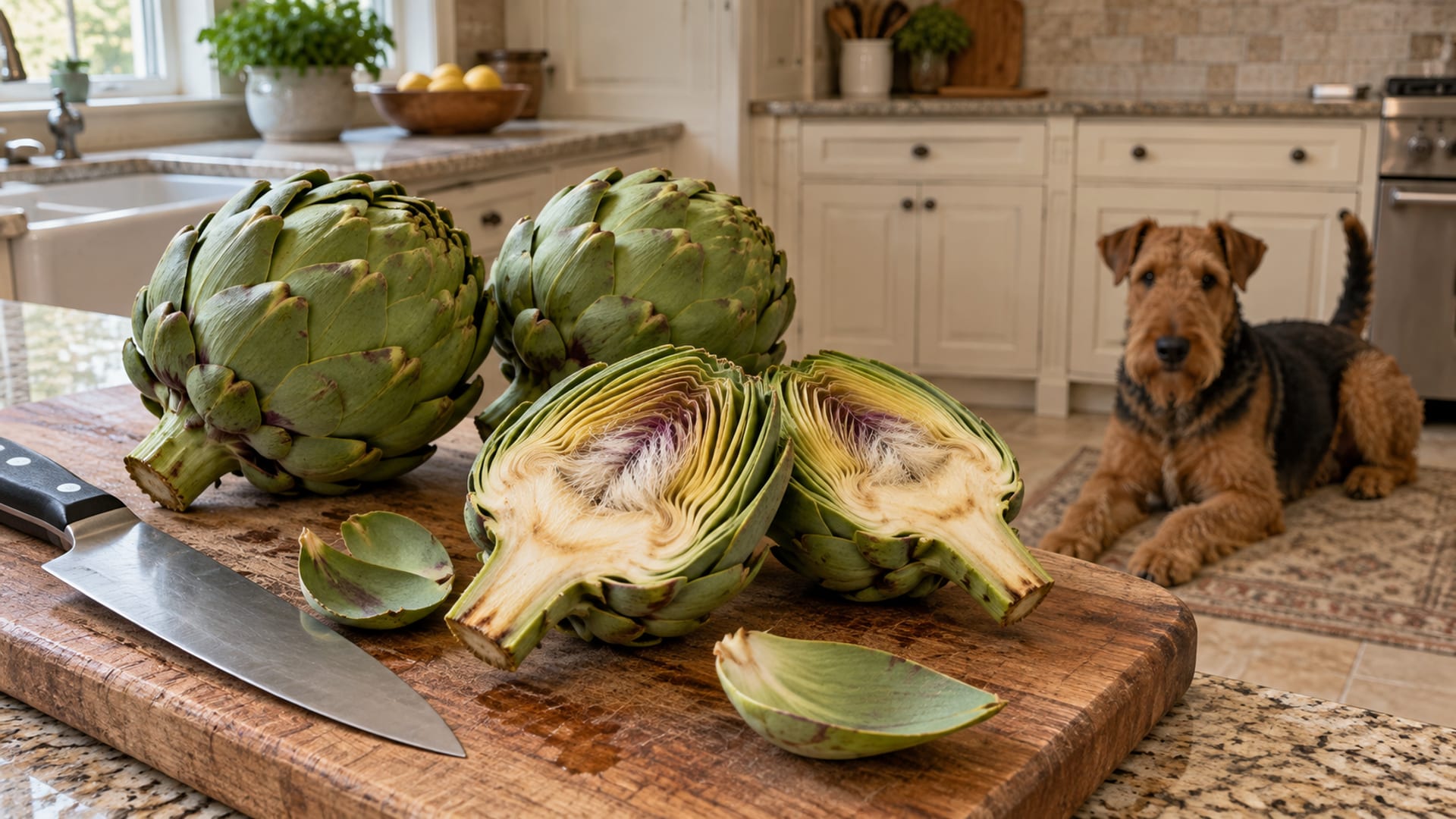
Yes. A small amount of plain, tender artichoke heart, cooked or raw, is safe for most dogs when it's cut into small pieces. The risk sits in two other places: the tough outer leaves, the stem and the fuzzy choke in the middle, which are hard to chew and can lodge in the throat or gut, and prepared versions like dip or marinated hearts, which bring oil, salt, garlic or onion along with them. If your dog just grabbed some, the steps below cover what to check.
Key takeaways
Tap a card to bring it forward.
- Plain, tender artichoke heart in small pieces is low risk for most dogs, cooked or raw.
- The tough outer leaves, stem and fuzzy choke are a choking and blockage risk, even though they aren't poisonous.
- Dip, marinated, jarred and canned artichokes can carry oil, salt, garlic or onion, so the label matters more than the artichoke.
- Call your vet right away for gagging, trouble breathing or swallowing, repeated vomiting, belly pain, or a large tough piece swallowed.
- Jerusalem artichoke, cardoon and artichoke supplements are different things, and this answer doesn't carry over to them.
What to do if your dog just ate artichoke
Globe artichoke, the green vegetable sold in grocery stores, doesn't appear on the ASPCA's list of toxic and non-toxic plants as a toxic plant. The ASPCA also says any plant material can cause vomiting or stomach upset, and that its list isn't meant to cover everything. So, the questions that matter tonight are about the piece and the recipe, not about a poison.
- Move the rest of the artichoke out of reach. A second, bigger piece is often the one that causes trouble.
- Work out which part your dog ate. A bit of soft heart is a very different event from a whole outer leaf, a length of stem or a mouthful of the hairy choke.
- Compare the piece to your dog. The American Kennel Club notes that eating a lot of leaves, sticks and similar plant material can lead to a blockage, and a fibrous chunk that a large dog passes easily can be a real problem for a small one.
- Find the jar, the can or the recipe. If the artichoke was marinated, canned or mixed into dip, the added ingredients may matter more than the vegetable, and your vet will ask what was in it.
- Watch your dog and skip home remedies. Keep your dog where you can see it and note any change in breathing, eating or drinking.
- Call right away if you see warning signs. Choking, gagging over and over, trouble breathing or swallowing, repeated vomiting, belly pain, marked tiredness, or not keeping water down all mean a phone call now. Call just as quickly if your dog swallowed a large tough piece, or if the product contained onion, garlic, a concentrated artichoke extract, unknown herbs, a lot of oil or a lot of salt.
If your dog ate a bite or two of plain heart and is acting normally, watching at home is usually the right call. Contact your vet if signs show up later, or if your dog is very young, very small, or swallowed a large fibrous piece. The ASPCA Animal Poison Control Center is there for any product where you can't tell what went into it.
Which parts of an artichoke are safe for dogs
An artichoke is an immature flower bud. The USDA Agricultural Research Service describes the parts people eat as the fleshy bases of the bracts, which are the leaves you scrape with your teeth, and the fleshy base in the center, which is the heart. Everything else on the bud is tough, and that toughness is what makes it a problem for dogs.
Tap or hover a row to highlight it.
| Part or form | For dogs | Why |
|---|---|---|
| Part or formPlain heart, cooked | For dogsFine in small pieces | WhySoft, easy to chew, nothing added |
| Part or formPlain heart, raw | For dogsFine in small pieces | WhyNot poisonous, but firmer and harder to chew |
| Part or formTough outer leaves | For dogsSkip | WhyFibrous, hard to chew, can cause choking or a blockage |
| Part or formStem | For dogsSkip | WhyWoody and fibrous |
| Part or formFuzzy choke | For dogsSkip | WhyHairy and hard to swallow |
| Part or formMarinated, jarred or canned hearts | For dogsSkip | WhyOften packed with oil, salt, garlic or spices |
| Part or formArtichoke dip | For dogsSkip | WhyOften made with garlic, onion, dairy and salt |
| Part or formExtract, powder, tea | For dogsAsk your vet first | WhyConcentrated, and not the same as a bite of vegetable |
Cooking softens the heart, but it doesn't make a buttered, oiled or seasoned artichoke a good dog treat. A spoonful of spinach artichoke dip usually carries garlic and onions, and often cream cheese and spinach too, so check each of those against what your dog ate.
How to serve a little plain artichoke heart
No veterinary source gives a set serving size for artichoke by dog size, so the careful approach is a small amount, offered now and then. If you'd like to share, here's how I'd set it up in my own kitchen:
- Start with the heart only. Pull off the tough outer leaves, cut away the stem and scrape out the fuzzy choke, then use just the soft heart and the tender inner leaf bases.
- Cook it plain or use it raw. Steamed or boiled with nothing added is easiest to chew; raw heart is fine but firmer.
- Leave out every extra. No butter, oil, salt, garlic, onion, lemon sauce, marinade or dip.
- Cut it small. Pieces your dog can't gulp whole keep the choking risk low, especially for small breeds and puppies.
- Offer a taste, then wait a day. Any new plant food can upset a dog's stomach, and a small first try tells you how yours handles it.
The edible part of an artichoke contains fiber, inulin, minerals, vitamin C and plant compounds such as chlorogenic acid and cynarin, according to a review by Salekzamani and colleagues. Your dog doesn't need any of it from artichoke, and nobody has worked out a dog benefit or a daily amount, so treat it as an occasional extra rather than part of the diet.
Signs to watch for after your dog eats artichoke
When plant material does upset a dog, the ASPCA points to vomiting and stomach upset, and a tough piece can add gagging, coughing, drooling or trouble swallowing if it catches on the way down.
A blockage looks different. The Merck Veterinary Manual explains that even plants that aren't poisonous can make an animal ill when a lot is eaten, and a fibrous leaf or stem can get stuck further along. Watch for:
- vomiting that keeps coming back
- belly pain, a hunched stance or not wanting to be touched
- unusual tiredness
- not keeping food or water down
- not passing stool
There's no fixed clock for any of this. How fast signs appear depends on how much your dog ate, how big the pieces were and where anything settles, and a blockage may not show up right away. Keep an eye on eating, drinking and bathroom trips over the next few days, not only the first hour.
My dog ate artichoke before and was fine
That happens, and I believe you. What that one experience can't do is promise the same result next time, because the things that decide the outcome change from night to night:
- The amount. A small bite of tender heart is not the same as a pile of scraped leaves from the bottom of the bowl.
- The part and the recipe. Soft heart, a woody stem, a hairy choke and a garlicky dip are four different risks.
- Your dog's size and the piece's size. The same fibrous leaf is a much bigger obstacle in a small dog's throat or gut.
- The individual dog. Plant material upsets some stomachs and not others, and not every exposure brings signs.
- Timing. A swallowed piece that causes a blockage may not show signs until later, so a dog that seems fine in the first hour hasn't fully cleared it yet.
So, the earlier night was real. It just isn't a rule you can count on for every dog, every piece or every recipe.
Artichoke products and plants with the same name
Several different plants and products are sold as artichoke, and the answer above only fits the green globe artichoke, *Cynara cardunculus* var. *scolymus*, also listed as *Cynara scolymus*.
Jerusalem artichoke (*Helianthus tuberosus*) is a separate plant grown for a knobby tuber, and Chinese or Japanese artichoke (*Stachys sieboldii*) is another tuber plant, according to the USDA Risk Management Agency. If one of these is what your dog ate, look up that plant by name or call your vet rather than relying on this page.
Cardoon is a thistle relative grown mainly for its leaf stalks. Some garden thistles also get called artichoke, so if your dog chewed a yard plant, share the name on the plant tag with your vet.
Artichoke extract, leaf supplements, powder and tea are concentrated products. The European Medicines Agency assesses artichoke leaf preparations separately from the vegetable, and a review by Byard and Musgrave warns that herbal products for animals can have the wrong ingredients, contamination, poor labeling or interactions with medicines. Talk to your vet before giving any of them, and call promptly if your dog got into a bottle.
Marinated, jarred and canned hearts usually sit in oil, brine or seasoning. The AKC's list of fruits and vegetables for dogs treats added kitchen ingredients as their own question, the same one salty olives raise.
Check what you learned
Three quick questions to make sure the key points stuck.
Quick check
Questions about dogs and artichokes
These come up often when artichoke is on the table.
Can puppies eat artichoke?
A puppy can have a tiny piece of plain, soft heart. Puppies are more likely to chew and swallow plant material they shouldn't, as the AKC points out, so keep leaves and stems well out of reach. Call your vet if a puppy swallows a large piece, even without signs.
Are there seeds in an artichoke I should worry about?
The artichoke you buy is a flower bud picked before it blooms, so it doesn't carry seeds the way a fruit does. The parts that deserve attention are the tough leaves, stem and hairy choke.
Is artichoke safe for cats too?
The ASPCA plant list covers both dogs and cats, and the same caution applies to both: plant material can upset the stomach.
My dog is on a special diet. Can I still share artichoke?
Ask your vet first. Dogs with pancreatitis should avoid oily or buttered artichoke because of the fat, and dogs with diabetes or kidney disease may need their own food plan. A plain bite is small, but a special diet is built around what goes in every day.
Sources
Checked September 25, 2026.
- ASPCA, Toxic and Non-Toxic Plants
- ASPCA, Animal Poison Control Center
- USDA Agricultural Research Service, Artichoke
- USDA Risk Management Agency, Globe Artichokes: An Economic Assessment of the Feasibility of Providing Multiple-Peril Crop Insurance
- American Kennel Club, Why Does My Dog Eat Everything?
- American Kennel Club, Fruits and Vegetables Dogs Can or Can't Eat
- Merck Veterinary Manual, Houseplants and Ornamentals Toxic to Animals
- Salekzamani et al., Evidences on Molecules Most Frequently Included in Canine and Feline Complementary Feed to Support Liver Function
- European Medicines Agency, Assessment Report on Cynara scolymus L., folium
- Byard and Musgrave, The potential side effects of herbal preparations in domestic animals