
Cushing's Disease in Dogs: Signs, Tests, Treatment and When to Call the Vet
By Cal Hewitt · Published
Health
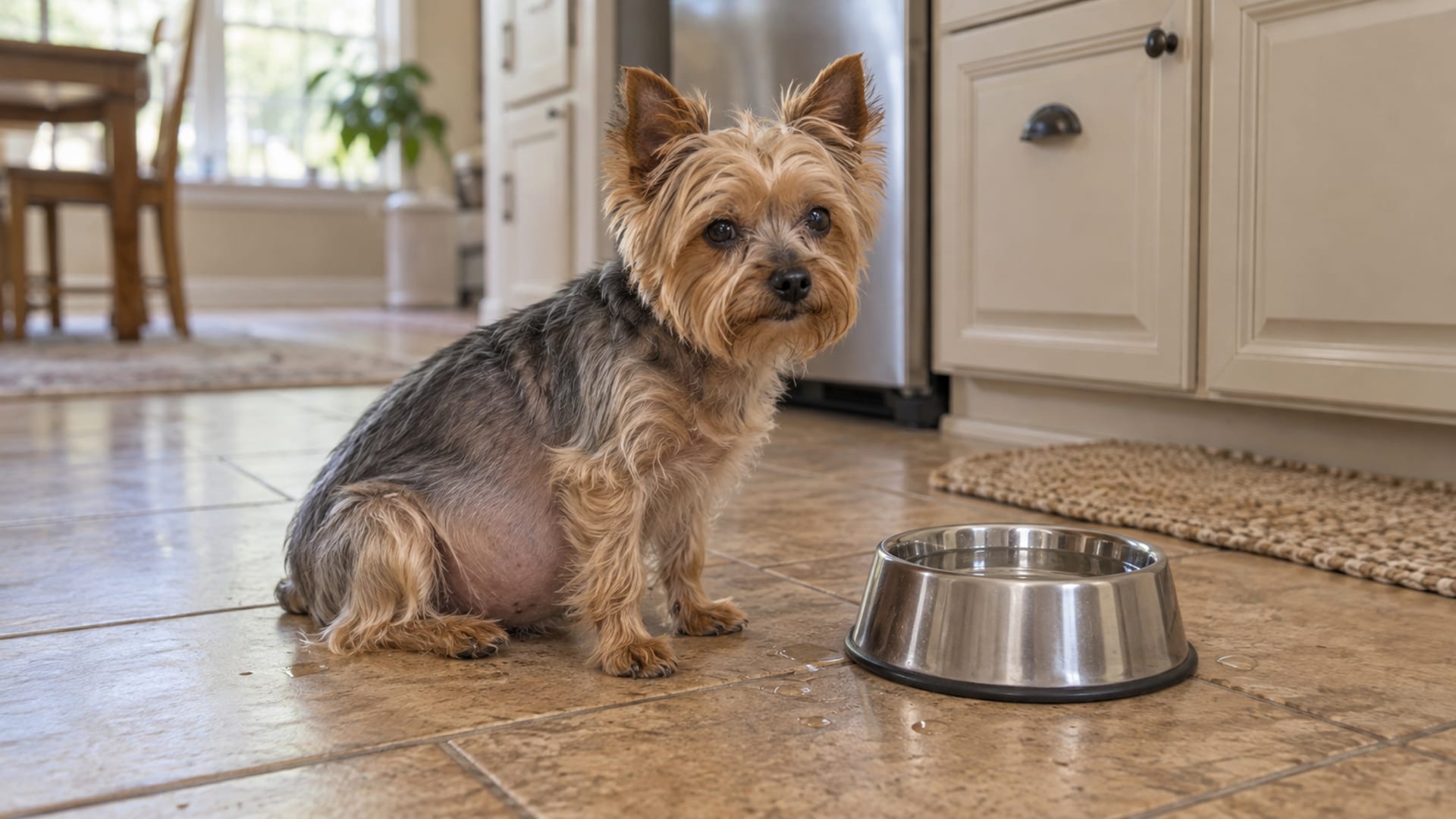
If your dog is already being treated for Cushing's and suddenly stops eating, vomits, has diarrhea, turns very weak or collapses, call your veterinarian or an emergency hospital now. Those signs can mean serious adrenal insufficiency, according to the FDA. Cushing's disease, or canine hyperadrenocorticism, means the body is exposed to too much cortisol. The common signs are more drinking and peeing, a bigger appetite, panting, a pot belly, muscle weakness, thin skin and hair loss. The three practical causes are a pituitary tumor, an adrenal tumor or long-term steroid medication. Signs alone can't confirm it; your vet pairs the exam with bloodwork, urinalysis and a hormone test, as the Merck Veterinary Manual describes.
Key takeaways
Tap a card to bring it forward.
- Cushing's means too much cortisol, from a pituitary tumor, an adrenal tumor or long-term steroid medication.
- More thirst, more peeing, constant hunger, panting and a pot belly are the signs owners notice most, but other illnesses cause them too.
- No single test confirms Cushing's, so diagnosis often takes more than one visit.
- A dog on treatment who stops eating, vomits, has diarrhea, turns very weak or collapses needs a vet right away.
- Costs vary widely, so ask your clinic for a written quote for testing, medication and monitoring.
- Never stop a steroid your dog has been on for a long time without your vet's plan.
Routine visit, same-day call or emergency: how do you decide?
It depends mostly on whether your dog is already on Cushing's treatment and how sick they look right now.
Go now, to your vet or an emergency hospital: a dog on Cushing's medication who has collapsed, is very weak, is trembling, has bloody diarrhea, or has stopped eating along with vomiting or diarrhea. The FDA and the Vetoryl label on DailyMed both list these as reasons for immediate veterinary contact, because they can signal that the adrenal glands have been suppressed too far.
Call today: a treated dog with a poor appetite, one episode of vomiting or diarrhea, or unusual tiredness. If your dog has been on steroids for a long time, call before changing anything; stopping steroids suddenly can be dangerous, according to the Merck Veterinary Manual's dog-owner page.
Book a routine appointment: a dog, usually middle-aged or older, who has slowly started drinking and peeing more, acting hungry all the time, panting more or losing hair, but is otherwise eating and acting like themselves.
Before that visit, jot down drinking, accidents, appetite, panting and sleep, photograph skin and coat changes, and list every medication, especially any steroid.
What Cushing's disease is, and the three types
Cushing's is a hormone disorder. The adrenal glands, near the kidneys, make cortisol, and in Cushing's the body gets too much of it for too long. Vets call it hyperadrenocorticism. "Cushing's disease" often means the pituitary form, and "Cushing's syndrome" means too much cortisol from any cause, though the names get used loosely.
Vets sort it into three practical types:
- Pituitary-dependent. A tumor in the pituitary gland at the base of the brain sends out too much ACTH, the hormone that tells the adrenal glands to make cortisol. The Spanish edition of the Merck manual puts this at about 80% to 85% of reported cases.
- Adrenal-dependent. A tumor on an adrenal gland makes cortisol on its own. It can be benign or malignant, and Merck puts it at about 10% to 15% of reported cases.
- Iatrogenic, or steroid-related. Long or heavy use of corticosteroid medication produces the same signs. Managing it means your prescribing vet reducing the steroid on a schedule, never an owner stopping it cold.
Those percentages describe reported cases, not your dog's odds. Cornell University's College of Veterinary Medicine says the disease is found mostly in middle-aged and older dogs. It links the pituitary form with smaller breeds such as Miniature Poodles, Dachshunds, Yorkshire Terriers and Miniature Schnauzers, and the adrenal form with larger breeds such as German Shepherds. A breed tendency raises suspicion; it never settles a diagnosis.

The signs that should prompt a vet call, and what else looks like Cushing's
Cushing's is easy to mistake for getting older. A senior dog who pants more, sleeps more and gets a round belly can look like a dog who is simply aging. What sets Cushing's apart is several of these changes arriving together, often with a clear jump in thirst and appetite.
Signs sources list include:
- Drinking and peeing more, including new accidents. Cornell reports this in about 80% to 90% of cases.
- A bigger appetite.
- Panting, and trouble handling heat.
- A pot belly.
- Muscle weakness or loss of muscle.
- Thin skin, hair loss or poor hair regrowth.
- Skin infections that keep coming back.
- Tiredness.
- Urinary tract infections and high blood pressure, which your vet finds rather than you.
New accidents indoors, restlessness or heavy panting shouldn't be treated as a training or anxiety problem until your vet has ruled out a medical cause.
Several other conditions can look like Cushing's. Merck and Cornell point to diabetes, kidney disease, urinary infection, liver disease, other hormone problems, skin disease and the effects of medication. Panting alone can come from heart or breathing problems, pain, heat or anxiety. Our Diabetes in Dogs and Senior Dog Care articles cover those overlapping conditions, and Signs of a Healthy Dog gives you a baseline for normal drinking and appetite.
How your vet diagnoses it, and why it can take more than one visit
Your vet starts with your dog's history, every medication including steroids, and a physical exam. The ACVIM consensus statement says suspicion should come from the history and exam, and that hormone testing belongs with dogs whose signs fit.
Routine tests come first: a CBC and chemistry panel, a urinalysis to check urine concentration, often a urine culture for infection, and blood pressure. These can raise suspicion and find other problems, but none of them proves Cushing's. A high liver enzyme called alkaline phosphatase, for example, can support the idea without confirming it.
Then come the hormone tests, as Merck describes them:
- Low-dose dexamethasone suppression test. Merck calls it the screening test of choice in many dogs. It checks whether cortisol drops as it should after a small injected steroid. Other illness can cause false positives.
- ACTH stimulation test. It measures how strongly the adrenal glands respond when stimulated. Merck notes it's useful when other illness makes the dexamethasone test less reliable, and it's the test of choice for steroid-related Cushing's.
- Urine cortisol-to-creatinine ratio. It uses urine you collect at home. It's good at ruling Cushing's out, but a high result needs confirming with another test.
- Abdominal ultrasound. It shows the size and shape of the adrenal glands, looks for tumors and checks other organs. It helps find the cause but can't diagnose Cushing's alone.
Other tests, such as the high-dose dexamethasone test or an endogenous ACTH level, may help tell pituitary from adrenal disease.
Why more than one visit? No test is perfect, other illnesses can throw results off, a first result can be unclear, and your vet still has to learn which type your dog has. Merck says that dogs with unclear screening results, or with lab changes but no matching signs, may be retested in three to six months rather than treated without a firm diagnosis. That isn't stalling; it avoids treating a disease your dog may not have.
What treatment involves: medication, surgery, radiation, tapering steroids and supplements
Treatment depends on the type, how much the signs affect your dog, other health problems, the tumor, access to a specialist and what you can manage financially. I'm not giving doses; those come only from your vet.
Trilostane, sold as Vetoryl, blocks an enzyme the adrenal glands need to make cortisol. The FDA says it's the only FDA-approved drug for both pituitary and adrenal Cushing's in dogs. It still needs regular monitoring, and approval doesn't make serious side effects impossible.
Mitotane, also called Lysodren, destroys cortisol-making tissue in the adrenal glands. It has been used off-label, and the FDA and Cornell both say it needs careful monitoring because side effects can be severe.
Selegiline, sold as Anipryl, is FDA-approved only for certain pituitary-dependent cases. Cornell calls its effect questionable and says it's no longer recommended.
Surgery to remove an adrenal tumor is the preferred treatment when the tumor is suitable and surgery is possible, according to Cornell, but it's a complicated operation with real risk. Pituitary surgery or radiation is offered at some referral centers, especially for larger pituitary tumors.
Steroid-related Cushing's is handled by your vet slowly reducing the steroid. Please don't stop a long-term steroid on your own; sudden withdrawal can cause dangerous adrenal insufficiency.
Can it go away for good? Removing a suitable adrenal tumor may resolve it. Medication usually controls the signs rather than removing a pituitary tumor.
You may see videos or posts about over-the-counter remedies or managing Cushing's naturally, and I understand the appeal when vet bills are ongoing. But none of the veterinary sources used for this page supports a supplement as a replacement for diagnosis, monitoring or treatment. Show any product to your vet before giving it, because some can interact with the disease or with prescribed medication.
Warning signs during treatment that mean calling the vet now
The FDA says frequent checkups and blood tests are usually needed in the first few months, then every few months depending on how your dog responds. Rechecks can include exams, weight, blood chemistry, electrolytes, urinalysis, blood pressure and repeat ACTH testing.
Call your vet right away, or go to an emergency hospital after hours, if your dog on treatment shows:
- Poor appetite or refusing food
- Vomiting
- Diarrhea, especially bloody diarrhea
- Marked weakness, lethargy or trembling
- Collapse
- Signs of dehydration, or a sudden, severe change in behavior
The Vetoryl label and the FDA explain that these can mean cortisol has dropped too low, a state called hypoadrenocorticism, or Addison's disease, which is roughly the opposite of Cushing's. An Addisonian crisis, with weakness, vomiting, diarrhea, dehydration and collapse, is an emergency, as the Merck dog-owner page notes. Our Dog Vomiting and Dog Diarrhea articles cover those signs in general, but for a dog on Cushing's medication, the call to the vet comes first.
What testing, medication and monitoring may cost
The research behind this page found no trustworthy US price list for Cushing's care, and I won't invent one. Costs swing with where you live, your dog's size, the lab, general practice versus referral hospital, the tests chosen and any complications. These are the pieces to ask about, so a quote makes sense:
- First workup: the exam, routine bloodwork, urinalysis and often a urine culture.
- Hormone testing: an ACTH stimulation test or low-dose dexamethasone suppression test, and sometimes more than one.
- Ultrasound: generally more than routine lab work, and it varies by provider and whether sedation is needed.
- Medication: depends on the drug, your dog's size, the pharmacy and whether it's compounded.
- Monitoring: frequent rechecks early, then every few months, according to the FDA.
- Surgery, radiation and hospital stays: referral-level costs that vary too much for any single figure.
Ask your clinic for a written estimate that separates diagnosis from monthly medication and monitoring. If you have insurance, our Pet Insurance for Dogs article covers how pre-existing conditions are usually handled.
Mild or untreated Cushing's: complications, quality of life and outlook
Not every dog with a Cushing's diagnosis is rushed into treatment. Cornell says treatment is generally pursued when signs affect quality of life or when it's needed to reduce complications. Your vet will consider how sure the diagnosis is, how the signs are progressing, other illnesses, the tumor type, drug risks and whether regular monitoring is realistic.
But untreated Cushing's isn't only a coat problem. Sources list high blood pressure, urinary infections, diabetes, skin disease and slow healing, muscle wasting, blood clots in the lungs and growth of the underlying tumor.
For outlook, Cornell gives average survival estimates:
Tap or hover a row to highlight it.
| Situation | Average survival reported by Cornell |
|---|---|
| SituationPituitary type, treated with medication | Average survival reported by CornellAbout 2 to 2.5 years |
| SituationPituitary surgery or radiation | Average survival reported by CornellAbout 2 to 5 years |
| SituationAdrenal tumor removed by surgery | Average survival reported by CornellAbout 1.5 to 4 years |
| SituationAdrenal type, treated with medication | Average survival reported by CornellAbout 1 year |
Cornell also reports a 10% to 25% risk of death around adrenal surgery. These are averages across many dogs, and individual dogs vary a lot. No reliable figure for untreated survival appears in the sources, so I won't guess at one.
Questions owners ask about Cushing's in dogs
These come up most often once a vet mentions Cushing's.
Is it worth treating Cushing's disease in a dog?
It depends on how much the signs affect your dog and which complications your vet is watching for. Medication can control the thirst, hunger and panting, but it means ongoing doses and rechecks. It's a fair decision to make with your vet, based on your dog's comfort, other health problems and what you can keep up.
How can I tell if my dog has Cushing's?
You can't confirm it at home. You can notice a pattern, such as more drinking, more peeing, a bigger appetite, panting and a pot belly, and bring notes to your vet. The ACVIM consensus statement says no screening test is perfect, so even your vet may need more than one test to be sure.
Should I treat my 14-year-old dog for Cushing's?
Age alone doesn't decide it. Ask your vet whether the signs are hurting your dog's daily comfort, whether complications such as high blood pressure or urinary infections are present, and how well your dog would handle regular blood tests. Merck notes that dogs with unclear results may simply be retested later, so waiting can be a reasonable plan.
How is Cushing's disease treated?
Veterinary sources describe medication first, usually trilostane, which the FDA has approved for both main types. Some adrenal tumors can be removed with surgery, and some pituitary tumors are treated with radiation or surgery at referral centers. Steroid-related Cushing's is handled by slowly reducing the steroid under your vet's direction.
What should I ask my vet at the first Cushing's appointment?
Ask which test they recommend and why, whether another illness could affect the result, and how they'll find out which type your dog has. Ask what monitoring schedule to expect and which symptoms mean an emergency call. Bring a list of every medication your dog has taken recently, especially any steroid, current or past.
Your next step
If your dog is on Cushing's treatment and is vomiting, weak, not eating or has collapsed, call your vet or an emergency hospital now. If you're seeing new thirst, hunger, panting or hair loss in a dog who otherwise seems well, write down what you've noticed for a few days and book a regular appointment. Ask for a written estimate before testing starts. You can find vets and emergency vets near you in our directory.
Sources
- Cornell University College of Veterinary Medicine: Cornell University's College of Veterinary Medicine
- dailymed.nlm.nih.gov: Vetoryl label on DailyMed
- Merck Veterinary Manual: Merck Veterinary Manual's dog-owner page
- Merck Veterinary Manual: Merck Veterinary Manual
- Merck Veterinary Manual: Spanish edition of the Merck manual
- PubMed: ACVIM consensus statement
- U.S. Food and Drug Administration: FDA