

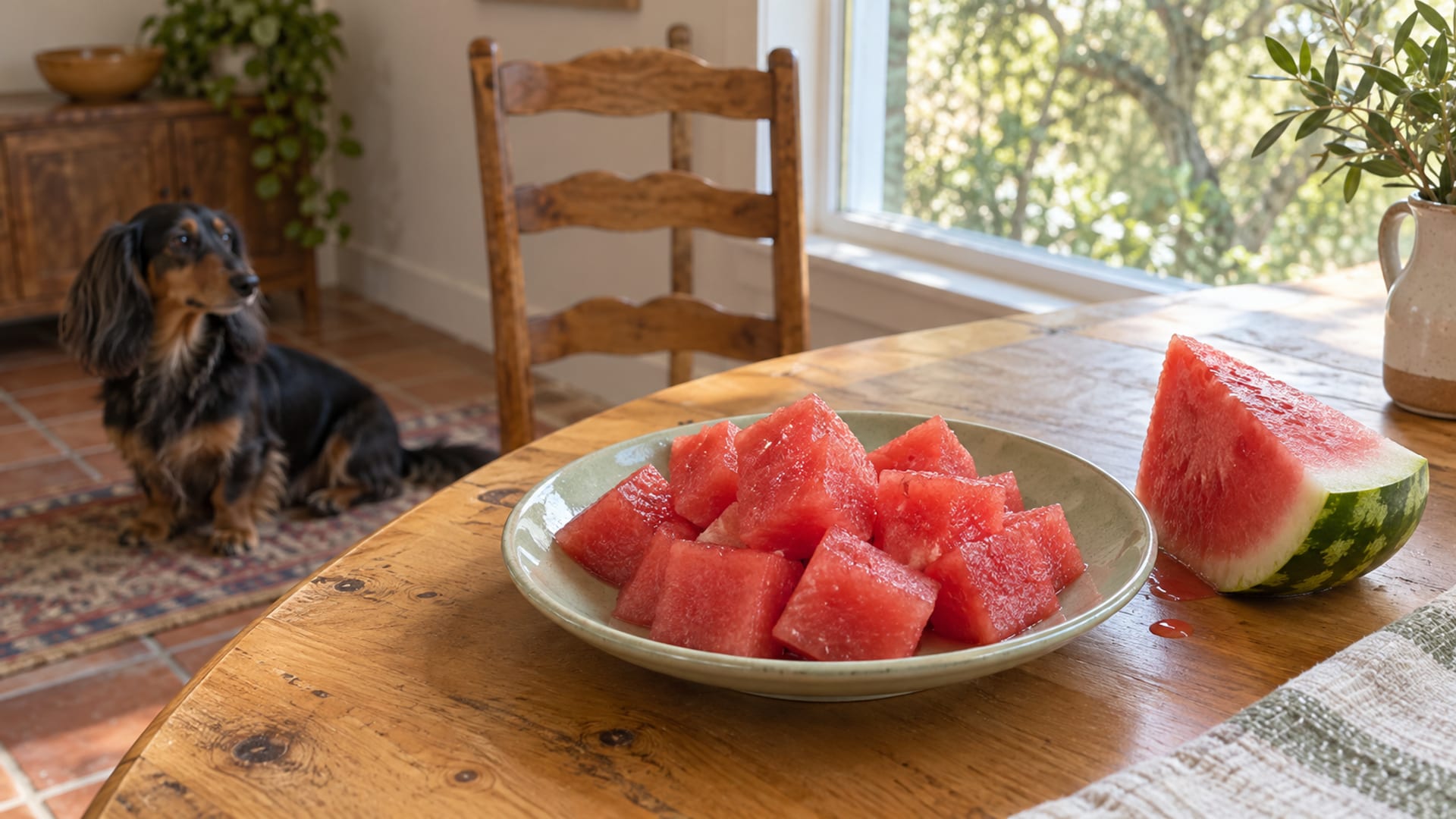
Yes. Ripe watermelon flesh is safe for dogs in small amounts once the seeds and rind are gone, according to the AKC. Give a few bite-sized pieces at a time as a cool snack, and keep the rind and seeds out of reach.
If your dog just ate a few cubes that fell off the table, you do not need to do anything. If they chewed up a rind, ate a lot of seeds, or got into a watermelon candy, drink or baked treat, the table below covers what to do.
Key takeaways
Tap a card to bring it forward.
- Seedless, rind-free watermelon flesh is a safe treat for most dogs.
- The rind is hard to digest and can bring vomiting, diarrhea, choking or a blockage.
- A lot of seeds can choke a dog or add to a blockage. "Seedless" melons still have some.
- A few bite-sized pieces at a time is plenty; treats stay under 10% of the day's calories.
- Watermelon candy, gummies, drinks and popsicles need a label check for xylitol and other ingredients.
Your dog already ate watermelon: next steps
Tap or hover a row to highlight it.
| What they ate | What to do |
|---|---|
| What they ateA few pieces of flesh, no rind | What to doNothing. At most a mild upset stomach. |
| What they ateA big bowl of flesh | What to doWatch for vomiting or diarrhea. Call your vet if it does not settle. |
| What they ateA lot of seeds | What to doWatch for gagging, vomiting, belly pain or trouble passing stool. Call your vet if you see any of them. |
| What they ateRind, or a whole wedge | What to doSame signs to watch for. Call your vet sooner for a small dog or a large piece. |
| What they ateCandy, gummies, a drink, a popsicle or a baked treat | What to doRead the label for xylitol, alcohol, caffeine, chocolate or raisins. If any are there, call now. |
The ASPCA asks owners to note how much their pet ate and then contact a vet or poison control. Keep the wrapper or bottle so you can read the ingredients over the phone.
The AKC names five reasons to call your vet after watermelon: vomiting that keeps coming back, diarrhea, belly discomfort, a lost appetite, or trouble passing stool. Choking or struggling to breathe means go now.
Flesh, rind, seeds and other forms
Tap or hover a row to highlight it.
| Part or form | Safe? | Why |
|---|---|---|
| Part or formRipe flesh, seeds removed | Safe?Yes, in small amounts | WhyThe AKC lists it as safe prepared this way |
| Part or formBlack seeds | Safe?Pick them out | WhyChoking risk, and many can add to a blockage |
| Part or formPale seeds in "seedless" melon | Safe?Remove what you can | WhyA seedless melon is not fully free of seeds |
| Part or formRind and green skin | Safe?No | WhyHard to digest; can cause upset, choking or a blockage |
| Part or formFrozen cubes, seedless and rind-free | Safe?Yes | WhyCut them to a size your dog can handle |
| Part or formPlain puree | Safe?Yes, a little | WhyOnly flesh, nothing added |
| Part or formJuice | Safe?Better skipped | WhySugar without the fiber; store juice may have additives |
| Part or formDried watermelon | Safe?Small amounts only, if at all | WhyDrying concentrates the sugar, and products may add more |
| Part or formCandy, gummies, flavored drinks | Safe?Check the label | WhyThe name does not tell you what is in it |
Watermelon flesh has no known poison for dogs. Every problem on this list comes from the parts around it: seeds and rind that can lodge, too much sugar and fiber at once, or other ingredients in a product. The AKC puts watermelon at about 92% water and roughly 50 calories a cup, with vitamins A, B6 and C and potassium. It is still a snack, and your dog needs a full water bowl too.
How much watermelon to give, and how to cut it
The AKC suggests "a few bite-sized pieces at a time," adjusted for your dog's size, age, activity level and overall diet. Keep all treats together under 10% of the calories your dog eats in a day.
- Cut the flesh away from the rind and throw the rind in a closed bin.
- Pick out the black seeds and as many pale ones as you can.
- Cut cubes sized for your dog's mouth. Smaller pieces for small dogs and fast eaters.
- Freeze a few cubes for a hot day if your dog likes them cold.
- Start small the first time; some dogs get an upset stomach from a new food.
Watermelon has natural sugar. If your dog has diabetes, ask your vet how it fits the plan. Dogs with pancreatitis or kidney disease also need food advice from their own vet.
Signs to watch for after rind, seeds or a big helping
Too much flesh tends to show up as a sore stomach, vomiting or diarrhea, and these usually pass once the food has moved through.
Rind and seeds can take longer to cause trouble, because it depends on where a piece stops. Look for vomiting, belly pain, not wanting to eat, straining, or not passing stool at all. A severe blockage can need surgery, so call your vet if any of these appear, even when the watermelon was eaten the day before.
"My dog chews watermelon rinds every summer and never gets sick"
Some dogs chew a rind for years and pass it every time, and that is real for that dog. The ASPCA says small fruit ingestions seldom cause more than minor stomach upset. A whole rind is a different story, and here is why one dog's summers do not predict another's:
- How much. A strip of rind is not the same as a whole wedge gulped down.
- Dog size and piece size. The AKC points out that small dogs face more choking risk from the same chunk.
- Chewing style. A dog that grinds the rind up is in a different spot from one that swallows it in big pieces.
- The individual dog. Some stomachs handle new foods better than others.
- Timing. Blockage signs can take a while to appear, so a dog that seems fine that evening has not always passed the rind.
- Chance. One piece moves through; the next one can lodge.
Cutting off the rind every time is the simple fix.
Watermelon candy, juice, popsicles and look-alikes
- Watermelon candy and gummies: the name does not mean the product holds only watermelon. Check the label for xylitol.
- Watermelon juice and agua de sandía: plain homemade juice is not toxic, but it delivers the fruit's sugar without the fiber. Skip store-bought versions with additives.
- Popsicles and frozen desserts: read for xylitol, chocolate or alcohol before your dog licks the stick.
- Watermelon dog treats, powders and supplements: a mixed product, so the full ingredient list decides the answer.
- Fruit salad: fine if it is only safe fruit. Grapes and raisins are dangerous for dogs; can dogs eat grapes? explains what to do. The Pet Poison Helpline suggests seedless watermelon as a safer fruit to share in moderation.
- Cantaloupe and honeydew: different melons with their own answer; see can dogs eat cantaloupe?.
- Watermelon peperomia, watermelon begonia and watermelon pilea: houseplants, not fruit. The ASPCA plant list covers them under those names.
Check what you learned
Quick check
Questions about dogs and watermelon
Can dogs eat watermelon seeds?
Pick them out first. The AKC says seeds can choke a dog, and many swallowed at once can add to a blockage. The risk grows with the number of seeds and shrinks with the size of the dog.
Can dogs eat watermelon rind?
No. The rind is hard to digest and can cause vomiting, diarrhea, choking or a blockage, according to the AKC. Cut the flesh off and throw the rind away where your dog cannot reach it.
Can dogs eat frozen watermelon?
Yes, if it is seedless, rind-free and plain. Cut the cubes to a size your dog can handle so they do not swallow a hard piece whole.
How much watermelon can a dog eat?
A few bite-sized pieces at a time, per the AKC, with less for small dogs. Keep all treats under 10% of your dog's daily calories.
Can puppies eat watermelon?
A small piece of seedless flesh is fine. Cut it very small, since puppies are more likely to choke, and start with a little to see how their stomach reacts.
My dog ate watermelon and is vomiting. What now?
Call your vet if the vomiting keeps going or comes with belly pain, loss of appetite or trouble passing stool. Those are the signs the AKC lists as reasons to get help.
Sources
Checked September 24, 2026.
- American Kennel Club, Can Dogs Eat Watermelon?
- ASPCA Animal Poison Control Center, People Foods to Avoid Feeding Your Pets
- ASPCA Animal Poison Control Center, Toxic and Non-Toxic Plants: Dogs
- Pet Poison Helpline, What Happens if a Dog Eats Raisins?