
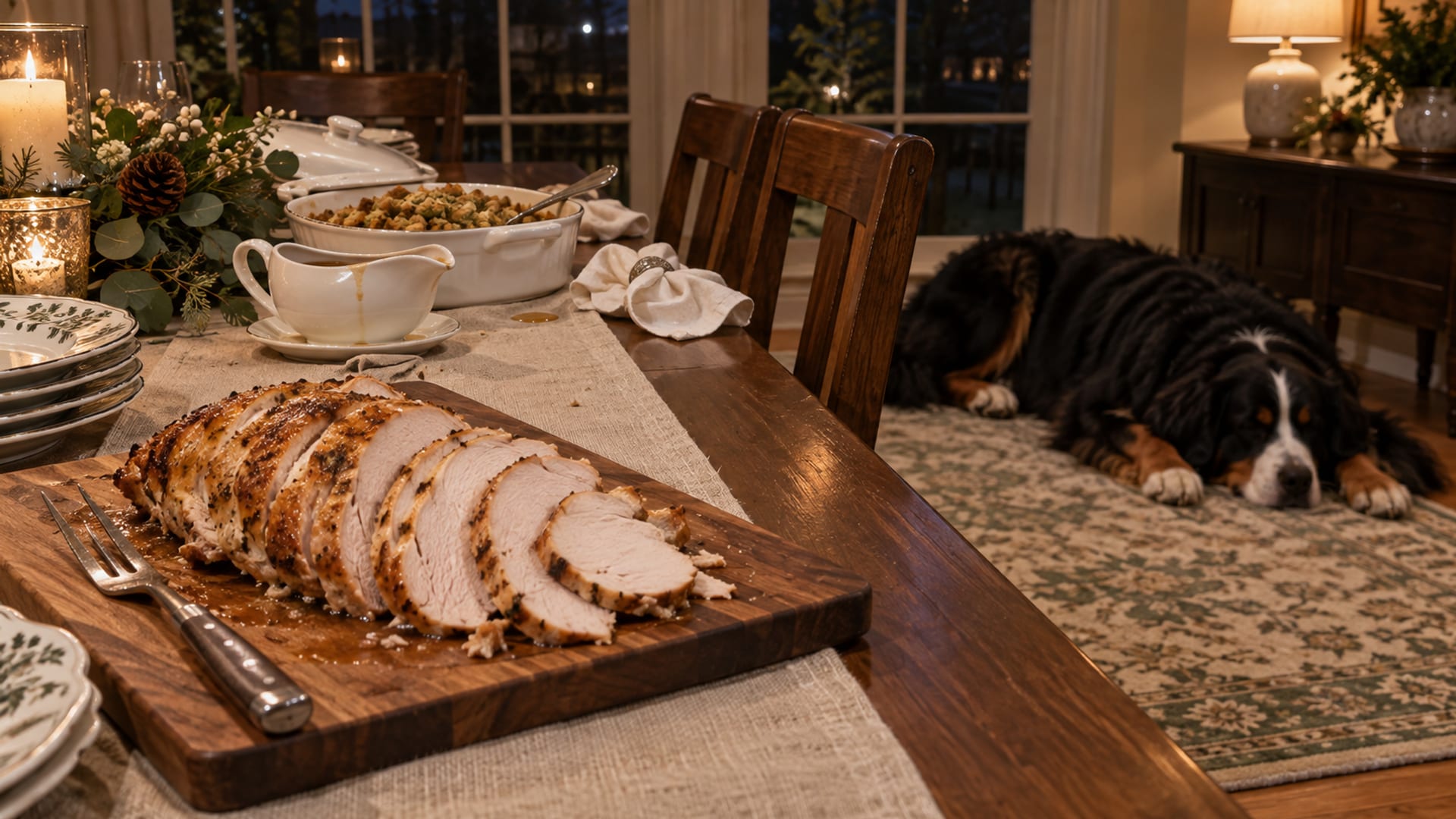
Yes. Plain turkey meat, fully cooked and with the bones out, is fine for most dogs in a small amount. The ASPCA says that if you share turkey, make it a small portion that is boneless and fully cooked, and the American Kennel Club says to take the skin off first.
The meat is rarely what gets a dog in trouble. The bones, the skin and drippings, the brine, the stuffing and gravy, and raw turkey are. If your dog raided the holiday leftovers, the table below sorts out what to do.
Key takeaways
Tap a card to bring it forward.
- Plain, fully cooked, boneless turkey meat is a fine small treat for most dogs.
- Cooked bones splinter. Any swallowed cooked bone is a reason to call your vet.
- Skin, fat, gravy and drippings are rich enough to upset the stomach and can bring on pancreatitis.
- Stuffing and seasoned turkey often hide onion and garlic; brined and deli turkey carry a lot of salt.
- Raw turkey can carry Salmonella and other germs, for your dog and your household.
Your dog got into the turkey: what to do
Tap or hover a row to highlight it.
| What they ate | What to do |
|---|---|
| What they ateA few bites of plain cooked meat | What to doNothing, beyond watching for a loose stool. |
| What they ateSkin, fat, drippings or gravy | What to doWatch for vomiting, diarrhea or belly pain. Call your vet if they appear, or right away if your dog has had pancreatitis. |
| What they ateA cooked bone, the carcass, a skewer, string or foil | What to doCall your vet now, even if your dog seems fine. |
| What they ateStuffing or seasoned turkey | What to doCheck for onion, garlic or xylitol. Call if any were in it or you are not sure. |
| What they ateBrined turkey, brine or a lot of deli meat | What to doCall your vet, especially if your dog is small or is drinking and peeing a lot. |
| What they ateRaw or undercooked turkey | What to doWatch for vomiting, diarrhea, fever or not eating, and call if those appear. Wash your hands and the bowls. |
Hold off on home fixes. Do not make your dog vomit, give hydrogen peroxide or medicine, or try to pull out a swallowed bone unless your vet tells you to. When you call, have ready what your dog ate, roughly how much and when, any ingredients you know, and your dog's weight.
A puppy, a very small dog, a dog that has had pancreatitis, or a dog that ate an unknown amount is worth a call even when the table says to watch.
Which parts of the turkey are safe
Tap or hover a row to highlight it.
| Part or form | Safe? | Why |
|---|---|---|
| Part or formWhite or dark meat, cooked plain | Safe?Yes, a little | WhyASPCA and AKC both allow plain cooked turkey |
| Part or formSkin | Safe?No | WhyHigh in fat, more so with butter or oil (AKC) |
| Part or formCooked bones, neck, wings, carcass | Safe?No | WhyBrittle; can choke, block or tear the gut |
| Part or formRaw meat or raw necks | Safe?Better not | WhySalmonella and other germs (FDA) |
| Part or formGravy and drippings | Safe?No | WhyFat, salt, and sometimes onion or garlic |
| Part or formStuffing | Safe?No | WhyOften onion, garlic, salt and fat |
| Part or formGiblets, cooked plain | Safe?A little | WhyLess worry than bones or fat; keep it a small extra |
| Part or formDeli, smoked turkey, turkey bacon, sausage | Safe?Better not | WhySalty, fatty and often seasoned |
The bones have their own page: can dogs eat turkey bones? covers what to do after a carcass raid, raw necks, and the signs of a blockage.
How much turkey to give, and how to prepare it
Keep it to a small portion as a treat and let your dog's regular food stay the main meal. The AKC says plain cooked turkey can be part of a homemade diet planned with your vet, and suggests talking with your vet about table food if your dog has a condition such as diabetes.
- Cook it all the way through.
- Pick lean meat and pull off the skin and any visible fat.
- Remove every bone, the cartilage, and any string or skewers.
- Skip the gravy, drippings, brine, stuffing, butter and seasoning.
- Cut it into small pieces and start with a little.
Plain ground turkey, cooked with nothing added, follows the same rules.
Signs to watch for after the holiday meal
What you see depends on what your dog ate:
- Too much meat or fat: vomiting, diarrhea, gas, belly discomfort, not wanting to eat, tiredness.
- Pancreatitis: vomiting, belly pain, a hunched back, weakness, not eating, diarrhea. This needs a vet.
- A bone or string: gagging, choking, drooling, trouble swallowing, repeated vomiting, straining, blood in the stool. These can show up right away or days later.
- Too much salt: heavy thirst and peeing, vomiting, diarrhea, weakness, wobbling, tremors or seizures, according to Merck.
- Germs from raw turkey: diarrhea, vomiting, fever, not eating, low energy.
Call your vet promptly for any of these, and go right away for choking, collapse, seizures or a dog that cannot keep water down.
Raw turkey and freeze-dried raw treats
Raw turkey can carry Salmonella, Listeria and Campylobacter. The FDA recommends cooking raw ingredients thoroughly and reports finding Salmonella and Listeria in raw pet food it sampled. It also notes that a dog can shed Salmonella without looking sick, which puts the people in the house at risk too.
Freeze-drying or dehydrating raw turkey takes out the water but does not reliably kill the germs. Some owners who feed raw use raw turkey necks, and the AKC says that choice needs a talk with your vet. For a household treat, cooked and boneless is the safer habit.
"Our dog gets turkey every Thanksgiving and loves it"
That can be a happy tradition, and plenty of dogs have a plate of plain turkey with no trouble. How it goes each year depends on what landed in the bowl. Lean white meat is one thing; skin, gravy and a bone off the carcass are another. A big dog handles a rich plate better than a small one, a dog with a pancreatitis history may not handle it at all, and a bone problem can take days to show. The same dog can also react differently from one year to the next. Keep the tradition and make it plain, lean and boneless.
Deli turkey, jerky, gravy and other turkey products
- Deli and smoked turkey: often brined or heavily salted, sometimes seasoned or preserved.
- Turkey bacon and sausage: processed, salty and fatty, often with onion or garlic.
- Human turkey jerky: salty and seasoned. Jerky sold as a dog treat is a separate product; read its label.
- Gravy: fat and salt, and often onion or garlic. Garlic in a holiday gravy is easy to miss, and can dogs eat garlic? covers what it does to dogs.
- "Turkey flavor" treats and turkey meal in dog food: check the ingredient list. Turkey meal is rendered and processed, and a flavor may contain little turkey.
- Turkey tail: can mean a mushroom supplement, a bird's tail or a chew. None of them are covered by this answer.
- Ham on the same table: can dogs eat ham? covers the other holiday roast.
Check what you learned
Quick check
Questions about dogs and turkey
Can dogs eat cooked turkey?
Yes, a small amount of plain, fully cooked, boneless meat. Leave off the skin and seasoning.
Can dogs eat turkey skin?
Better not. The skin is high in fat, more so with butter, oil or drippings, and too much fat can cause stomach upset and pancreatitis.
Can dogs eat raw turkey?
It is a caution food. Raw turkey can carry Salmonella and other germs, and cooking lowers that risk.
Can puppies eat turkey?
A little plain, fully cooked, boneless meat, cut small. Puppies are more likely to choke and to get sick from germs, so the boneless and cooked parts matter even more.
What if my dog ate turkey stuffing or gravy?
Check for onion, garlic, salt, fat, xylitol and bones, and think about how much went down. Call your vet for a large or unknown amount, or if any signs appear.
Can dogs eat deli turkey?
Not as a regular treat. Deli turkey is usually salty and often seasoned. A small piece of plain, low-salt turkey is the better pick.
Sources
Checked September 24, 2026.
- ASPCA, Thanksgiving Safety Tips
- American Kennel Club, Can Dogs Eat Turkey? Holiday Safety Tips for Pet Owners
- Merck Veterinary Manual, Salt Toxicosis in Animals
- U.S. Food and Drug Administration, Get the Facts: Raw Pet Food Diets Can Be Dangerous to You and Your Pet