

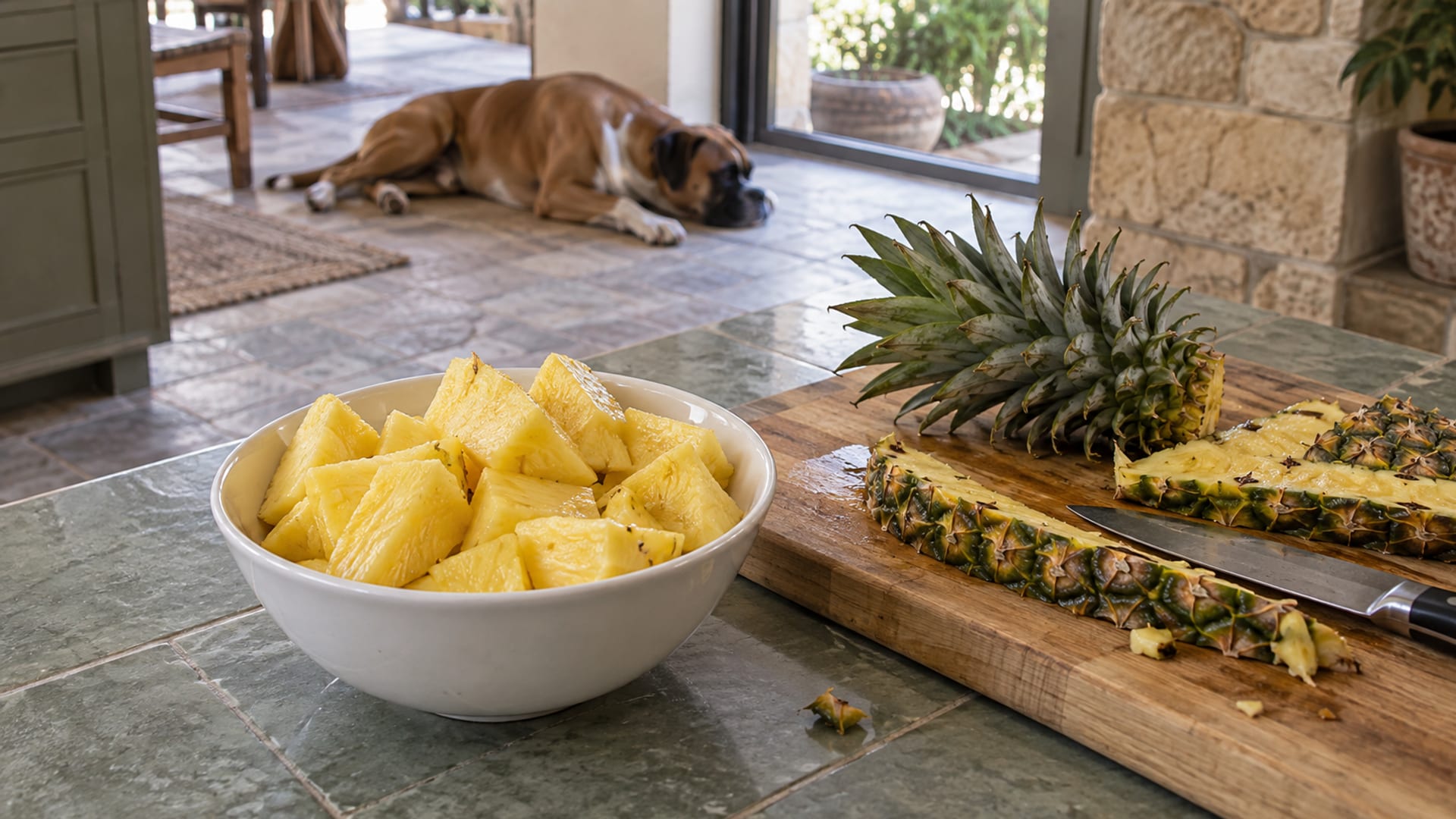
Yes. The AKC says raw pineapple is safe for dogs in small amounts, and Pet Poison Helpline lists fresh pineapple without the skin or core among foods safe for healthy pets. The spiny skin, the leafy crown and the woody core are what cause trouble, because a dog can choke on them or have them lodge in the gut.
If your dog ate a few chunks of the yellow flesh, there is nothing to do beyond watching for a loose stool. If they chewed up the core, swallowed pieces of skin, or ran off with the crown, call your vet.
Key takeaways
Tap a card to bring it forward.
- A few chunks of fresh pineapple flesh are plenty for most dogs.
- The skin, crown and core can choke a dog or cause a blockage.
- Frozen chunks of fresh pineapple make a cold treat.
- A big helping can bring vomiting or diarrhea from the sugar and fiber.
- Pineapple in syrup, piña colada mix and pineapple sweets stay off the menu.
Your dog got into the pineapple: what now
Tap or hover a row to highlight it.
| What they ate | Next move |
|---|---|
| What they ateA few chunks of flesh | Next moveNothing. Keep an eye on the next stool. |
| What they ateA large bowl of flesh | Next moveExpect some stomach upset. Call if vomiting or diarrhea keeps going. |
| What they ateThe core, skin or crown | Next moveCall your vet promptly and describe how big the pieces were. |
| What they ateCanned pineapple in syrup | Next moveWatch for an upset stomach, and check the label for anything besides fruit and sugar. |
| What they atePiña colada, pineapple cocktail, candy or cake | Next moveCheck for alcohol, xylitol, chocolate or macadamia nuts, and call if any are there. |
Take away whatever pineapple is left and check that your dog is breathing easily and acting like themselves, the first steps Pet Poison Helpline lists for any possible poisoning. For a swallowed core or skin, the ASPCA advises calling even if signs are mild or absent, instead of waiting for them to get worse. The people on the other end will ask your dog's age and health and what and how much they ate, according to the ASPCA, so have those answers ready.
Get to a vet right away for choking, labored breathing, collapse, seizures, vomiting that keeps coming, or a belly that is clearly painful.
Which parts of a pineapple are safe
Tap or hover a row to highlight it.
| Part | Okay for dogs? | Why |
|---|---|---|
| PartRipe flesh, raw | Okay for dogs?Yes, a few chunks | WhyThe AKC and Pet Poison Helpline both list it as safe |
| PartFrozen chunks of fresh flesh | Okay for dogs?Yes | WhyThe AKC suggests them as a treat |
| PartPlain cooked flesh | Okay for dogs?Yes, in small amounts | WhyNo added sugar, butter or glaze |
| PartSpiny skin | Okay for dogs?No | WhyTough and hard to chew: a choking and blockage hazard |
| PartCrown and leaves | Okay for dogs?No | WhyFibrous plant parts a dog cannot break down well |
| PartCore | Okay for dogs?No | WhyWoody enough to lodge in the gut |
| PartCanned in syrup | Okay for dogs?No | WhyHeavy added sugar |
| PartJuice | Okay for dogs?Skip it | WhyConcentrated sugar with little of the fiber |
The yellow flesh has water, natural sugar, fiber, vitamins and minerals, according to the AKC, which also says fruit should add to a complete dog food and never stand in for it. The risk from pineapple is almost all in the parts that do not get eaten by people either.
How much pineapple to give, and how to cut it
The AKC says a few chunks of raw pineapple are generally enough for most dogs. There is no chart by weight, so size the chunks and the number to your dog: a Yorkie gets one or two small cubes, a Lab can have a few more.
- Twist or cut off the crown.
- Stand the pineapple up and slice the skin away from top to bottom.
- Cut it into quarters lengthwise and slice out the hard core from each one.
- Cut the flesh into bite-size cubes, smaller for a small dog or a puppy.
- Try one or two the first time, and stop if your dog gets vomiting or diarrhea.
Freeze a few cubes on a tray for a summer treat. If your dog has diabetes, carries extra weight, has had pancreatitis, or has a sensitive stomach, check with your vet before adding sweet fruit, as Pet Poison Helpline recommends for any dog with health concerns.
Signs to watch for after the core, skin or a big helping
Too much flesh shows up during digestion: vomiting, diarrhea or a gurgling, uncomfortable belly. The AKC puts that down to the sugar and fiber. Call your vet if it keeps going or your dog stops eating.
A swallowed core, crown or large piece of skin is a different problem, and it can take longer to show because the piece has to travel before it gets stuck. Watch for:
- vomiting that repeats
- a painful or tight belly
- tiredness or hiding
- skipping meals
- straining with little or no stool
- distress that gets worse over time
Any of those after a core or skin means a call to your vet.
"My dog chews the pineapple core every summer and has always been fine"
That can be true, and a lot of dogs gnaw on a core without a problem. It is still not a guarantee for the next core or the next dog. A big dog that chews the core into shreds is in a different spot from a small dog that swallows a chunk whole. A dog that eats a whole core in one sitting takes on more than one that nibbles the edges. And a stuck piece may not cause trouble until later, after everyone has stopped watching. The safe routine is to toss the core, skin and crown into a bin your dog cannot open.
Canned, dried, juice and other pineapple products
- Canned pineapple in syrup: the AKC says to skip it because of the added sugar. Pineapple packed in water or its own juice is not toxic; drain it and share only a piece or two.
- Dried pineapple: the sugar is concentrated, and some brands add more sugar or preservatives. A small piece at most.
- Pineapple juice: more concentrated than the fruit and missing most of its fiber, and some bottles are sweetened. Water is the better choice.
- Pineapple candy, soda and cake: sugar first, and sometimes xylitol, chocolate or macadamia nuts. Read the label before any of it reaches your dog.
- Piña colada and pineapple cocktails: alcohol, plus a lot of fat. Call if your dog drank some.
- Pineapple sage and pineapple lily: garden plants named for their scent or shape, and neither one is the fruit. If your dog chewed one, tell your vet the plant's name.
Check what you learned
Quick check
Questions about dogs and pineapple
Is pineapple a laxative for dogs?
Not in any reliable way. Too much pineapple can loosen a dog's stool because of its sugar and fiber, which the AKC notes can upset digestion. A few chunks usually do nothing to the stool at all.
Can dogs eat the pineapple core?
No. The core is tough enough to cause a blockage. Cut it out and throw it away.
Can dogs eat canned pineapple?
Skip anything packed in syrup. Pineapple canned in water or its own juice is okay in a small amount if you drain it first.
Can dogs drink pineapple juice?
It is better to give fresh chunks. Juice is concentrated and often sweetened, and it lacks most of the fiber in the fruit.
Can puppies eat pineapple?
A small cube of fresh flesh is fine. Cut it smaller than you would for an adult dog, since puppies choke more easily and tend to swallow tough bits.
What other fruits need their peel or pits removed?
Several. Orange peel carries oils that upset a dog's stomach, and Can dogs eat oranges? covers it. Peach pits are a choking and blockage risk, explained in Can dogs eat peaches?.
Sources
Checked September 24, 2026.
- American Kennel Club, Can Dogs Eat Pineapple?
- American Kennel Club, Fruits and Vegetables Dogs Can or Can't Eat
- Pet Poison Helpline, Pet Friendly Human Food
- Pet Poison Helpline, Emergency Instructions for Pet Poisoning
- ASPCA, My Pet Ate Something! When Should I Seek Help?
- ASPCA, Emergency Care for Your Pet