

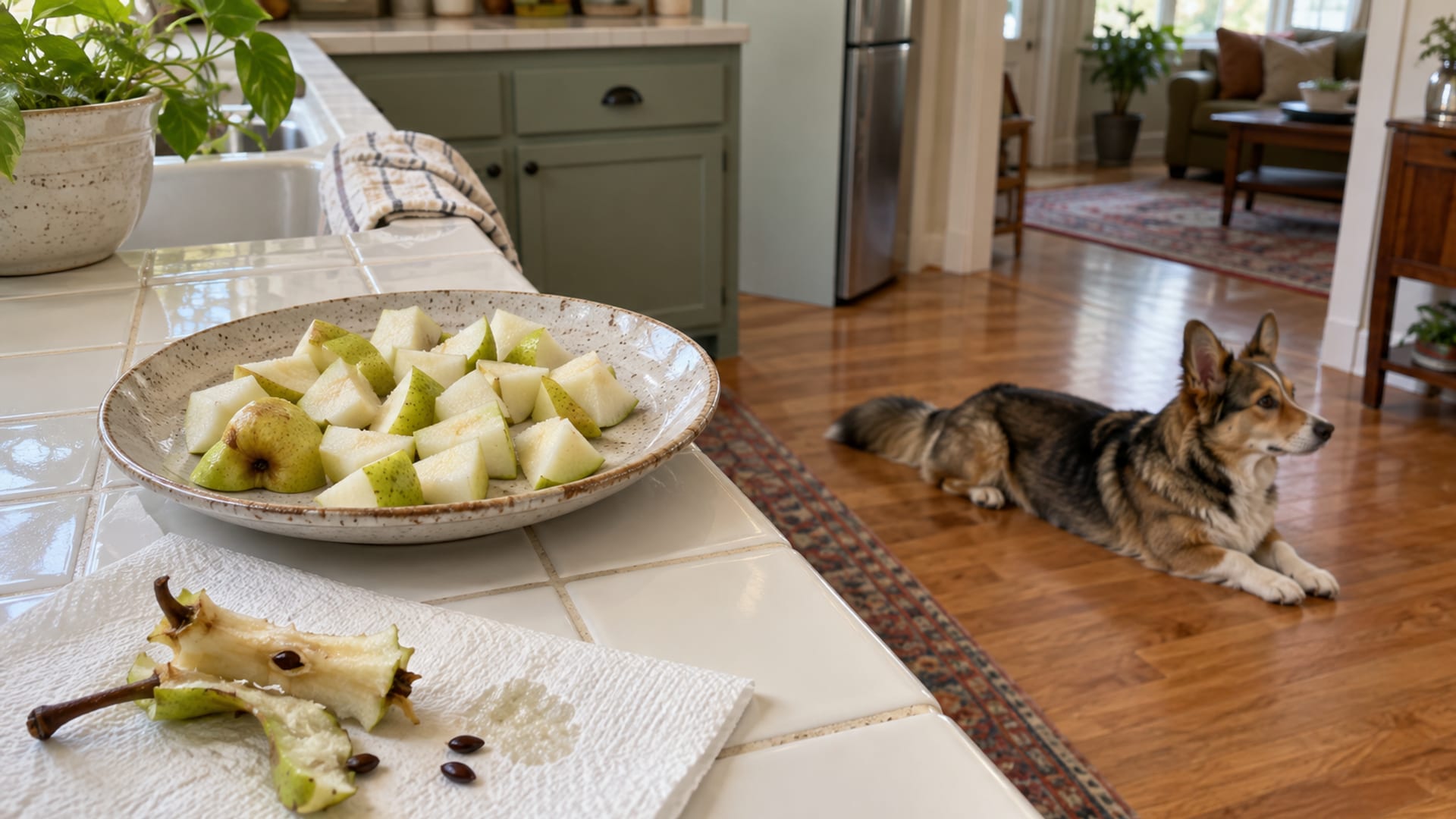
Yes. Ripe pear is safe for dogs in moderation once the core and seeds are out, according to the AKC and Pet Poison Helpline. The seeds contain traces of cyanide, and the core is a choking and blockage risk, most of all for a small dog.
A few pieces of pear flesh need nothing from you. If your dog swallowed a core, crunched a handful of seeds, or cleaned out a bowl of canned pears or pear pie, the next section walks through each case.
Key takeaways
Tap a card to bring it forward.
- Ripe pear flesh, cut into small pieces, is a safe occasional treat.
- Cut out the core and every seed before sharing.
- Pear seeds contain traces of cyanide, which becomes a problem in large amounts.
- A swallowed core can choke a small dog or get stuck further down.
- Pears in syrup, pie filling and sugar-free pear products need a label check.
If your dog already ate pear
Tap or hover a row to highlight it.
| What they ate | What to do |
|---|---|
| What they ateA few pieces of flesh, with or without skin | What to doNothing. A big helping may bring a loose stool or some gas. |
| What they ateA whole core, small dog | What to doCall your vet. A core is big enough to choke or block a small dog. |
| What they ateA whole core, large dog | What to doWatch closely for gagging, vomiting, belly pain or skipped meals, and call if any appear. |
| What they ateA lot of chewed seeds | What to doCall your vet or a poison line, with your dog's weight and a rough count. |
| What they ateCanned pears, pie filling, jam or baby food | What to doRead the label for xylitol, grapes, raisins or alcohol, and call if any are listed. |
The AAHA advises that when a dog may have eaten something toxic, you call your veterinarian or a pet poison control line right away for instructions. Have the part eaten, the amount, the time and your dog's weight ready, and keep the can or jar if there was one.
Go to a vet now if your dog is choking, struggling to breathe, collapses, vomits over and over, has a painful belly, or is suddenly very flat and weak.
Which parts of a pear are safe
Tap or hover a row to highlight it.
| Part | Safe? | Why |
|---|---|---|
| PartRipe flesh | Safe?Yes, in small pieces | WhyAKC and Pet Poison Helpline both call it safe |
| PartSkin | Safe?Yes, washed | WhyNeither source flags it; peel it for a sensitive stomach |
| PartCore | Safe?No | WhyChoking and blockage risk, and it holds the seeds |
| PartSeeds | Safe?No | WhyTraces of cyanide, per the AKC |
| PartStem and leaves | Safe?No | WhyPlant parts with no place in a dog's bowl |
The Merck Veterinary Manual explains that in plants that can form cyanide, the seeds and leaves carry far more of it than the fleshy fruit. The AKC describes pear seeds as holding traces of cyanide that turn toxic in large quantities. A seed has to be chewed or broken down before much cyanide is released, which is one reason a seed or two swallowed whole tends to pass without trouble.
How much pear to give, and how to prepare it
The AKC gives a sense of scale: a slice now and then may suit a small dog, while a whole pear is probably too much. It also says treats should stay within 10 percent of what your dog eats in a day, and Pet Poison Helpline keeps food outside the regular diet to 5 to 10 percent.
- Wash the pear.
- Quarter it and cut out the core, then check for stray seeds.
- Cut the flesh into bite-size pieces, smaller for a little dog or a puppy.
- Start with a piece or two and see how your dog's stomach handles it.
Pear is sweet. If your dog has diabetes, is on a weight-loss plan or a prescription diet, or has a touchy gut, ask your vet first.
Signs to watch for after a core or seeds
From too much flesh, the usual result is short-lived: vomiting, diarrhea, gas or a sore-looking belly.
A core or a large swallowed chunk is a mechanical problem. Watch for:
- gagging, coughing or trouble breathing
- vomiting that repeats
- belly pain, or a dog who will not settle
- tiredness and not wanting to eat
- straining with no stool coming out
Cyanide poisoning from a large dose of chewed seeds comes on fast. Merck describes weakness, trouble breathing, worsening nervous-system signs and collapse. Any of those means an emergency vet now.
"Our dog has eaten fallen pears from the yard for years"
That happens, and for that dog it has gone fine. It still does not make pears safe in every form for every dog. A dog eating soft fallen fruit may mostly get flesh, and seeds swallowed whole release little. A bigger dog handles a core that could lodge in a small one. The amount changes from one day to the next, and a blockage can show up after the dog seemed fine. If your dog forages under a pear tree, keep an eye on what they are eating and how their stomach behaves afterward.
Canned pears, baby food and other pear look-alikes
- Canned pears: the AKC says to skip pears in syrup. Fruit packed in syrup or with added sugar is not a dog treat.
- Pear juice and nectar: mostly sugar, without the fiber of the fruit.
- Pear puree and baby food: read the label. Some blends add other fruit juices, and Pet Poison Helpline warns that grape derivatives may be toxic to pets.
- Dried pear: more sugar and calories in every bite. A small piece at most.
- Pie filling, preserves and jam: sugar and spices, and sometimes raisins or alcohol.
- Sugar-free pear products: check for xylitol. The Merck Veterinary Manual describes xylitol as causing low blood sugar and liver failure in dogs.
- Asian, nashi and Korean pears: the same rules as any pear: flesh yes, core and seeds out.
- Avocado pear or alligator pear: another name for avocado, a different plant listed separately in the Merck Veterinary Manual. Can dogs eat avocado? covers it.
- Prickly pear: the fruit of a cactus, unrelated to the pear on your counter. Ask your vet if your dog ate one.
Check what you learned
Quick check
Questions about dogs and pears
Can dogs eat pear with skin?
Yes. Pear skin is not a known problem for dogs. Wash the fruit well, and peel it if your dog tends to get an upset stomach from new foods.
Are pear seeds poisonous to dogs?
They contain traces of cyanide, and the AKC says they become toxic in large quantities. A seed or two swallowed whole is unlikely to matter; a lot of chewed seeds is a reason to call your vet.
My dog ate a pear core. What should I do?
For a small dog, call your vet, because the core can block the gut. For a big dog, keep watching for vomiting, belly pain or not eating even after the first few hours, and call if you see any of them.
Can puppies eat pears?
A small piece of flesh with no core or seeds is fine. Cut it very small, and keep treats a tiny part of a growing puppy's diet.
Are pears or apples better for dogs?
Both work the same way: the flesh is fine in small pieces, and the core and seeds come out. Can dogs eat apples? covers apple seeds and cores in detail.
Sources
Checked September 24, 2026.
- American Kennel Club, Can Dogs Eat Pears?
- Pet Poison Helpline, Friendly Fall Foods
- Merck Veterinary Manual, Cyanide Poisoning in Animals
- Merck Veterinary Manual, Hepatotoxins in Small Animals
- Merck Veterinary Manual, Plants Poisonous to Animals
- American Animal Hospital Association, Recognizing the Signs of Poisoning in Dogs