
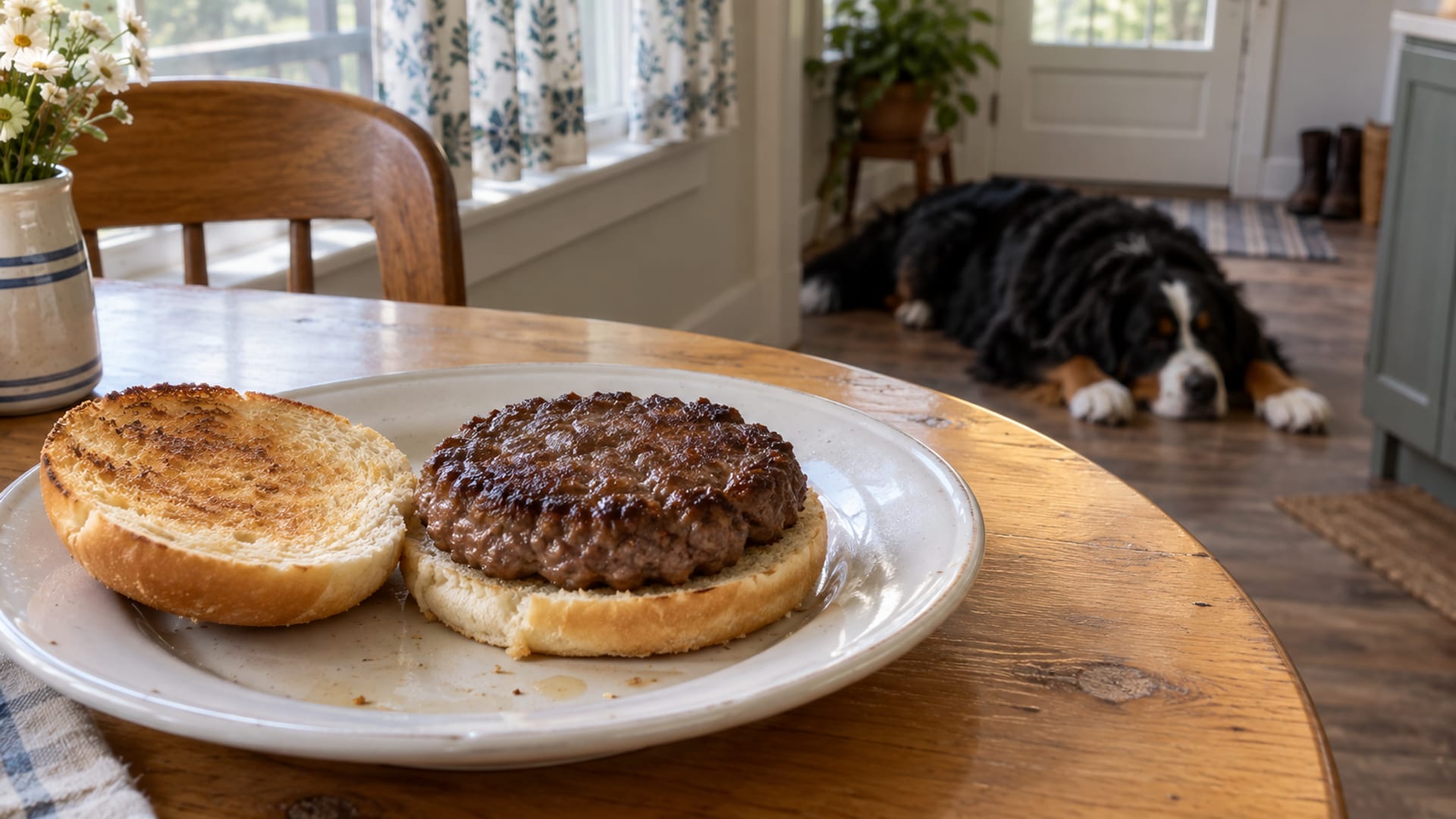
Yes, if it is plain. A small amount of fully cooked, unseasoned hamburger meat with the fat drained is fine for most dogs, and the American Kennel Club says it can add protein to a complete diet. The burger on your plate is usually a different food. Onion and garlic can damage a dog's red blood cells, grease can bring on pancreatitis, and raw or undercooked meat can carry Salmonella and E. coli.
If your dog grabbed a bite of a plain patty, you likely have nothing to do. If they ate a burger made with onion or garlic, a greasy pile of drippings, raw ground beef, or a burger with an unknown sauce, the table below tells you what to do.
Key takeaways
Tap a card to bring it forward.
- Plain, fully cooked hamburger meat with the fat drained is fine in small amounts.
- Onion and garlic, fresh or powdered, are the ingredients that turn a burger into a vet call.
- Greasy meat, drippings and big portions can cause vomiting and pancreatitis.
- Raw or undercooked ground beef can carry Salmonella and E. coli.
- A plain bun is not toxic, but sauces, cheese and toppings each need a look.
My dog ate a hamburger: what to do now
Tap or hover a row to highlight it.
| What they ate | What to do |
|---|---|
| What they ateA bite or two of plain cooked patty | What to doNothing. Watch for a loose stool. |
| What they ateA whole burger with onion, garlic or onion or garlic powder | What to doCall your vet or a pet poison line today, even if your dog seems fine. |
| What they ateA big helping of greasy meat, drippings or fat trimmings | What to doCall your vet, and watch for vomiting, diarrhea, belly pain or tiredness. |
| What they ateRaw or undercooked ground beef | What to doWatch for vomiting and diarrhea. Call if it was a puppy, an older dog, or a dog who is ill. |
| What they ateA burger with an unknown sauce, or a sugar-free sauce | What to doCheck for xylitol, onion and garlic. Call if you cannot tell. |
| What they ateA burger with bone pieces, or a whole wrapped burger | What to doCall your vet. Watch for gagging, repeated vomiting or straining to pass stool. |
When you call, have your dog's weight, what was in the burger, roughly how much they ate, and when. The ASPCA says to call your vet or its poison control center right away if you suspect your pet ate something toxic.
Go to an emergency vet now for weakness, collapse, pale gums, fast breathing, dark or bloody urine, seizures or trouble breathing.
What in a burger causes the trouble
Hamburger meat on its own is not a poison. The risk depends on what went into the burger and how it was cooked.
Tap or hover a row to highlight it.
| Part | Concern | Why |
|---|---|---|
| PartPlain cooked patty, fat drained | ConcernLow | WhyThe AKC's version: cooked through, nothing added |
| PartRaw or undercooked meat | ConcernModerate | WhyCan carry Salmonella, E. coli and other germs |
| PartGrease, drippings, fatty trimmings | ConcernModerate to high | WhyCan cause vomiting, belly pain and pancreatitis |
| PartOnion, garlic, chives, shallots, their powders | ConcernHigh | WhyDamage red blood cells; cooking does not make them safe |
| PartHeavy salt or seasoning blends | ConcernModerate | WhySalt poisoning is possible in large amounts |
| PartCheese | ConcernLow to moderate | WhyAdds fat; can upset a lactose-sensitive dog |
| PartKetchup, barbecue or special sauce | ConcernCheck the label | WhySome contain onion, garlic, a lot of salt, or xylitol |
| PartPickles | ConcernCheck the label | WhySalt and seasonings |
| PartPlain bun | ConcernLow | WhyNot toxic in a small amount, with little to offer a dog |
| PartCooked bone pieces | ConcernHigh | WhyCan splinter, block or injure the gut |
Onion and garlic are the biggest reason to call. The Merck Veterinary Manual says raw, cooked and powdered onion and garlic can all cause a type of anemia in dogs. Pet Poison Helpline notes that Japanese breeds such as the Akita and Shiba Inu are more sensitive to them. Our pages on onions and garlic list the published reference amounts.
Fat is the next concern. The ASPCA says fat drippings and greasy leftovers can cause vomiting, stomach pain and pancreatitis in some pets. For raw meat, the FDA warns that it can carry harmful bacteria, and that dogs can carry and shed them while looking healthy, which puts the people in the house at risk too.
How to share plain hamburger
The AKC's steps for a dog-safe portion:
- Cook the meat all the way through.
- Leave out onion, garlic, salt, sauces and spices.
- Drain or blot off the fat, and use lean meat when you can.
- Check for and remove any bone pieces.
- Cut it into bite-sized pieces.
- Serve it as an occasional extra on top of your dog's normal complete food.
No published chart gives a hamburger portion by dog size, so keep it to a few small pieces for a small dog and a little more for a big one. Hamburger should not become the whole diet. The AKC warns that a dog fed only hamburger, or hamburger and rice, over time can end up short on nutrients such as calcium.
Skip the fatty meat entirely for a dog who has had pancreatitis. Merck lists table scraps and eating inappropriate food as common suspected triggers, and notes that Miniature Schnauzers, Yorkshire Terriers, Cocker Spaniels, Dachshunds and Poodles are among the breeds that get it more often.
Signs to watch for, and when
What you see depends on what was in the burger:
- Grease or a big portion: vomiting, diarrhea, belly pain, tiredness or not eating. Pancreatitis can be severe.
- Onion or garlic: vomiting or diarrhea may come early, but the damage to red blood cells can take several days to show. Watch for weakness, pale gums, fast breathing, a racing heart, and red or dark urine.
- Raw meat: vomiting, diarrhea, fever or tiredness, though some dogs show nothing and still carry the germs.
- Heavy salt: thirst, peeing a lot, vomiting, diarrhea, and in severe cases tremors or seizures, according to the ASPCA.
- Bone pieces: gagging, repeated vomiting, belly pain or straining without passing stool.
Any of these after a burger is a reason to call your vet.
"My dog gets burger scraps at every cookout and has been fine"
That can be true, and plenty of dogs have had a bite of burger with no trouble. It is still not a rule you can lean on. One burger has no onion and the next has onion powder mixed into the meat. A bite is a very different amount from a whole patty and the grease in the pan. A small dog gets a much bigger dose from the same scrap. Some dogs, and some breeds, are more prone to pancreatitis or more sensitive to onion. And the anemia from onion or garlic can show up days after the cookout, when nobody connects it to the burger. Keep a few plain pieces aside for your dog before the seasoning goes on.
Cheeseburgers, fast food, buns and other burger foods
- Cheeseburgers and bacon burgers: more fat and salt. Cheese can upset a lactose-sensitive dog; see can dogs eat cheese?
- Fast-food and restaurant burgers: you cannot see the salt, fat or seasoning, so skip them as a planned treat.
- Buns: a plain bun is not toxic in a small amount. See can dogs eat bread? for more, and keep raw yeast dough away from dogs.
- Fries on the side: salt and oil; can dogs eat french fries? covers them.
- Pickles and condiments: read the label; can dogs eat pickles? has the details.
- Hamburger steak, meatloaf and meatballs: often mixed with onion, breadcrumbs and seasoning.
- Hamburger Helper and boxed meals: seasoning packets can contain onion, garlic and a lot of salt.
- Plant-based burgers: not hamburger at all. They can contain onion, garlic and a lot of sodium, so read the label.
- Dog burgers and beef dog treats: made for dogs, so the product label is your guide.
- Freeze-dried or dehydrated raw beef: drying does not always kill germs unless the label says the product went through a pathogen-control step.
Cats are even more sensitive to onion and garlic than dogs, so a cat that shared a seasoned burger needs a call too.
Check what you learned
Quick check
Questions about dogs and hamburger
Can dogs eat plain cooked hamburger?
Yes, a small amount. Cook it through, leave out seasoning, drain the fat, and use it as an occasional extra, never the whole diet.
Can dogs eat raw hamburger?
It is best avoided. The FDA warns that raw meat can carry Salmonella and E. coli, which can make dogs and the people around them sick.
What if the hamburger had onion or garlic in it?
Call your vet or a pet poison line. Onion and garlic can damage red blood cells, and the signs can take days to appear.
Can hamburger cause pancreatitis in dogs?
It can. Fatty hamburger, grease and big portions of table food are linked to pancreatitis in dogs prone to it. Watch for vomiting, belly pain, tiredness, diarrhea and not eating.
My dog ate a fast-food burger. What should I do?
Find out what was in it and how much your dog ate. Call your vet if it had onion, garlic, a lot of grease, an unknown sauce or bones, or if your dog starts showing any signs.
Sources
Checked September 24, 2026.
- American Kennel Club, Can Dogs Eat Hamburgers?
- American Kennel Club, Do Dogs Need to Eat Meat?
- ASPCA, What BBQ Staples are Dangerous to My Pet? (June 2025)
- ASPCA Animal Poison Control Center, People Foods to Avoid Feeding Your Pets
- Merck Veterinary Manual, Garlic and Onion (Allium spp) Toxicosis in Animals (reviewed September 2024)
- Merck Veterinary Manual, Pancreatitis and Other Disorders of the Pancreas in Dogs
- Pet Poison Helpline, Onions Are Toxic To Dogs
- U.S. Food and Drug Administration, Get the Facts! Raw Pet Food Diets can be Dangerous to You and Your Pet