
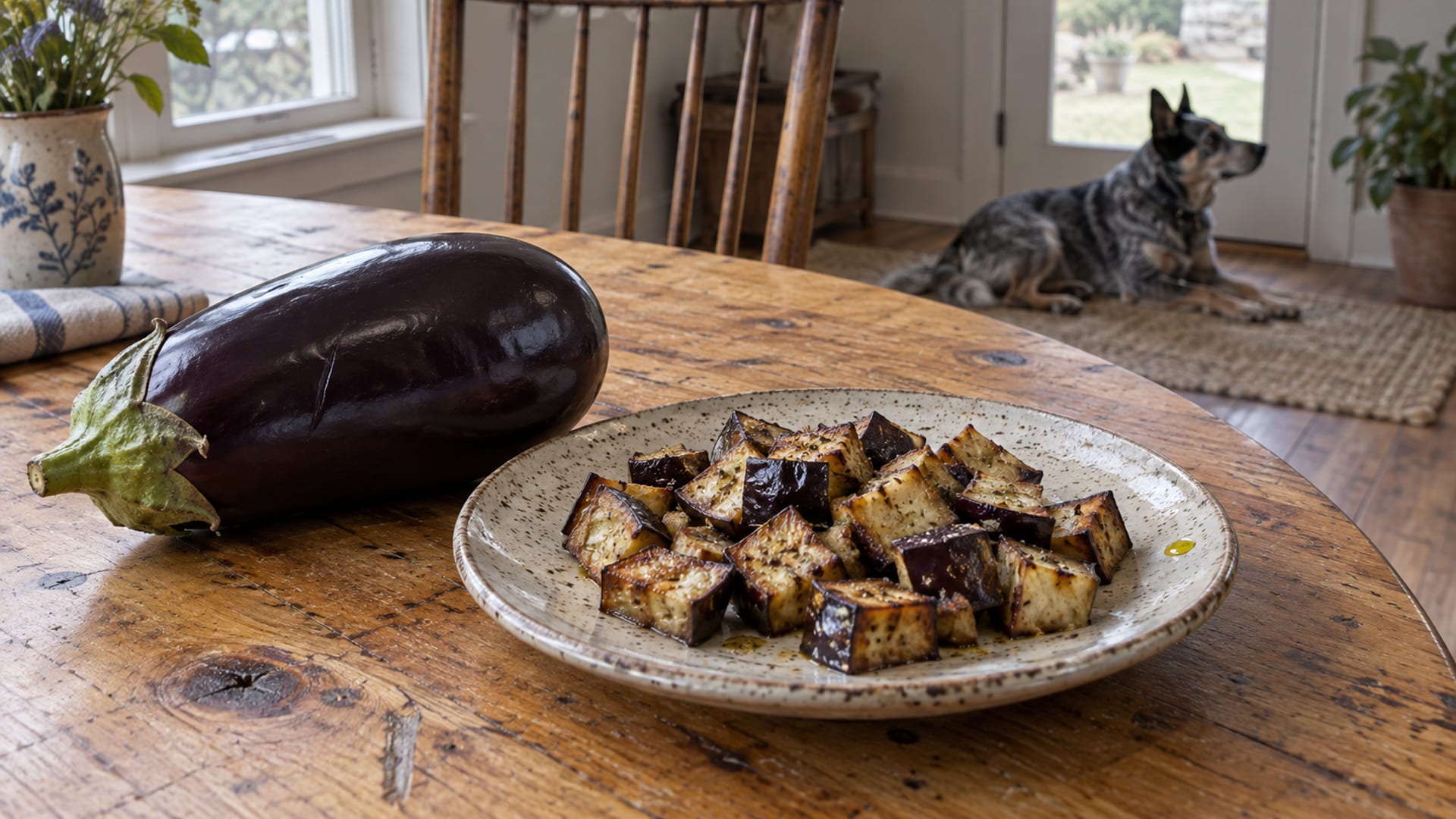
Yes. A small amount of plain, ripe eggplant is safe for most dogs, and the American Kennel Club says dogs can eat it in moderation, cut into tiny pieces. Cooked eggplant is softer and easier to chew, though ripe raw eggplant is fine too. The rest of the plant is a different case: the leaves, stems, flowers and unripe fruit can carry more of the natural compounds that make some nightshades poisonous.
If your dog snatched a cube of plain eggplant off the cutting board, keep an eye out for an upset stomach and carry on with your evening. If they chewed the plant in your garden, ate a lot, or got into a dish made with garlic or onion, the table below tells you what to do.
Key takeaways
Tap a card to bring it forward.
- Plain, ripe eggplant in small pieces is an occasional treat most dogs handle well.
- Cooked and unseasoned is the easiest form for a dog to chew and digest.
- The leaves, stems, flowers and unripe fruit are the parts to keep away from dogs.
- Baba ganoush, eggplant parmesan and fried eggplant bring garlic, onion, fat and salt along.
- Vomiting, drooling, weakness or confusion after eating the plant means it is time to call your vet.
If your dog already ate eggplant
Tap or hover a row to highlight it.
| What they ate | What to do |
|---|---|
| What they ateA few pieces of plain ripe eggplant, raw or cooked | What to doMost likely nothing. Watch for vomiting or a loose stool over the day. |
| What they ateA large amount of plain eggplant | What to doWatch closely, and call your vet if vomiting, diarrhea or belly pain shows up. |
| What they ateLeaves, stems, flowers or green unripe fruit | What to doCall your vet or a pet poison line promptly with your dog's weight and a rough amount. |
| What they ateA garden plant you are not sure is eggplant | What to doCall, and bring a photo or a piece of the plant. |
| What they ateBaba ganoush, eggplant parmesan, a casserole or fried eggplant | What to doCheck the recipe for garlic, onion, oil and cheese. If garlic or onion is in it, call. |
| What they ateEggplant powder, capsules, extract or juice | What to doCall, with the label in hand. |
For a plant your dog may have been poisoned by, the ASPCA tells owners to reach its poison control center or their own vet quickly. Pet Poison Helpline says the risk depends on how much was eaten, the size of the animal, and individual factors such as allergies.
Get your dog seen right away if you notice weakness, confusion, wide pupils, tremors, collapse, heavy drooling, or trouble breathing.
Which parts of the eggplant are safe
Tap or hover a row to highlight it.
| Part | Safe? | Why |
|---|---|---|
| PartRipe flesh, cooked and plain | Safe?Yes, in small amounts | WhySoft and easy to chew; the AKC's preferred way to serve it |
| PartRipe flesh, raw | Safe?Yes, in small amounts | WhyThe AKC says ripe raw eggplant is fine, just harder to chew |
| PartSkin | Safe?Yes, peeling is better | WhyNot toxic, but tough, and the AKC notes a choking risk |
| PartSeeds inside the fruit | Safe?Yes | WhyFine along with the flesh |
| PartStem and green cap | Safe?No | WhyCut them off before serving |
| PartLeaves, shoots and flowers | Safe?No | WhyPoisonous parts of Solanum plants, according to Merck |
| PartUnripe fruit | Safe?No | WhyYoung fruit can carry higher levels of glycoalkaloids |
| PartPowder, capsules, extract, juice | Safe?No | WhyConcentrated, with no dog-specific safety data behind them |
The Merck Veterinary Manual names the leaves, shoots and unripe berries as the poisonous parts of plants in the Solanum group, and eggplant belongs to that group. A study of two Iranian eggplant varieties by Bagheri and colleagues found that levels of solasonine, one of these compounds, differed between leaves, flowers and fruit and shifted as the fruit matured.
A green eggplant is not always an unripe one. Some varieties stay green, white or striped when fully ripe, so go by the variety and how firm and full-sized the fruit is before you share any.
How much eggplant to give, and how to serve it
The AKC recommends tiny, bite-sized pieces, a slow start, and keeping all treats within 10% of your dog's daily calories. To prepare it:
- Wash the eggplant and cut off the stem and cap.
- Peel it, which removes the tough skin.
- Cut it into small pieces.
- Cook it plain, with no oil, butter, salt, garlic, onion or sauce.
No published serving size by body weight exists for eggplant, so start with a piece or two and give a small dog less than a large one. Watch how the first serving sits before offering more. If your dog is on a medical diet, ask your vet first. For a dog that has had pancreatitis, oily or fried eggplant is the one to avoid, because of the fat.
Signs to watch for after the plant or a big helping
Most dogs that eat a little plain eggplant show nothing at all. Pet Poison Helpline says a few bites of fruit or foliage from food-crop nightshades are unlikely to cause more than mild nausea.
A larger amount, or the leaves and stems, can cause more. For nightshade plants in general, the ASPCA lists:
- vomiting and diarrhea
- drooling or not wanting to eat
- drowsiness or confusion
- weakness
- dilated pupils
- a slow heart rate
The sources give no typical onset time for eggplant itself, so keep your dog close for the rest of the day and call your vet if any of these show up.
"My dog eats eggplant out of the garden and has always been fine"
That can be true, and plenty of dogs nibble a ripe eggplant with no trouble at all. It just does not make every eggplant exposure safe for every dog. How much they ate matters, and so does their size, because a few pieces are a much bigger dose for a Chihuahua than for a shepherd. The part matters too: ripe fruit is not the same as leaves, flowers or a young green fruit, and researchers have found the compound levels change with the tissue, the variety and the stage of ripeness. Dogs also differ in how sensitive they are. And "nightshade" is a name for more than 2,000 plants, some of them far more toxic than eggplant, so a dog that is fine with one may not be fine with a weed growing beside it. Fencing off the garden bed is the simplest fix.
Baba ganoush, eggplant parmesan and other eggplant dishes
- Baba ganoush and eggplant dips: can contain garlic, plenty of oil and salt. Garlic is a problem for dogs; see can dogs eat garlic?
- Eggplant parmesan and casseroles: cheese, oil, salt, and often onion or garlic in the sauce. Can dogs eat onions? explains why that matters.
- Fried or grilled eggplant: the flesh soaks up oil, and fat is the concern for dogs prone to pancreatitis.
- Pickled eggplant: salty and spiced. Skip it.
- Eggplant powder, capsules and extracts: concentrated products with unknown amounts. Keep them out of reach.
- Aubergine, brinjal and garden egg: other names for the same plant, so the same answer applies.
- Other nightshades: tomatoes, potatoes and peppers each have their own answer. See can dogs eat tomatoes?, can dogs eat potatoes? and can dogs eat bell peppers?
Check what you learned
Quick check
Questions about dogs and eggplant
Can dogs eat raw eggplant?
Yes, if it is ripe. The AKC says ripe raw eggplant is fine, but cooked eggplant is softer and easier for a dog to chew.
Can dogs eat cooked eggplant?
Yes, when it is plain and cut small. Steamed, boiled or roasted without oil is the way to go. Skip anything cooked with garlic, onion, salt or a sauce.
Are eggplant leaves toxic to dogs?
Treat them as unsafe. Merck names the leaves and shoots as the poisonous parts of Solanum plants, so call your vet if your dog chewed them.
Can dogs eat eggplant skin and seeds?
The skin is not toxic, but it is tough, and the AKC mentions a choking risk, so peeling is safer. The small seeds inside the fruit are not listed as a separate hazard.
Is eggplant safe for cats?
The ASPCA lists nightshade plants as toxic to cats as well as dogs. Keep cats away from the leaves and stems, and ask your vet before sharing eggplant with a cat.
Sources
Checked September 24, 2026.
- American Kennel Club, Can Dogs Eat Eggplants?
- ASPCA Animal Poison Control Center, Nightshade
- Pet Poison Helpline, Nightshade Is Toxic To Dogs
- Merck Veterinary Manual, Plants Poisonous to Animals
- Bagheri and others, Evaluation of Solasonine Content and Expression Patterns of SGT1 Gene in Different Tissues of Two Iranian Eggplant Genotypes