

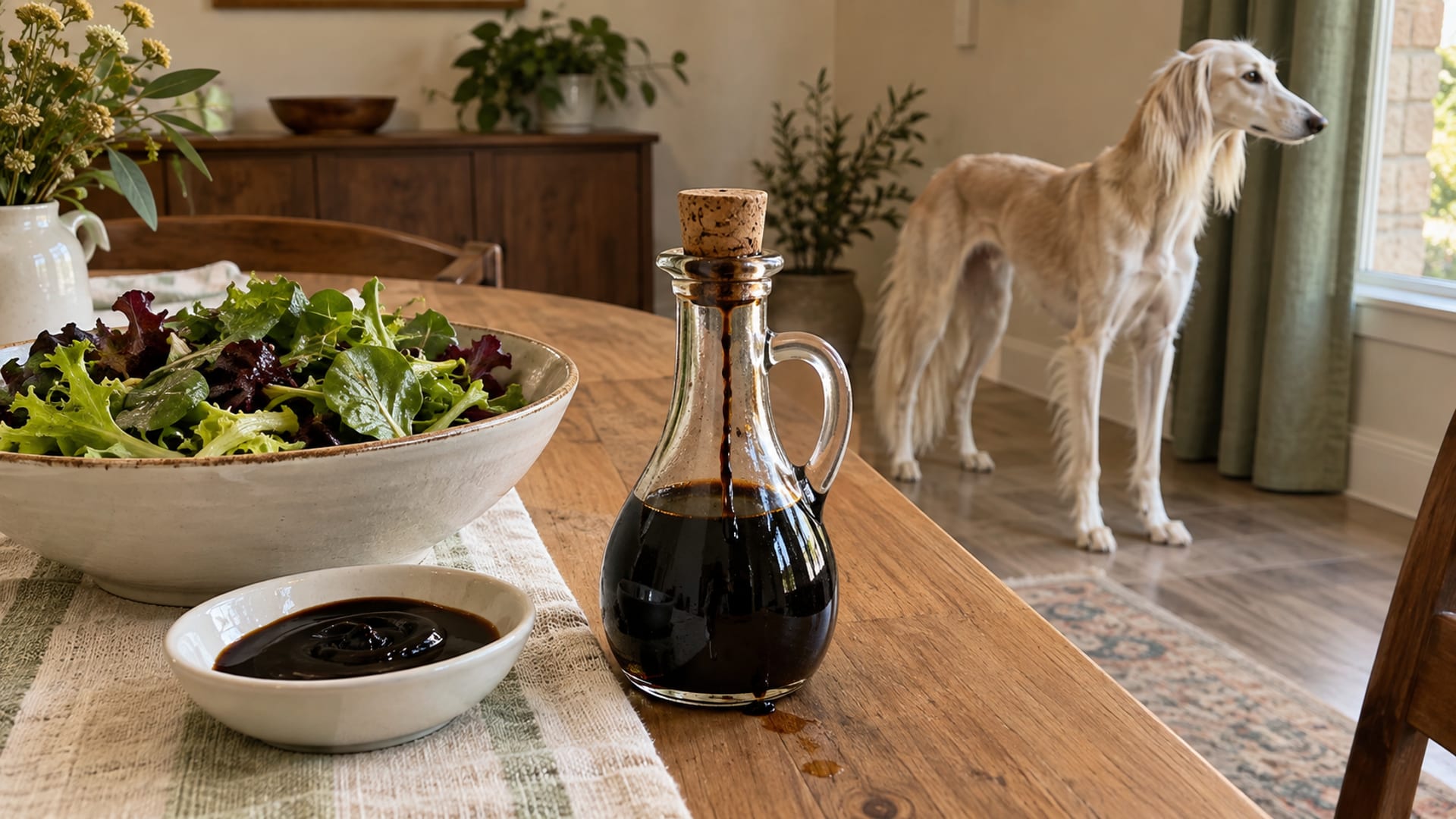
Not on purpose, but a small lick of plain balsamic vinegar is usually a minor problem. Its acid can sting the mouth and upset the stomach, and the veterinary sources that cover vinegar handle it as an irritant, separate from grape or raisin poisoning.
If your dog just licked some off the floor or a salad bowl, start with the bottle. A little plain food-grade vinegar usually means watching at home. A large amount, a cleaning vinegar, or a glaze or dressing with other ingredients means calling your vet or a poison line now.
I understand why this one causes a scare, since balsamic comes from grapes. The Merck Veterinary Manual does link grapes and raisins to kidney injury in dogs, and the FDA notes that some balsamic vinegars are made with grape must or concentrated grape juice. Neither treats ordinary balsamic like a handful of grapes. What the ASPCA describes with vinegar is irritation: stomach upset, vomiting, diarrhea and a sore mouth, mostly when the vinegar is concentrated or undiluted.
Key takeaways
Tap a card to bring it forward.
- A small lick of plain balsamic vinegar is usually a minor exposure, and the main risk is acid irritation of the mouth and stomach.
- Ordinary balsamic vinegar is handled separately from grapes and raisins, though a dish with raisins or grape pieces brings the fruit's own risk.
- Glazes, reductions, dressings and marinades can carry onion, garlic, xylitol, alcohol or extra salt, so the label decides how worried to be.
- Call now for a large or unknown amount, a concentrated or cleaning vinegar, or any drooling, vomiting, pain or trouble swallowing.
- Balsamic vinegar doesn't belong in your dog's bowl on purpose, in any amount.
What to do right now after a lick or a spill
These are the steps in the order I'd take them, with the bottle still in my hand.
- Move your dog away and clean up. Every extra lap adds acid.
- Read the label before you call. The ingredient list tells you whether onion, garlic, xylitol, alcohol, raisins or grape pieces are involved.
- Work out how much and when. Whoever you call will want the amount, the time and your dog's weight.
- Look at your dog's mouth and behavior. Drooling, pawing at the face, gagging, vomiting or struggling to swallow move you from watching to calling.
- Leave vomiting to the professionals. The Merck Veterinary Manual's guide to treating poisoning explains that inducing vomiting is not recommended when a substance could damage the esophagus or stomach on the way back up, and acid is that kind of substance.
- Call unless it was clearly a small lick of plain vinegar. The ASPCA's household products page tells owners to contact a veterinarian or poison control right away if they suspect a toxic exposure. For trouble breathing, collapse or seizures, the ASPCA's advice on when to seek help is to go straight to the nearest veterinary hospital.
Plain vinegar, glaze or dressing: which one did your dog get?
"Balsamic" on a label covers several products with different risks.
Tap or hover a row to highlight it.
| What your dog got into | Main concern | What to do |
|---|---|---|
| What your dog got intoA small lick of plain balsamic vinegar | Main concernMild acid irritation of the mouth or stomach | What to doWatch at home and call if signs appear |
| What your dog got intoBalsamic mixed into food or water | Main concernLess acid per lick, but still some | What to doWatch at home and call if signs appear |
| What your dog got intoA large amount or a knocked-over bottle | Main concernMore acid and more irritation | What to doCall your vet or a poison line now |
| What your dog got intoBalsamic glaze, cream or reduction | Main concernMore sugar and acid per spoonful, plus whatever else is in it | What to doRead the label, then call |
| What your dog got intoVinaigrette, dressing or marinade | Main concernOnion, garlic, xylitol, alcohol, salt or fat, depending on the recipe | What to doRead the label, then call |
| What your dog got intoA dish with raisins, grapes or dried currants | Main concernThe fruit itself, which is linked to kidney injury | What to doCall now |
| What your dog got intoCleaning vinegar or any non-food vinegar | Main concernStronger acid in a product not made to be eaten | What to doCall now |
Glazes and reductions are vinegar cooked down until it thickens, and cooking doesn't make it gentler. A reduction can pack more sugar and more acid into each spoonful than the thin vinegar it started as, and store-bought creams may add thickeners and flavorings. Dressings and marinades are where the extra ingredients hide: garlic or shallot in a vinaigrette, onion, salt and oil in a marinade. If the label shows onions or garlic, those become the bigger question. Xylitol or alcohol on a label is a reason to call right away.
How much balsamic is a problem, and can you share any?
This question has two halves, and the answers differ.
Sharing first. No veterinary or poison-control source gives a serving size of balsamic for dogs, and it adds nothing to their diet. If you like to share, set aside a few strawberries or lettuce leaves before the balsamic goes on.
Then the amount that should worry you. There is no published dose of balsamic vinegar that marks a line between safe and toxic for dogs. When you call, give your dog's weight and your best guess at the amount, and let the vet work from that. Size matters in a general way: a lick that a big dog barely notices is a larger share of a small dog's body weight.
Raisins and grapes are a different case. The Merck Veterinary Manual estimates that more than one grape or raisin per 4.5 kg (10 lb) of body weight may pose a kidney risk. That figure is for the fruit and never for the vinegar. Pet Poison Helpline adds that the exact amount that causes poisoning is unknown, so any raisins on that salad are worth a call. Our grapes and raisins page covers that side.
If your dog has pancreatitis, diabetes or kidney disease, ask your vet about even small tastes of a sugary reduction, a fatty dressing or a salty marinade.
Signs to watch for after balsamic vinegar
Most dogs that get a small lick of plain balsamic show nothing. The signs the ASPCA links to concentrated or undiluted vinegar are vomiting, diarrhea, mouth irritation and pain, and drooling, a dropped appetite or a tender belly belong with them. The ASPCA doesn't give a set time for these to start, so keep an eye on your dog for the rest of the day and call if any show up.
Stronger acids are a bigger worry. For corrosive exposures, the Merck Veterinary Manual's household hazards page lists drooling, vomiting, belly pain, trouble swallowing or breathing, throat swelling and ulcers in the mouth, esophagus or stomach and notes that these injuries can happen quickly, depending on strength and amount. The ASPCA's page on corrosive household products advises urgent evaluation because some effects appear later, which matters most with cleaning vinegar.
Go to a vet right away for collapse, unresponsiveness, seizures, bleeding, repeated vomiting, severe pain or heavy drooling. The realistic worst case from ordinary balsamic is a badly irritated mouth or stomach, or dehydration from ongoing vomiting and diarrhea. If raisins or grapes were in the dish, Merck reports that kidney failure can develop within 24 to 72 hours, so a quiet evening doesn't settle that part.
My dog ate it before and was fine
That happened, and I believe it. It just doesn't make balsamic safe for every dog every time.
A dog may show nothing because the amount was small, the vinegar was mixed into food, or the product was milder. The ASPCA describes vinegar as something that can cause irritation, which leaves room for dogs that react and dogs that don't.
The product changes too: this time it might be a garlic-heavy marinade, a sweet glaze or cleaning vinegar. With grapes or raisins, Pet Poison Helpline notes that dogs don't all react the same way. Your dog's good luck was real, and it was one dog, one product and one amount.
Balsamic look-alikes and the other vinegars in your kitchen
A few names and neighbors come up often when people search this.
- Aceto balsamico, balsamic vinegar of Modena and white balsamic. The name alone can mean a thin vinegar, a thick glaze or a dressing, so check the label.
- Red wine vinegar and grape vinegar. These are also made from grapes, and the FDA's vinegar definitions give wine and grape vinegar their own categories. A small lick is still mainly an acid question.
- Apple cider, white and rice vinegar. These share the same acid; the Merck Veterinary Manual covers acetic acid, the acid in vinegar, among acids used as antiseptics in animal care.
- Cleaning vinegar and vinegar water. Cleaning vinegar can be stronger than table vinegar and isn't food-grade, and the ASPCA's household products page notes that vinegar-and-water mixes can irritate.
- Currants. The dried currants in many salads are Zante currants, a small dried grape, and they carry the grape risk. Merck notes that true currants from the Ribes plant have not been linked to kidney injury.
- Cream of tartar. This pantry powder has nothing to do with balsamic, but Merck cites reports of kidney injury in dogs after eating it, so keep it out of reach too.
Check what you learned
Three quick questions on the main points.
Quick check
Questions about dogs and balsamic vinegar
These tend to come up once the first scare has passed.
Can my cat get sick from balsamic vinegar too?
The ASPCA discusses vinegar in dogs and cats together and says it can cause stomach upset and irritation, so the same caution applies. Grape and raisin kidney injury has been reported mainly in dogs, and Merck mentions anecdotal reports in cats but no published cat cases.
Does fermenting the grapes into vinegar remove the danger?
Merck names tartaric acid as the proposed cause of grape poisoning, and a 2022 study by Wegenast and colleagues tied cream of tartar and tamarinds to kidney injury in dogs. That work is about the fruit and tartaric acid and doesn't measure balsamic vinegar, so judge the vinegar by its acid and label, and treat real grape or raisin content as its own problem.
My dog threw up once after licking balsamic. Is that an emergency?
Call your vet now and describe the product, the amount and the time. Vomiting that repeats, or comes with drooling, pain or trouble swallowing, needs to be seen right away.
What about balsamic on holiday dishes and party platters?
Holiday tables often mix balsamic with raisins, dried fruit, stuffing and garlic, and Pet Poison Helpline lists holiday meals as a common time for dogs to get into grapes, raisins and currants. If your dog cleaned a platter, mention everything that was on it when you call.
Sources
Checked September 25, 2026.
- ASPCA Animal Poison Control Center, Pet Poisons: Be Mindful of these Household Products and Cleaning Agents
- ASPCA Animal Poison Control Center, Poisonous Household Products
- ASPCA Animal Poison Control Center, My Pet Ate Something! When Should I Seek Help?
- ASPCA, What Pet Parents Need To Know About Corrosive Household Products
- Merck Veterinary Manual, Grape, Raisin, and Tamarind (Vitis spp, Tamarindus spp) Toxicosis in Dogs
- Merck Veterinary Manual, Household Hazards
- Merck Veterinary Manual, General Treatment of Poisoning
- Merck Veterinary Manual, Acids and Alkalies as Antiseptics and Disinfectants for Use With Animals
- U.S. Food and Drug Administration, Nutrition and Supplement Facts Labels: Questions and Answers Related to the Compliance Date, Added Sugars, and Declaration of Quantitative Amounts of Vitamins and Minerals
- U.S. Food and Drug Administration, CPG Sec 525.825 Vinegar, Definitions
- Pet Poison Helpline, Thanksgiving Pet Poisons
- Pet Poison Helpline, What Do Grapes Do to Dogs?
- Journal of Veterinary Emergency and Critical Care, Acute kidney injury in dogs following ingestion of cream of tartar and tamarinds and the connection to tartaric acid as the proposed toxic principle in grapes and raisins