
Web Design for Dog Businesses
Plenty of dog businesses run on a Facebook page, an Instagram account and word of mouth, and the calendar mostly fills. Then a new client asks for your website, or a friend refers you and the person searches your name, and what they find is a page from three years ago with the old phone number. That is the gap a website closes: one place where a referred client can see what you do, where you work, what it costs and how to book, at 10 pm, on a phone.
We build websites for trainers, groomers, walkers and sitters, boarding and daycare, vets and rescues. Builds start at $1,500, plus $99 a month for hosting, care and at least four new blog posts a month. Below is what a dog business site needs, when doing it yourself makes sense, how we work, and every price.
The short answer: a dog business website should show your services, your service area, why people can trust you, your policies, and one easy way to call, ask or book. Connect it to an accurate Google Business Profile and to your booking system, and keep it current. It can make you easier to find and easier to choose.
What your site needs depends on what you do
Every dog business needs the same base: a home page that says what you do and where, a page for each service, your service area, a phone number and hours that match your Google listing, a clear call or book button on every page, who you are and your credentials, real reviews, your policies, and a contact form that actually reaches you. After that, the pages differ by trade.
- Trainers. Private training, classes, the behavior problems you take on (and the ones you refer out), your methods, your qualifications, your schedule or an enquiry form, and your cancellation and safety policy. People want to know how you train before they call.
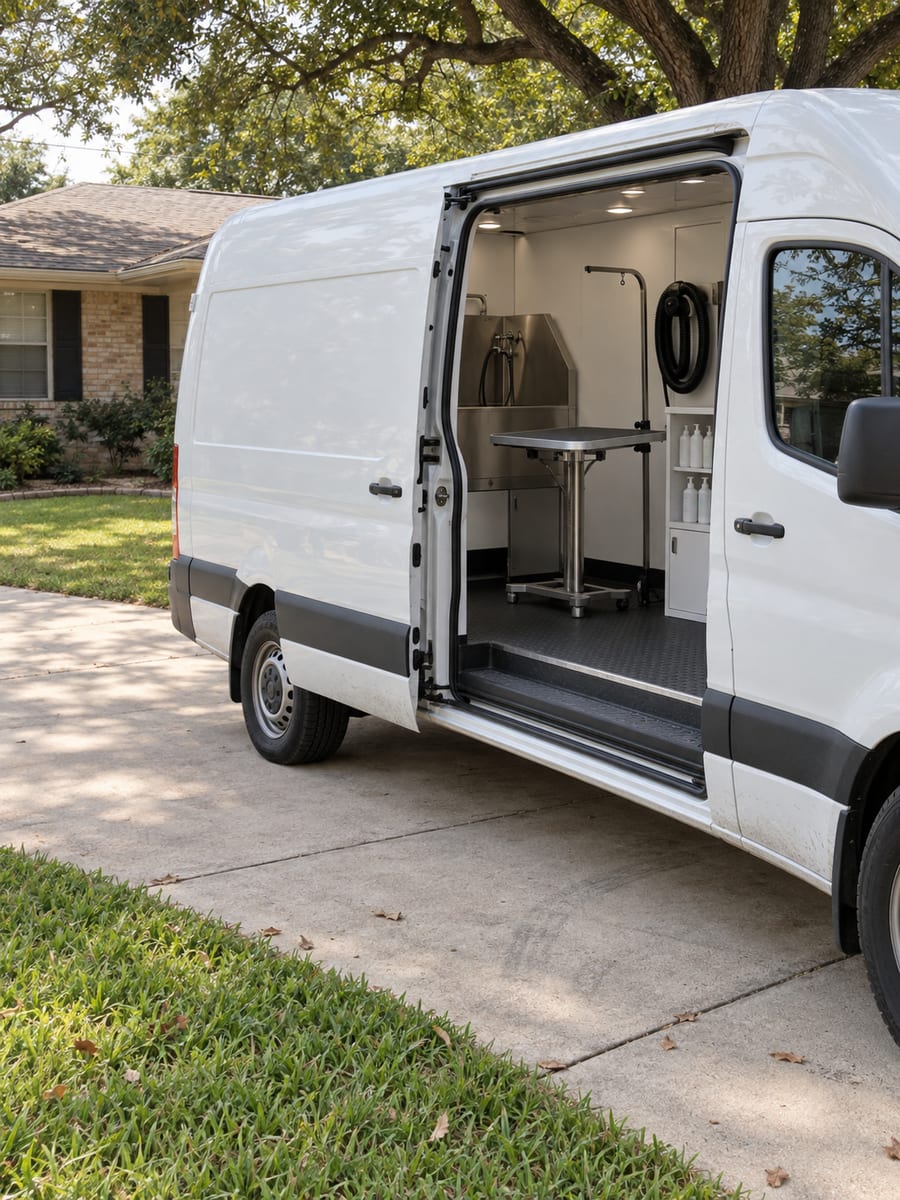
- Groomers. Services by size or coat, starting prices or a plain explanation of how you quote, how new clients book, your matting and late-cancellation policies, whether you are a salon or mobile, and your vaccination rules.
- Walkers and sitters. Your zones, visit types and lengths, how to request dates, insurance or bonding if you carry it, who does the visits, how keys and access work, and what happens in an emergency.
- Boarding and daycare. Location and hours, how to book a tour, how dogs are assessed and grouped, vaccination requirements, feeding and medication policy, your emergency plan, and the booking portal.
- Vets. Services, clinicians and credentials, hours, what to do in an urgent situation, the new-client process, appointment and refill routes, and your estimate policy. Clinical pages are reviewed by your clinicians before they go live.
- Rescues. Adoptable dogs or a link to your adoption platform, the adoption process and fees, the application, foster, volunteer and donate routes, and your 501(c)(3) details if they apply.
For boarding especially, owners look for safety first. In a 2017 survey of 652 US pet owners commissioned by the International Boarding and Pet Services Association, safety and security (44%) and reputation (43%) were the top reasons for choosing a boarding facility, and 80% rated vaccination requirements very or extremely important (Pet Boarding and Daycare). It is the same question clients ask on the phone: is my dog safe with you?
Should you build it yourself or hire someone?
Building it yourself is a real option, and plenty of trainers and groomers do it well. The platforms are cheap. Squarespace's annual Basic plan is $16 a month, about $384 over two years, and a site cannot be published after the trial without a paid plan (Squarespace pricing, Feb 2025). WordPress.com's Personal plan is $4 a month billed yearly, and its free plan puts ads on your site and uses a wordpress.com address (WordPress.com pricing). Templates made for dog trainers and groomers exist too.
What those prices leave out is your time. You write every page, source the photos, connect the booking link, fix what breaks, and keep it current, on top of a day spent with dogs. DIY makes sense if you like that kind of work, you have a few evenings a month, and a five-page site covers what you do.
Hiring someone makes sense when you would rather be training or grooming, when you need a page for every service and every area you serve, or when your site has gone stale because nobody has time to post. That second part is where most sites fail. A site built once and never touched again looks closed.
How we build your site
- A short call and a questionnaire. You tell us what you do, where, for whom, what you charge and what makes you different. You do not need to write anything.
- A page plan. We map every page: each service, each area you serve, your policies, your team. A typical DogServ site runs 60 to 80 pages, because each service and each area is something a client searches for on its own.
- Drafts you approve. We write the pages from your answers, in your words where we can. You check every fact, price and policy. Nothing about your credentials, health claims or policies goes live without your OK.
- Your booking system, connected. If you use Gingr, MoeGo, Precise Petcare, Time To Pet or another system, we link or embed it the way that vendor supports, and test it on a phone.
- Launch, with your Google Business Profile matched. Your name, phone, hours and services on the site match your profile, and we set up tracking so you can see calls, form messages and booking clicks.
- Every month after. At least four new blog posts a month, written from the questions your clients actually ask (first grooming visit, vaccine paperwork, what a daycare assessment involves), plus hosting, security and care.
The work is done by Web Leveling, the web agency Cal Hewitt founded in 2019.
What it costs
All prices are starting prices. Trainers, groomers, walkers and sitters usually pay the starting price. Vets and businesses with several locations usually need more pages, locations and content, and we quote those individually.
| Package | Starting price | What is included |
|---|---|---|
| Website | $1,500 build + $99/month | A full site, typically 60 to 80 pages. The monthly covers hosting, SSL, care, at least 4 new blog posts a month, and DogServ's premium features for dog businesses |
| Website + Google Business Profile | website + $149/month | Profile setup and optimization, weekly posts, photo updates, review replies, a monthly report |
| Website + Local SEO and AI search | website + $395/month (6-month commitment) or $495/month month to month | Local SEO, visibility in AI search answers, citations, a monthly report |
| Website + Social media | website + $295/month | 3 posts a week on 2 platforms, captions and local hashtags, a monthly report |
| Growth bundle (all three) | website + $595/month, 6-month commitment | Google Business Profile, SEO and AI search, and social media; $244 a month less than the $839 they cost separately |
What changes the price: the number of pages and locations, online booking beyond a link or embed, a shop, extra blog posts, extra social platforms, and content we write from scratch rather than from your notes.
What is not included: your booking software subscription, your domain registration, professional photography, and legal or privacy advice. We will tell you about any of these before they come up.
Is $1,500 a fair price for a website?
For a full site, it is on the low end of what the pet industry charges, on purpose. These are the published prices we found on 2026-09-24:
- Barketing, a pet-industry agency, starts builds at $1,350 for the essential pages, with care plans from $40 to $275 a month (Barketing).
- Website Bulldozer lists dog-trainer packages at $1,500 for 5 pages, $3,800 for up to 20 pages, and $8,000 for 100 or more (Website Bulldozer).
- Pet Business Hub offers monthly plans with no build fee, from $27 a month for one page to $149 a month for 30 pages (Pet Business Hub).
Our $1,500 is a starting price we set low to take on our first dog business clients, and it will rise as our client list grows. When you compare quotes, compare the same things: how many pages, who writes them, whether posts continue after launch, what the monthly covers, and what you keep if you leave.
How Google decides who shows up nearby

Google says local results are based mainly on relevance, distance and prominence, and that you cannot pay for a better local ranking (Google Business Profile Help). Distance is where the searcher is standing, which no website controls.
What a good site does is remove the reasons a ready client walks away: no phone number on mobile, a service area they cannot find, a booking link that goes nowhere, hours that disagree with Google. We track calls, form messages, booking clicks and search impressions so you can see what the site is doing, month by month.
Questions we get asked a lot
Do I need a website if I have Facebook and Instagram? Keep them. A website gives a referred client one stable place to see your services, policies and next step, and it is yours rather than a platform's. It does not guarantee search visibility on its own.
Can clients book from my website? Usually, yes. Most pet booking systems give a link, a button or an embed, and some support Reserve with Google. The exact method depends on your system and your plan, and we confirm it with the vendor before we promise it.
Will a new site put me first on Google? No, and be careful of anyone who guarantees it. A good site makes you easier to find for the services and areas you actually cover.
How long does it take? Usually one to two weeks from the day we have your answers and photos to launch. A site with many locations, or one that waits on content from you, takes longer, and we will tell you the date up front.
Do I own my site and my domain? Yes. Once the build is paid in full, the site and the domain are yours. The $99 monthly is month to month; there is no long contract.
What if I want to cancel? Give us 30 days' notice and the monthly stops. You keep your site and your domain, and we help you move them wherever you want.
I have no time to write. Is that a problem? No. You answer questions and check facts; we write. Your credentials, services and policies come from you, so those are the questions we ask first.
Tell us about your business
Send us a message with what you do and where, and we will reply with what your site would need and what it would cost. Tell us about your business in the form below.
Other services
Dog care answers in your inbox, once a week
We only use your email for this newsletter. Unsubscribe any time.