
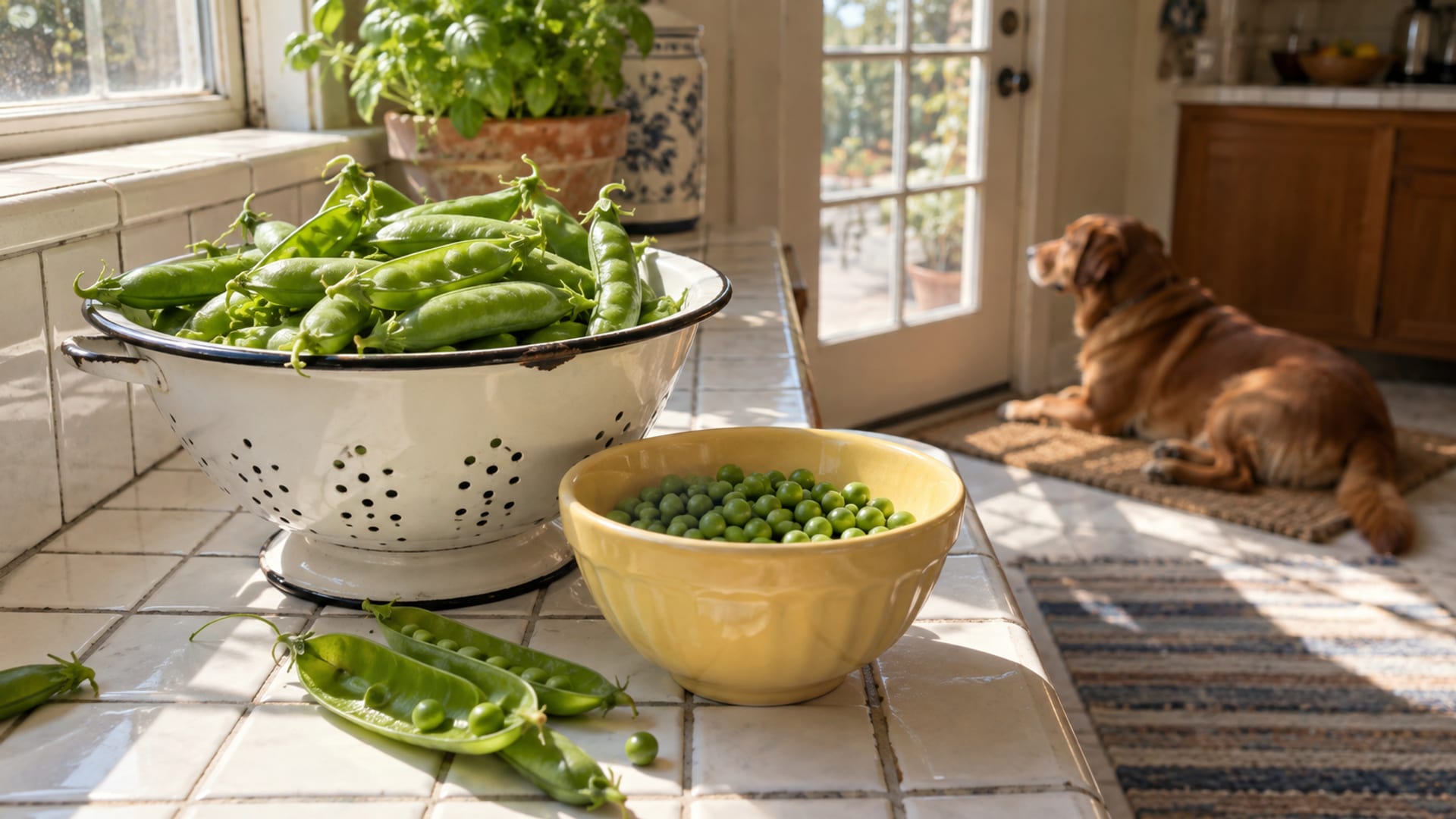
Yes. Plain peas are fine for dogs as an occasional treat, and the American Kennel Club names green, garden, English, snow and sugar snap peas as acceptable now and then. Serve them plain, with no butter, salt or seasoning, and pop garden peas out of the pod first.
If your dog just vacuumed up peas that rolled off the table, there is nothing to do. If they ate a big bowl, a salty or seasoned pea dish, a whole pod in one gulp, or chewed a flowering sweet pea from the garden, the sections below cover what to watch for.
Key takeaways
Tap a card to bring it forward.
- Plain peas, fresh, frozen or cooked, are a fine small treat for most dogs.
- Shell garden peas. Chop snow and sugar snap pods, which can catch in the throat.
- Choose fresh or frozen over canned, which usually carries added salt.
- Ornamental sweet peas are a different plant, and one kind is toxic to pets.
- Peas as a main ingredient in dog food are part of an open FDA question about heart disease. A few peas as a treat are not.
My dog ate peas: what now?
For a few plain peas, nothing. Most dogs pass them without a second thought, though a big helping can bring gas or a loose stool.
Look closer if any of these fit:
- A seasoned dish. Pea soup, a casserole or buttered peas can hold onion, garlic, ham, bacon, lots of salt or fat. Check the recipe, and call your vet if onion or garlic was in it. Can dogs eat onions? explains why that matters days later.
- A whole pod swallowed in a gulp. Watch for gagging, coughing, repeated vomiting or a sore belly.
- A garden plant with flowers. If it was a flowering sweet pea and not a vegetable pea, call your vet or a pet poison line. Pet Poison Helpline lists appetite loss, low energy, limping, stumbling, circling and seizures after a large amount of *Lathyrus odoratus*.
- A bag of dried split peas. These are concentrated and harder to digest. A large amount can upset the stomach, so watch for vomiting and diarrhea and call if it keeps up.
Call right away for choking, trouble breathing, collapse, trembling, seizures, stumbling or vomiting that does not stop.
Which peas are fine, and which to skip
Tap or hover a row to highlight it.
| Pea | Okay for dogs? | Notes |
|---|---|---|
| PeaGreen, garden or English peas, shelled | Okay for dogs?Yes, a few | NotesFresh, frozen or plainly cooked |
| PeaFrozen peas, plain | Okay for dogs?Yes, a few | NotesA cold crunchy treat; thaw them for small dogs |
| PeaSnow peas and sugar snap peas | Okay for dogs?Yes, in pieces | NotesThe pod is edible but can lodge in the throat (AKC) |
| PeaGarden pea pods | Okay for dogs?Better not | NotesTough and stringy; shell them |
| PeaCanned peas | Okay for dogs?Only no-salt, plain | NotesRegular canned peas usually have added sodium (AKC) |
| PeaDried or split peas | Okay for dogs?Only a little, cooked | NotesConcentrated and harder to digest |
| PeaPea soup, buttered or seasoned peas | Okay for dogs?No | NotesOnion, garlic, ham, salt or fat |
| PeaSweet pea flowers and vines | Okay for dogs?No | NotesA separate ornamental plant |
The AKC's advice on canned peas is to reach for fresh or frozen, since canned versions typically have added salt. It also points out that vegetables are not a required part of a dog's diet, so peas are a snack, never a replacement for food.
How many peas to give, and how to serve them
For amounts, PetMD offers general serving amounts for plain cooked peas, which work as an upper limit for a treat:
Tap or hover a row to highlight it.
| Your dog's weight | Peas per serving |
|---|---|
| Your dog's weight2 to 20 lb | Peas per serving1 teaspoon or less |
| Your dog's weight21 to 30 lb | Peas per serving2 teaspoons or less |
| Your dog's weight31 to 50 lb | Peas per serving3 teaspoons or less |
| Your dog's weight51 to 90 lb | Peas per serving1 to 2 tablespoons or less |
| Your dog's weightOver 90 lb | Peas per serving3 tablespoons or less |
To serve them:
- Use plain peas: fresh, frozen or steamed with nothing added.
- Shell garden peas. Cut snow and sugar snap pods into short pieces for small dogs or fast eaters.
- Start with a few and see how your dog's stomach handles them.
- Scatter them in a snuffle mat or on top of dinner, or hand them out as training rewards.
PetMD adds that dogs on a prescription diet should not get extra foods without the vet's okay.
Gas, loose stool and other signs
The usual result of too many peas is a gassy dog. VCA Animal Hospitals lists peas among the foods that can add to flatulence, depending on the amount, and notes that dogs vary a lot in how much gas they make. A loose stool, a little vomiting or a sore belly can follow a large helping too.
Signs of a pod that went down wrong are different: choking or coughing right away, or later repeated vomiting, a tender belly, not eating or straining without passing stool. Any of those needs a call.
Peas in dog food and the heart question
Some owners arrive here because peas sit near the top of their dog food label. The FDA has been looking into reports of dilated cardiomyopathy (DCM), a heart muscle disease, in dogs eating diets high in peas, lentils and other pulses. The FDA says legumes are not inherently dangerous and the cause has not been worked out. A study by Smith and others found peas were the leading ingredient linked to the diets in question, again without showing that peas cause the disease.
That research is about dogs eating pea-heavy food every day for months, so a spoon of peas as a treat sits outside it. If your dog eats a food with peas or pea protein high on the list, the FDA suggests talking over the diet with your vet. The AKC lists signs of DCM to raise with the vet: tiring easily on walks, coughing, trouble breathing and fainting. It also notes that Doberman pinschers, boxers, Great Danes and several other breeds carry an inherited risk.
"My dog has eaten peas off the plate for years"
That can be true, and plenty of dogs eat peas with no trouble at all. It is still not a promise for every dog or every pea. A teaspoon of peas is a large share of a Yorkie's snack for the day and a small one for a mastiff. A whole sugar snap pod can slide down a big dog and stick in a small one. Plain peas are a different food from pea soup made with onion and ham. Dogs also differ a lot in how much gas the same helping gives them. And the heart question concerns what fills the bowl every day for months, which no single meal would reveal. Keep them plain and keep them small.
Pea soup, sweet peas and pea protein
- Pea soup and split pea soup: often made with onion, garlic, ham or bacon and a lot of salt. Do not share it. Can dogs eat ham? covers the ham part.
- Sweet pea (*Lathyrus odoratus*): a garden flower that Pet Poison Helpline lists as toxic to pets. Only the name and the curly vines match the vegetable.
- Everlasting or perennial pea (*Lathyrus latifolius*): the ASPCA lists this one as non-toxic to dogs and toxic to horses. If you cannot tell which sweet pea your dog chewed, take a photo of the plant and call.
- Pea protein, pea starch, pea fiber and pea flour: processed ingredients in dog food. They are not a poisoning risk; they belong to the diet question above.
- Chickpeas, green beans and edamame: different legumes with their own answers.
Check what you learned
Quick check
Questions about dogs and peas
Can dogs eat frozen peas?
Yes. Plain frozen peas are fine, and many dogs like them cold. Thaw or mash them for a small dog or a puppy.
Are canned peas okay for dogs?
Better to skip regular canned peas, which usually contain added salt. A no-salt, plain canned pea is acceptable, but fresh or frozen is the better choice.
Can dogs eat snow peas and sugar snap peas?
Yes, in pieces. The pods are edible, but the AKC warns they can lodge in a dog's throat, so cut them up and supervise a dog that gulps.
Do peas cause heart problems in dogs?
The FDA is still studying a possible link between diets high in peas or other pulses and DCM, and it has not found that peas cause it. A few peas as a treat are not part of that question. If your dog's main food is heavy in peas, ask your vet about it.
Can puppies eat peas?
Yes, a few soft, plain peas are fine. Mash or halve them so they are easy to swallow.
Why does my dog get gassy after peas?
Peas can add to gas in some dogs, depending on how many they eat, according to VCA. Cut back the amount, or leave peas out if the gas is bothersome.
Sources
Checked September 24, 2026.
- American Kennel Club, Can Dogs Eat Peas?
- American Kennel Club, Diet-Associated Dilated Cardiomyopathy: 2023 Update
- U.S. Food and Drug Administration, Questions and Answers: FDA's Work on Potential Causes of Non-Hereditary DCM in Dogs
- Smith and others, Investigation of diets associated with dilated cardiomyopathy in dogs using foodomics analysis
- Pet Poison Helpline, Sweet Pea
- ASPCA Animal Poison Control Center, Sweet Pea
- VCA Animal Hospitals, Dogs and Gas
- PetMD, Can Dogs Eat Peas?