

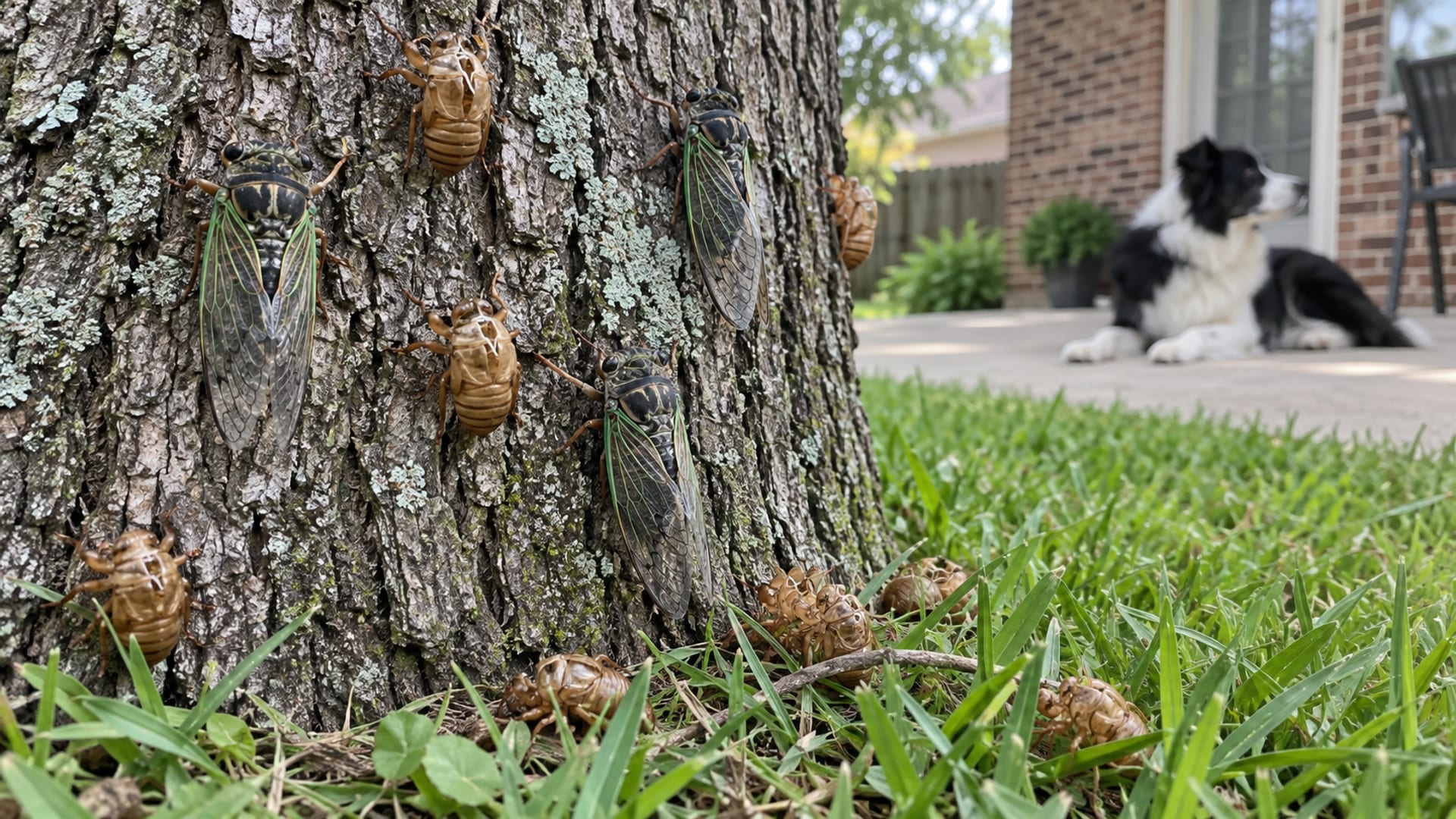
A few cicadas will not poison your dog. The ASPCA says cicadas carry no toxins, but their shell is made of chitin, which dogs have a hard time digesting, and a dog that eats a lot of them can end up with an intestinal blockage.
If your dog crunched one or two in the yard and is acting like themselves, bring them inside and keep an eye out for vomiting or loose stool. If they spent the afternoon feasting, ate a number you cannot guess, or found the bugs under a tree or on a lawn that was sprayed, call your vet.
Key takeaways
Tap a card to bring it forward.
- Cicadas are not poisonous to dogs. The hard shell is what causes trouble.
- A few may cause drooling, vomiting or diarrhea, or nothing at all.
- A dog that gorges can choke or develop a blocked gut.
- Bugs from a yard treated with insecticide are a chemical exposure and need a call.
- No one has published a safe number, so limit yard time during an emergence.
My dog ate cicadas: what to do now
Tap or hover a row to highlight it.
| What happened | What to do |
|---|---|
| What happenedOne or two cicadas, dog acting normal | What to doBring your dog in and watch for drooling, vomiting or loose stool for the rest of the day. |
| What happenedA few cicadas, then one bout of vomiting | What to doLet the stomach settle as described below, and call your vet if the vomiting continues. |
| What happenedDozens, or no idea how many | What to doCall your vet today, especially for a small dog or a puppy. |
| What happenedCicadas from a sprayed tree, lawn or garden | What to doCall your vet or a poison line now, with the product name if you have it. |
| What happenedGagging, trouble breathing, a swollen face or hives | What to doGo to a vet now. |
| What happenedRepeated vomiting, a sore or swollen belly, bloody diarrhea, or refusing food and water | What to doCall your vet now, because these can point to a blockage. |
For a pet that gets sick after a few cicadas, the ASPCA suggests taking away food and water for about an hour so the stomach can settle, then calling a vet if the vomiting keeps going. If your dog has a health condition, check with your vet before you hold back water.
When you call, be ready to say roughly how many cicadas your dog ate, when it happened, what your dog weighs, and whether anyone treated the yard or trees nearby.
Why the shell is the problem
Chitin is the stiff material in a cicada's shell, wings and legs. The University of Illinois College of Veterinary Medicine explains that the exoskeleton can irritate a dog's digestive tract and cause drooling, vomiting or diarrhea, and that a large number can obstruct the gut. Pet Poison Helpline is the most reassuring of the sources: it says cicadas generally cause no lasting damage, with an upset stomach as the usual complaint.
Tap or hover a row to highlight it.
| What your dog found | Concern | Why |
|---|---|---|
| What your dog foundLive adult cicada | ConcernLow for a few | WhyShell, wings and legs are hard to digest |
| What your dog foundNymph crawling out of the ground | ConcernLow for a few | WhyNo special toxin reported; the same shell problem |
| What your dog foundEmpty shed shell on a tree or fence | ConcernKeep them from eating these | WhyAlmost nothing but chitin |
| What your dog foundDead or dried cicada | ConcernLow for a few | WhyBrittle and stiff, still hard to digest |
| What your dog foundCicadas under a sprayed tree or on a treated lawn | ConcernCall your vet | WhyThe insecticide is a separate risk |
| What your dog foundCooked, freeze-dried or powdered cicada snacks | ConcernDo not feed | WhyNo dog safety data, and seasonings or oils add their own problems |
How many cicadas is too many?
Nobody has published a number. The vet and poison-control sources describe the risk in words: a handful may pass with a mild upset or none, and a large amount can block the gut. A blockage is a bulk problem, a mass of shell that will not move along, so it tracks how much your dog ate more than any dose.
These make a bad outcome more likely:
- A small dog or a puppy. The same mouthfuls make a bigger load in a smaller body.
- Hours alone in the yard during an emergence. A dog left out can keep snacking long after you would have stopped it.
- Shed shells. They are close to pure exoskeleton.
- Chemicals. The AKC lists pesticide exposure among the risks for dogs that eat insects from treated areas, and Penn State Extension covers the insecticides people use during periodical cicada years.
- Allergy. The ASPCA notes that chitin can, rarely, set off an allergic reaction.
Signs to watch for, and when they mean a call
Timing varies from dog to dog. Mild stomach upset can show up after eating and then settle on its own. Signs of a blockage tend to hang on or get worse.
- Mild: drooling, vomiting, diarrhea, a bit of belly discomfort.
- Call your vet: vomiting that keeps coming back, not keeping water down, a painful or bloated belly, bloody diarrhea, low energy or weakness, or skipping meals. The AKC reports that dogs who gorge can have severe stomach pain, vomiting and bloody diarrhea.
- Go now: choking, struggling to breathe, a puffy face, hives or collapse.
"My dog eats cicadas every summer and is fine"
Plenty of dogs snap up cicadas every year without a problem, and if yours is one of them, that track record is real. It tells you how your dog handled those bugs in those summers. It does not promise the next one goes the same way. A brood year can put far more cicadas within reach than an ordinary summer, so the amount can jump. A small dog carries a bigger load from the same mouthfuls than a large one. A pile of shed shells is harder going than a few live bugs. A few dogs react to chitin with an allergy. A blockage can take time to show, and a bug from a sprayed yard carries a chemical that has nothing to do with the cicada.
Cicada killers, shed shells and other summer bugs
- Cicada killers: these are large wasps, a different insect entirely. A dog that grabs one risks a sting.
- Shed shells: the empty brown skins left on bark after a nymph molts. Sweep them up where your dog plays.
- Grasshoppers, locusts, katydids, June bugs and beetles: different insects with their own risks, especially after spraying.
- Edible insect snacks and cicada powders: no dog serving can be recommended. Check any seasoning, salt or oil on the label.
- Periodical broods: these cicadas emerge every 13 or 17 years in parts of the eastern and central United States, and in huge numbers. The ASPCA wrote about Brood X in 2021, and the University of Illinois covered the joint Brood XIII and Brood XIX emergence in 2024. In those years, walk your dog on a leash and watch yard time closely.
Check what you learned
Quick check
Questions about dogs and cicadas
Are cicadas poisonous to dogs?
No. The ASPCA, Pet Poison Helpline and the University of Illinois all say cicadas are not toxic. The concerns are stomach irritation, a blockage, choking, a rare allergy, or insecticide on the bugs.
My dog ate one cicada. Is that an emergency?
Usually not. One cicada in a healthy dog is low risk. Watch for vomiting, diarrhea, belly pain, gagging or odd behavior, and call your vet if any of those show up.
What if my dog ate a lot of cicadas?
Call your vet, especially if you cannot tell how many or your dog is small. A large amount of shell can obstruct the gut, and your vet can tell you what to watch for or whether to come in.
Can dogs eat cicada shells?
Keep them from it. The empty shells are almost all exoskeleton, the part that is hard to digest and can build up into a blockage.
What if the cicadas were sprayed with insecticide?
Treat it as a pesticide exposure and call your vet or a poison line promptly. The product and how much your dog took in decide how serious it is, so have the container or the lawn company's name ready.
Can cats get sick from cicadas too?
The same sources cover cats: cicadas are not toxic to them either, but a lot of shell can irritate or block a cat's gut, and sprayed bugs carry the same risk.
Sources
Checked September 24, 2026.
- ASPCA, The Cicadas Are Coming: What You Need to Know
- University of Illinois College of Veterinary Medicine, Cicadas: Pet Treat or Pet Threat?
- Pet Poison Helpline, My Dog Ate a Cicada! Are Cicadas Poisonous to Dogs?
- American Kennel Club, Dogs Eating Cicadas: Tasty Treat or Trouble?
- Penn State Extension, Periodical Cicada