

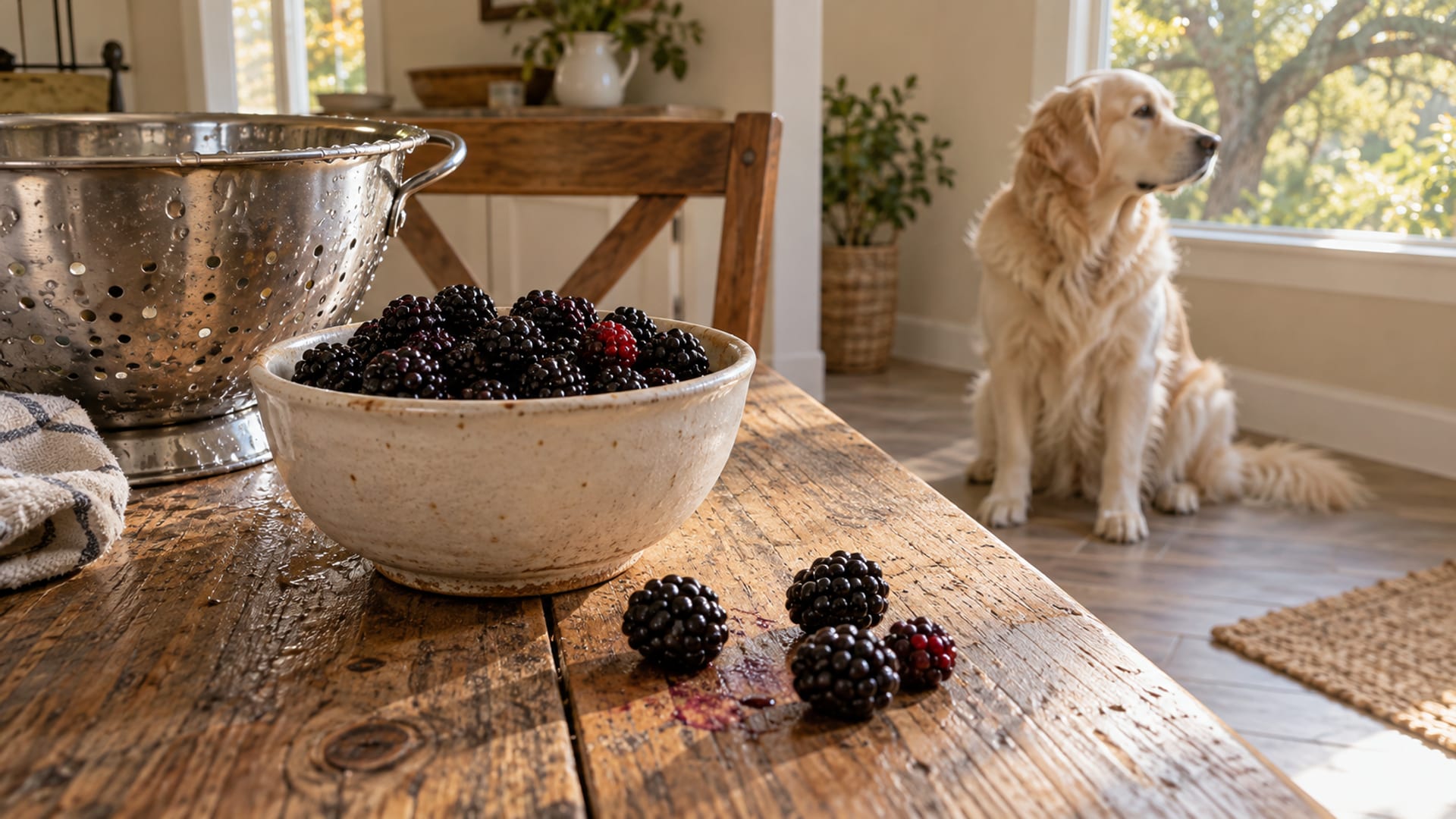
Yes. Plain blackberries are safe for dogs in moderation, according to the AKC, which suggests a few berries for a toy breed and up to a handful for a giant breed like a Great Dane. Wash them first and keep them an occasional treat.
If your dog ate a few blackberries off the bush or out of your bowl, there is nothing to do. If they ate a lot, got into jam or a frozen berry mix, or ate a dark berry you cannot name, the steps below will help.
Key takeaways
Tap a card to bring it forward.
- Ripe, washed blackberries are a safe treat for dogs in small numbers.
- The AKC suggests a few berries for a toy dog and a handful for a giant breed.
- Too many can bring vomiting, diarrhea, gas or constipation.
- Check jam, syrup, yogurt and frozen berry packs for xylitol before sharing.
- Pokeberries and some other wild dark berries are toxic. Be sure it is a blackberry.
If your dog already ate blackberries
Start by working out what they ate and how much.
- Confirm it was a blackberry. Garden and grocery blackberries are fine. If your dog ate a wild dark berry and you are not sure what it was, call your vet or a poison line and send a photo of the plant.
- Check any label. Jam, jelly, syrup, pie filling, yogurt, smoothies and some frozen berry products can contain xylitol. The FDA warns that xylitol is dangerous for dogs, so if it is on the label, call now.
- Estimate the amount. A few berries in a big dog is nothing. A whole pint in a small dog is more likely to upset the stomach.
- Watch for the next day. The AKC says to contact your vet if your dog gets vomiting, diarrhea or gas after eating blackberries.
The AKC lists signs that mean call your vet right away: vomiting that will not stop, seizures, weakness or loss of coordination, collapse, heavy diarrhea, or blood in the vomit or stool.
Fresh, frozen, dried and the rest of the bush
Tap or hover a row to highlight it.
| Form | Okay for dogs? | What to know |
|---|---|---|
| FormFresh ripe berries, washed | Okay for dogs?Yes, a few | What to knowWhole, halved or mashed, sized to your dog |
| FormPlain frozen berries, no sugar added | Okay for dogs?Yes, a few | What to knowRead the bag; some frozen products add sugar or xylitol |
| FormCooked plain berries | Okay for dogs?Yes, a few | What to knowSkip recipes with sweeteners, chocolate or alcohol |
| FormDried blackberries | Okay for dogs?Only a little | What to knowDrying shrinks them, so it is easy to give too many |
| FormJam, jelly, syrup, pie filling | Okay for dogs?Usually no | What to knowSugar, and some brands use xylitol |
| FormLeaves, stems and thorny canes | Okay for dogs?Do not feed them | What to knowThorns can hurt the mouth; plant material can upset the stomach |
| FormTiny seeds inside the berry | Okay for dogs?Fine | What to knowPart of the fruit, and not a known hazard |
Blackberries do contain a trace of xylitol that forms naturally in the fruit. The AKC calls the amount minute and says a dog would need to eat a large amount of berries for it to matter. The xylitol that causes real trouble is the concentrated kind added to sugar-free foods.
How many blackberries to give
The AKC's guide is a few berries for a toy breed and up to a handful for a giant breed such as a Bernese mountain dog or Great Dane. Scale between the two for dogs in the middle. The AKC also recommends keeping all treats under 10 percent of a dog's diet.
To serve them:
- Rinse the berries and pick out any stems or leaves.
- For a small dog or a puppy, cut each berry in half or mash it.
- Offer a couple the first time and see how your dog does.
- Use them as a training reward, a topper on the food bowl, or frozen on a hot day.
If your dog has diabetes, a sensitive stomach or a prescription diet, ask your vet before adding fruit.
Signs your dog ate too many
The usual result of too many blackberries is an upset stomach. The AKC mentions vomiting, diarrhea, gas and constipation, and each of these tends to follow a big helping. The severe signs in the AKC's list, such as seizures, collapse or blood in the stool, are not what a normal serving of berries causes. If you see them, think about what else your dog might have eaten, like a sugar-free product or a wild berry, and call right away.
"My dog eats blackberries off the bush all summer"
That happens, and for your dog it may have been fine every time. It does not mean any amount is fine for any dog. A few berries is a much bigger share of a toy dog's day than a large dog's. Fresh fruit is a different thing from a jar of jam or a bag of sweetened frozen berries. Dogs vary in how well their stomachs handle new foods, and an upset does not always show up right away. Wild bushes also grow near other plants, and a dog that eats berries by the mouthful may take in something that only looks similar. Keep the numbers small and know which bush your dog is grazing on.
Wild look-alikes, jam and other blackberry foods
- Pokeberries (pokeweed): dark purple to black berries hanging in long clusters. They are toxic to dogs, and the AKC reports a Pet Poison Helpline toxicologist saying every part of the plant is toxic. If your dog ate some, call your vet or a poison line.
- Baneberries: a different wild plant; Pet Poison Helpline lists it as toxic to dogs.
- Fetterbush, also called staggerberry or maleberry: a shrub the ASPCA lists as toxic to dogs because it contains grayanotoxins.
- Mulberries, boysenberries and marionberries: related or similar fruits with their own answers.
- Blackberry jam, jelly and syrup: mostly sugar, and sugar-free versions may use xylitol.
- Blackberry yogurt, pie and smoothies: check for xylitol, chocolate and alcohol, and keep fatty desserts off the menu.
- Grapes and raisins: not a berry to share at all. They can cause kidney failure; can dogs eat grapes? explains what to do.
Check what you learned
Quick check
Questions about dogs and blackberries
Which berries are toxic to dogs?
Pokeberries, baneberries and fetterbush, also sold as staggerberry, are toxic plants. Grapes and raisins are far more dangerous still, because they can cause kidney failure. Blackberries, blueberries and strawberries are safe in small amounts.
How many blackberries can a dog eat?
A few for a toy breed, up to a handful for a giant breed, according to the AKC. Most dogs fall somewhere in between. Keep berries and all other treats to a small part of the day's food.
Can dogs eat wild blackberries?
Yes, when you are sure they are blackberries. The AKC says wild blackberries are fine as long as you can identify them. If you cannot, keep your dog off the bush.
Can dogs eat frozen blackberries?
Yes, plain ones. Read the bag first, because some frozen fruit products add sugar or xylitol. Halve them for small dogs so a hard berry is not swallowed whole.
Can dogs eat blackberry leaves?
Do not feed them. Leaves, stems and thorny canes are not food, the thorns can scratch the mouth, and plant material can upset the stomach.
Sources
Checked September 24, 2026.
- American Kennel Club, Can Dogs Eat Blackberries?
- American Kennel Club, Pokeberries and Dogs: What to Know About Pokeweed Poisoning
- U.S. Food and Drug Administration, Paws Off Xylitol; It's Dangerous for Dogs
- ASPCA Animal Poison Control Center, Fetterbush
- Pet Poison Helpline, Baneberry Is Toxic to Dogs