

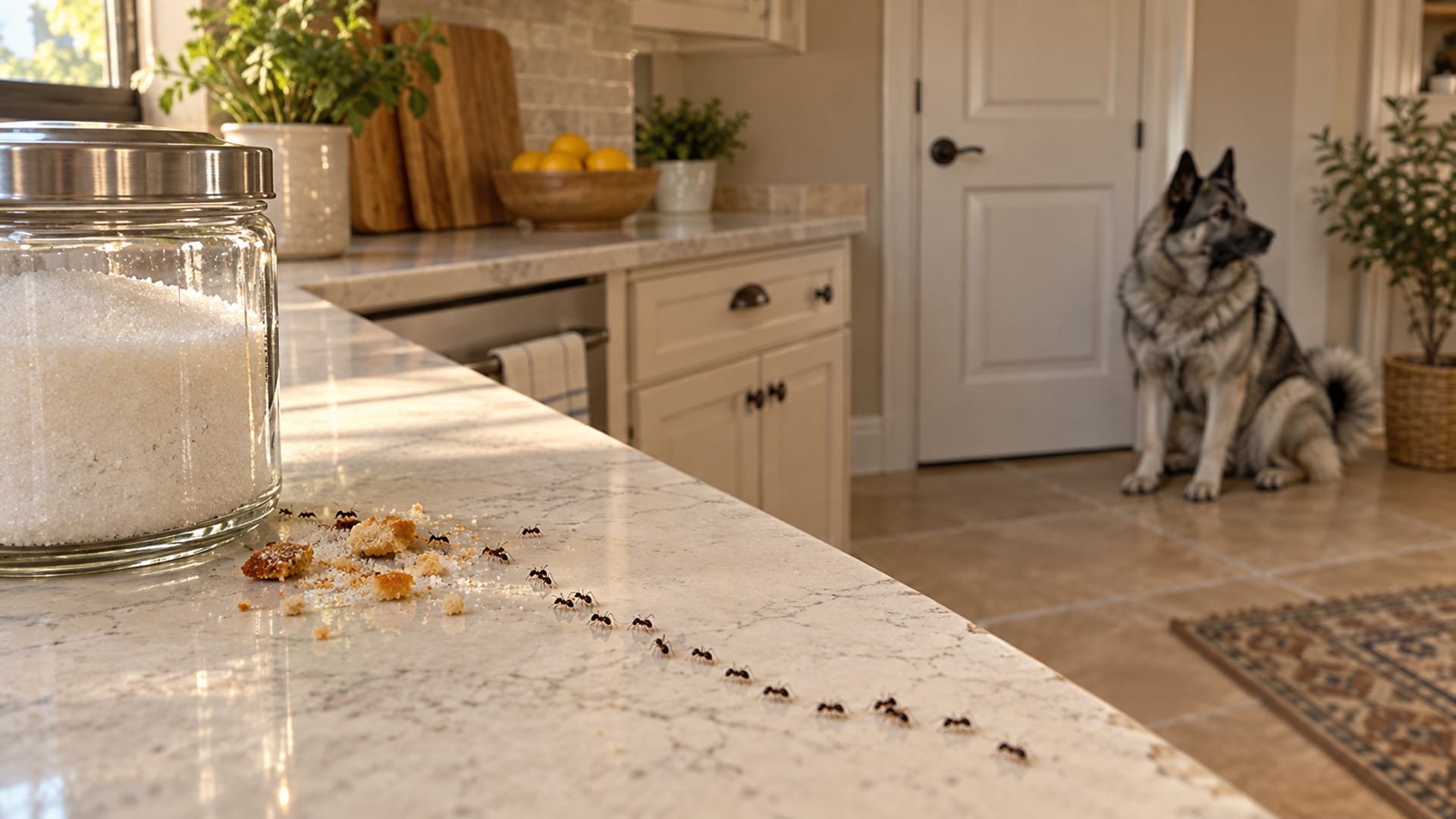
A few ordinary household ants are low concern for a dog that is acting normally, as long as no ant bait or bug spray was involved. Fire ants are different because they sting, and ant traps, baits and lawn granules carry their own poisoning risk that calls for your vet or a pet poison line right away.
If your dog just licked a few ants off the floor or out of the food bowl, tonight is mostly about watching. If there was a mound, a lot of ants on the dog, a swollen face, or any chance your dog reached a bait station or a freshly treated lawn, pick up the phone now.
Key takeaways
Tap a card to bring it forward.
- A few ordinary ants swallowed by accident are low concern when your dog seems normal and no pesticide was nearby.
- Fire ants bite to hold on and then sting again and again; stings on the muzzle, mouth, eyes or throat matter most.
- Ant bait, ant traps, gel and lawn granules are a pesticide exposure, so call your vet or a pet poison line right away.
- Sting redness and swelling can show within 15 minutes, itchy bumps by about 6 hours, and most skin reactions settle within 24 hours.
- Ants are not a treat; no veterinary source gives a safe amount or a way to prepare them.
What to do if your dog just ate ants
Take a minute to look around first; what you find settles most of the urgency.
- Move your dog away from the ants. Fire ants can stay attached and keep stinging, so getting your dog clear of a trail or mound stops the stings from adding up.
- Look for ant products within reach. Check for bait stations, gel, traps, granules on the lawn, or an open spray can. Ant bait is a poisoning question in a way that ants themselves aren't.
- Check the muzzle, mouth, eyes, ears and belly. Texas A&M AgriLife Extension names the ears, eyes, muzzle and tender belly skin as the areas fire ants commonly reach on animals, so look there for clinging ants and red, puffy spots.
- Work out roughly how many. A couple of ants licked off a counter is a small exposure, while a nose pushed into a colony can mean many stings at once.
- Call right away if any warning sign is present. That means any ant poison, many stings, swelling of the face, tongue or throat, trouble breathing, heavy drooling, vomiting, tremors, seizures or collapse. Have your dog's weight, the product label if there is one, and your best guess at the amount ready.
- Otherwise, watch your dog through the next day. For a few ordinary ants and a dog acting like itself, there's no home treatment to give, and the Merck Veterinary Manual says most ant stings resolve with no treatment.
Which ants and ant products are the real concern
Most ants a dog meets in a kitchen or on a patio, such as small black ants, sugar ants or the odd carpenter ant, have no known toxic compound when swallowed. The Merck Veterinary Manual treats ants as a sting problem and singles out the red imported fire ant (*Solenopsis invicta*) and the black imported fire ant (*Solenopsis richteri*), found across the southeastern United States and west into Texas. They bite to anchor themselves and then sting repeatedly.
Their venom is mostly alkaloids called solenopsins, chiefly solenopsin A, according to a peer-reviewed review of imported fire ant venom, and Merck ties these compounds to cell and skin damage at the sting site. With fire ants, the stinging is the worry far more than the swallowing.
Color is a poor guide. "Red ants" might be fire ants or an unrelated reddish ant, and the black imported fire ant is black. Where you live, how the nest reacts when it's disturbed, and whether a product was used nearby tell you more.
Tap or hover a row to highlight it.
| What your dog got into | Main concern | What to do |
|---|---|---|
| What your dog got intoA few household ants, dog acting normal | Main concernLow concern; no known toxic compound | What to doWatch through the next day |
| What your dog got intoAnts in or around the food bowl | Main concernLow concern unless bait or spray is nearby | What to doReplace the food and check for ant products |
| What your dog got intoFire ants, or ants from a mound | Main concernStings, especially many, or in the mouth, eyes or throat | What to doMove your dog away, check for swelling, call if stings are many or on the face |
| What your dog got intoDried ants, ant powder or insect protein | Main concernNo dog safety data; ingredients vary | What to doRead the label and call if you can't tell what it is |
| What your dog got intoAnt bait, traps, gel, granules or spray | Main concernPesticide poisoning | What to doCall your vet or a pet poison line right away |
How many ants is too many?
Dogs have no published toxic count for ants, ordinary or fire ants, so the decision rests on four things: which ants they were, whether any product was involved, how many stings your dog has and where, and how your dog is acting. If you're unsure about any of those, call and give your dog's weight, what you saw, and your best guess at the amount.
Size and health lower the bar for calling, so a young puppy, a tiny dog or a dog with health problems is worth a call even for mild signs. Pet Poison Helpline notes that smaller dogs can show stronger signs after ant poison exposure.
As for feeding ants on purpose, I'd leave them off the menu. No veterinary source gives a serving size or a way to prepare them, cooked or dried. Fire ants and ants from a treated yard or kitchen should never be offered, and if a commercial treat lists insect protein, ask your vet before you buy it.
Signs to watch for over the next 24 hours
For a few swallowed household ants, you may see nothing at all. Stings follow a fairly clear clock. In a controlled study of four adult dogs stung on the skin by fire ants, Rakich and colleagues saw swelling and redness at 15 minutes and itchy red bumps by 6 hours, and the skin looked normal from 24 through 72 hours, though some inflammation still showed under the microscope.
Tap or hover a row to highlight it.
| Time after the stings | What you may see | Source |
|---|---|---|
| Time after the stingsAbout 15 minutes | What you may seeSwelling and redness at the sting sites | SourceRakich et al. |
| Time after the stingsWithin about an hour | What you may seeA raised welt with redness that typically fades | SourceMerck Veterinary Manual |
| Time after the stingsBy about 6 hours | What you may seeItchy red bumps | SourceRakich et al. |
| Time after the stingsWithin 24 hours | What you may seeMost skin bumps settle | SourceMerck Veterinary Manual, Rakich et al. |
The Merck Veterinary Manual lists pain, itching, redness, swelling, pustules, drooling, coughing, vomiting, diarrhea, weakness, collapse and breathing trouble among the possible signs. Stings on the mouth, throat or eyes, or across a large patch of skin, are more serious, and the worst realistic outcome is severe illness or death from many stings, a blocked airway, or complications. Merck notes that allergic shock from fire ant stings hasn't been reported in pets, but a swollen face or throat can crowd the airway on its own, which is why it's on the call-now list.
Ant poison looks different. Pet Poison Helpline links bifenthrin to stomach upset and nervous system signs, including tremors and seizures after a large amount is eaten. If there's any chance your dog reached a product, call right away instead of waiting for vomiting, trembling or wobbliness to start.
My dog ate ants before and was fine
That happened, and I believe it. Plenty of dogs lick a few ants off a dropped cookie and never show a thing. It just can't be carried to the next time as a rule, because the next time may be a different exposure.
A few household ants are a different event from a colony attack or a mouthful of bait, and fire ants behave nothing like sugar ants. Merck ties more severe reactions to multiple stings, and where they land matters: the eyes, muzzle, mouth and throat carry more risk than one sting on a leg. Dogs also vary in how they react, and sting bumps can take hours to appear, so a dog that looked fine at 10 minutes may be itchy and swollen by bedtime.
Ant bait, lawn granules and other look-alikes
Ant bait, traps, gel, fire ant killer, lawn granules and yard treatments are pesticides, and they call for a different response than ants do. Check the label for the active ingredient, such as bifenthrin, and have it in hand when you call.
The ASPCA warns that ant and cockroach baits can attract pets and advises contacting your veterinarian or its Animal Poison Control Center immediately if a pet eats something potentially toxic. Pet Poison Helpline describes a service dog that had seizures after eating bifenthrin granules put down for fire ant control, so keep your dog off a freshly treated lawn.
"Ant powder" can mean dried insects, an insect protein ingredient, or pesticide dust. If you can't tell which one your dog got into, treat it as the pesticide until someone reads the label. And if the bug your dog crunched in the yard was big and buzzing, the Cicadas entry covers that one.
Check what you learned
Three quick questions on what matters most tonight.
Quick check
Questions about dogs and ants
These usually come up once the first worry has passed.
Is an ant sting on my dog's nose an emergency?
One or two stings on the nose usually mean some redness and itching that settles within a day. Call right away if the swelling spreads across the face or reaches the lips, tongue or throat, or if your dog starts drooling heavily, coughing or breathing with effort.
Are black ants poisonous to dogs?
Ordinary small black household ants have no known toxic compound for dogs. Color doesn't tell you the species, though, and the black imported fire ant is one of the two fire ants Merck names.
My dog ate an ant trap, but the ants in it were dead. Does that still count?
Yes. The concern with a trap is the bait and insecticide inside it. Call your vet or a pet poison line right away with the package in hand so they can see the active ingredient.
Can my cat have the same trouble?
The same split applies to cats: ordinary ants swallowed by accident aren't a known toxic exposure, while fire ant stings and ant control products can be. Cats may not carry exactly the same risk as dogs, so call your vet with the same warning signs in mind.
Sources
Checked September 25, 2026.
- Merck Veterinary Manual, Wasp, Bee, and Ant Stings to Animals
- Pet Poison Helpline, Ant Poison and Dogs, Everything a Dog Owner Needs to Know
- Pet Poison Helpline, Beware of Bifenthrin
- Pet Poison Helpline, Service Dog for Child with Seizures Suffers Seizures After Ingesting Ant Poison
- ASPCA, 5 Items Pet Parents Shouldn't Panic About
- Veterinary Pathology (Rakich et al., 1993), Clinical and histologic characterization of cutaneous reactions to stings of the imported fire ant (Solenopsis invicta) in dogs
- PubMed Central, Chemistry and Functions of Imported Fire Ant Venom
- Texas A&M AgriLife Extension, Fire Ants and Their Management