

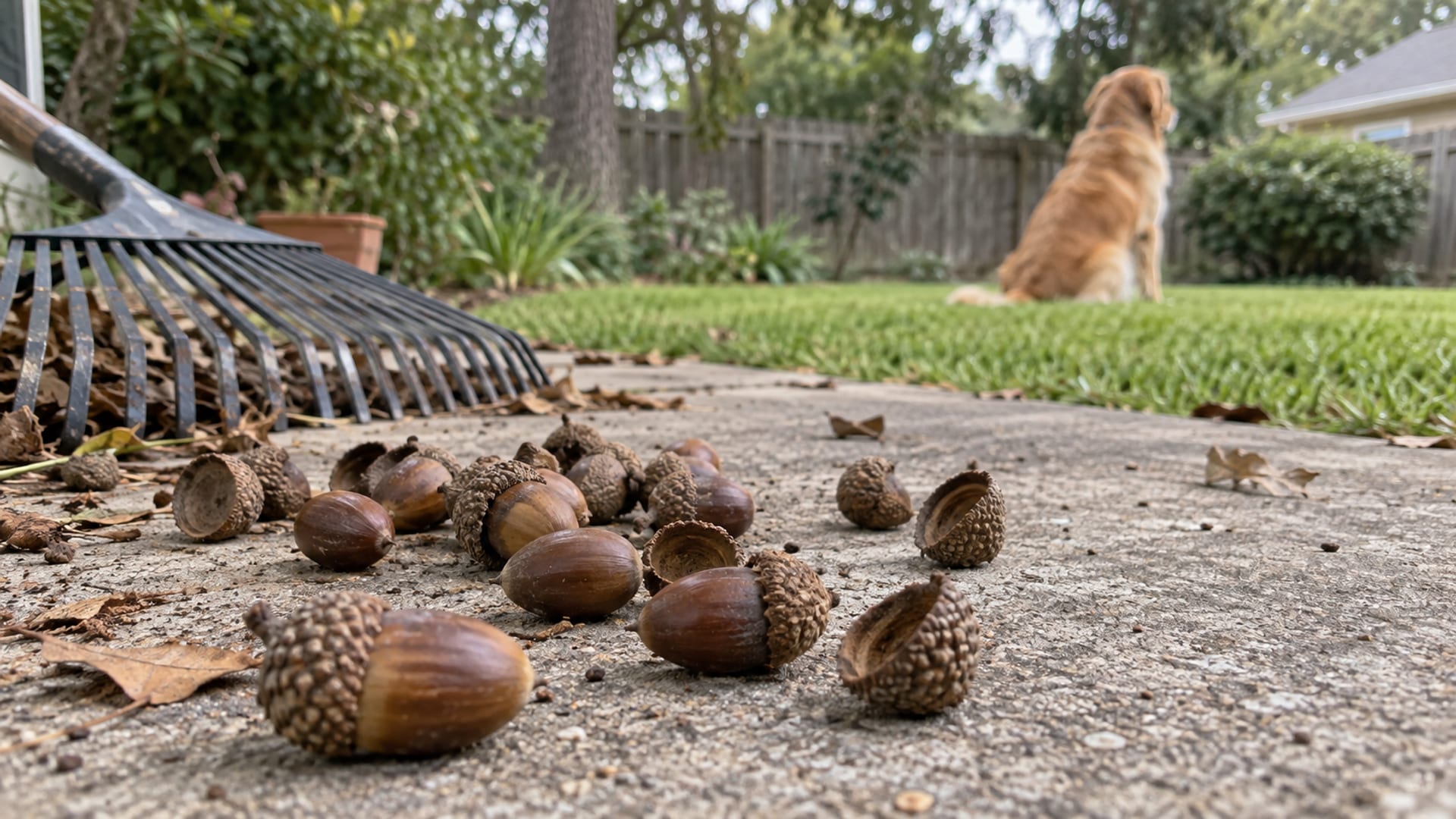
Keep acorns away from your dog. They contain tannins that can irritate the stomach and gut and, in bigger or repeated amounts, damage the kidneys and liver, according to the Merck Veterinary Manual. A whole acorn can also lodge in the throat or the intestine.
If your dog ate more than one acorn, you are not sure how many, or your dog is small, call your vet or a poison line now. The AKC advises calling your veterinarian right away if you think your dog has eaten acorns.
Key takeaways
Tap a card to bring it forward.
- Acorns, oak leaves and oak buds contain tannins that can make dogs sick.
- A whole acorn can choke a dog or block the intestine.
- If your dog ate several acorns, or you cannot say how many, call a vet now.
- Stomach signs can start within a few hours; signs after a large amount can take days.
- One acorn often passes without trouble, but there is no safe number to count on.
My dog ate acorns: what to do now
- Stop the snacking. Move your dog inside or onto a leash and clear what is left on the ground.
- Work out how many. Count the empty caps and chewed shells if you can. Note whether the acorns were green or brown, swallowed whole or chewed, and when it happened.
- Call your vet or a poison line with your dog's weight and your best count. The ASPCA says to contact its poison control center or your local vet as soon as possible when you suspect your pet ate something toxic.
- Keep watching for several days, even if you are told to wait and see. Merck notes that signs after large amounts of green acorns or young oak leaves can take several days to appear.
Get to a vet right away for choking, gagging, trouble breathing, repeated vomiting, belly pain, bloody stool or urine, yellow gums or eyes, weakness or collapse.
Why acorns make dogs sick
Acorns from oak trees contain tannins called gallotannins. In the gut they break down into gallic acid and pyrogallol, which can injure the lining of the stomach and intestines and add to kidney and liver damage, Merck explains.
How much tannin an acorn holds depends on the kind of oak, how ripe the acorn is and the season, so one handful is not like another. The Veterinary Poisons Information Service adds that tannic acid may not be the only harmful substance involved, which is part of why no simple dose works.
Serious kidney or liver injury seems to be uncommon in dogs. A report in the Canadian Veterinary Journal by Chalmers and others describes a Labrador treated for suspected acorn toxicity with stomach and gut signs and yellowing, and notes that this kind of organ injury is seldom seen in dogs. The vet school at Texas A&M says one or two acorns usually do not poison a dog and that most dogs need large amounts over time to get sick. A single acorn can still choke a dog or get stuck.
How many acorns are too many?
No one has published a safe or toxic number of acorns for dogs. These are the things that raise the risk, and the details your vet will ask about:
Tap or hover a row to highlight it.
| Factor | Why it matters |
|---|---|
| FactorSeveral acorns, or an unknown number | Why it mattersMore tannin, and more chances for a piece to lodge |
| FactorA small dog or a puppy | Why it mattersMore tannin per pound, and a narrower gut for a whole acorn |
| FactorGreen or unripe acorns | Why it mattersMerck names green acorns as a source of oak poisoning; young material can hold more tannin |
| FactorAcorns swallowed whole | Why it mattersA choking and blockage risk on top of the tannins |
| FactorDaily access all fall | Why it mattersRepeated amounts add up |
| FactorOak leaves, buds or sprouting acorns | Why it mattersMerck lists them with acorns as sources of oak poisoning |
| FactorMoldy acorns | Why it mattersMold can bring its own toxins |
The AKC points out that how a dog reacts depends partly on how many acorns were eaten and on the dog's size. It also notes that oaks have mast years, every two to five years, when they drop an unusually large crop, so some autumns leave far more on the ground than others.
Signs, and how fast they come
Tap or hover a row to highlight it.
| When | What you may see |
|---|---|
| WhenRight away | What you may seeGagging, choking or trouble breathing if an acorn lodges |
| WhenWithin a few hours | What you may seeVomiting, diarrhea, belly pain, loss of appetite, tiredness |
| WhenOver the next few days | What you may seeConstipation then diarrhea, dehydration, heavy thirst, peeing more, dark or bloody urine, yellow gums or eyes, weakness |
| WhenAny time a piece is stuck | What you may seeVomiting again and again, refusing food, a sore belly, straining without passing stool |
The few-hours timing comes from the AKC. The ASPCA lists belly pain, constipation followed by diarrhea, depression and discolored urine among the signs of oak poisoning, and Merck's owner guide on acorn poisoning describes signs starting several days after large amounts.
"My dog has eaten acorns every fall and never been sick"
That can be true, and plenty of dogs pick up an acorn or two on a walk with no trouble at all. It does not make acorns safe for every dog, or for your dog in a different year. Your dog may have eaten only a few, spread out over weeks. A big dog gets much less tannin per pound than a small one. The oaks in your yard may be a kind with less tannin, and brown acorns differ from green ones. A whole acorn that slides through one dog can wedge in another. And signs after a large amount can take days, so a dog who looked fine that afternoon was not always fine by the weekend. Rake the yard, keep your dog on a leash where acorns are thick, and call when a lot of them go down.
Oak leaves, acorn flour and look-alikes
- Oak leaves, buds and sprouting acorns: keep them away too. Spring buds and young leaves are listed alongside acorns.
- Acorn flour, meal, bread and acorn coffee: skip them. Processing does not make them a known safe food for dogs, and recipes can add fat, salt, chocolate, raisins or xylitol.
- Moldy fallen acorns: mold adds a risk of its own.
- Horse chestnuts (conkers): a different tree and a separate poisoning question. Call your vet if your dog ate them.
- Acorn squash: a vegetable from the pumpkin family, unrelated to oaks.
- Oak galls ("oak apples"): plant galls that form on oaks, a different thing from acorns.
- Other nuts: walnuts, pecans and macadamia nuts carry their own risks. Can dogs eat nuts? goes through them.
Check what you learned
Quick check
Questions about dogs and acorns
Can one acorn kill a dog?
A single acorn often passes without making a dog sick, especially a larger dog. There is no dependable safe number, and a whole acorn can still cause a blockage, so call your vet if signs appear or you are unsure how many were eaten.
My dog ate several acorns. What should I do?
Call your vet or a poison line now with your dog's weight and your best count, then keep watching your dog for several days.
Are green acorns more dangerous?
Merck names green acorns as a source of oak poisoning, and unripe plant material may hold more tannin. Keep your dog away from them.
What signs should I watch for after my dog ate acorns?
Choking, vomiting, diarrhea, belly pain, constipation, tiredness, loss of appetite, heavy thirst, peeing more, bloody urine or stool, yellow gums, collapse or trouble breathing.
Can dogs eat acorn flour or acorn bread?
Skip them. No safe serving has been set for dogs, and recipes can add fat, salt, chocolate, raisins or xylitol.
Are acorns bad for cats?
Cats should be kept away from acorns too. Little is published on cats and acorns, so call your vet if your cat ate some.
Sources
Checked September 24, 2026.
- Merck Veterinary Manual, Oak Toxicosis in Animals
- Merck Veterinary Manual, Quercus Poisoning (Oak Bud Poisoning, Acorn Poisoning)
- ASPCA Animal Poison Control Center, Oak
- American Kennel Club, Can Dogs Eat Acorns and Other Tree Nuts?
- Texas A&M School of Veterinary Medicine and Biomedical Sciences, Should You Keep Dogs Away From Acorns?
- Chalmers and others, Successful management of suspected acorn (Quercus petraea) toxicity in a dog, Canadian Veterinary Journal
- Veterinary Poisons Information Service, Oak and acorns (Quercus species)